After going throught this chapter you will,
- Learn how ratios and proportions are tested on the aptitude test.
- Be able to apply the techniques and formulas discussed in this chapter.
- Be able to solve complex ratios and proportions problems.
Ratios
Lets get the basic understanding of where you stand today by solving the sample question below:
A basketball team won 40% of its first 90 games. The team has 60 games remaining in the season. How many of the remaining games must the team win in order to finish the season having won exactly 48% of all its games?
- 32
- 34
- 36
- 38
Lets solve to reach the conclusion rather than jumping on to the answer straight forward.
First, find how many of the first 90 games the team won:
So, the number of wins team currently has:
Now find the total number of games in the season:
To win exactly 48% of all 150 games, the team needs:
Total wins.
Since it already has 36 wins:
Therefore, the team must win:
So the correct answer = C
To understand ratios further, we can say; a ratio is a comparison of two quantities by division. Ratios may be written with a fraction bar \(\frac{x}{y}\), with a colon (x:y), or in words as, “the ratio of x to y“. Alike fractions, ratios should be reduced to the lowest terms.
For instance:
Sam is 14 years old and Sara is 12. The ratio of Sam’s age to Sara’s age is 14 to 12.
Or,
Remeber that in ratios, the numerator is often denoted with the word of and the denominator with the word to.
Rules in ratios
1. As mentioned in the above example, a ratio is the comparison between two quantities. If there are 12 red balls and 18 blue balls:
This means for every 2 red balls, there are 3 blue balls. Therefore, ratios should normally be simplified just like fractions.
2. Order matters. If,
Then,
But can’t be written as,
To solve such a question, carefully identify which quantity appears first.
3. Ratios represent parts, not necessarily actual quantities. For instance, If,
We can’t conclude that
Instead, it means that for every 4 equal parts of A, there are 7 equal parts of B. The numbers 4 and 7 describe the relationship between the quantities, not necessarily their actual values.
For a common multiplier K.
For example, all of the following have the same ratio:
Although the actual quantities are different, each pair has the same relative relationship.
4. Add ratio parts to find the whole. If boys and girls are in the ratio:
then the total number of parts is:
Therefore:
and:
If there are 240 students:
5. Proportions are equations between two ratios. A proportion states that two ratios are equal:
To solve it, use cross multiplication:
For example:
Cross multiply:
6. Ratios can be scaled to a known quantity. Lets suppose:
and,
We can use the principle introduced in 5th rule, cross multiplication and substitution.
7. Combining two ratios requires a common term. This is one of the key rules tested in the aptitude. Suppose:
You can’t simply write:
As B here has different values in the aforementioned ratios.
Here we will apply the rule of bringing B in equal terms by taking the LCM of both values, in the above ratios, of B.
LCM of both values of B, 3 and 4, is:
Now the advanced ratio rule states,
Multiply first ratio by 4,
Multiply second ratio by 3,
Now we can finally say,
8. Part-to-part and part-to-whole ratios are different. The distinction among them often appears in the ratio word problems.
Suppose a class contains 18 boys and 12 girls.
But boys to total students:
And girls to total:
So from:
We get
9. Ratios must compare quantities in compatible units. Convert quantities to the same units before forming or simplifying the ratio. This applies to distance, time, weight, money, volume, etc.
Suppose:
Don’t immediately simplify 2:30.
First convert 2 hours to minutes:
Then,
10. Finding the original ratio. Few questions may give the final ratio without giving the actual one.
Suppose
The ratio of A to B is 3:5. If 12 is added to A, the ratio of A to B becomes 1:1. Find the original values of A and B.
This is the initial illustration of moving towards algebraic ratios.
The given ratio is not necessarily the actual quantity
When we’re told A:B = 3:5
this does not necessarily mean:
It means that A and B are in the same proportion as 3 and 5.
Their actual values could be any of the following:
because all of these simplify to 3:5.
To solve this we might represent the unknown scale using K.
Since both numbers must be multiplied by the same number, we can write:
Here, k simply represents the unknown multiplier.
For example, if k=2:
So lets find K.
The question tells us 12 is added to A. Originally, A=3K, so after adding 12 it might become:
Nothing was added to B and the question then tells us that the new ratio is 1:1. Therefore:
A 1:1 ratio tells us that the two ratios are equal. Therefore, if:
Then,
Now:
So finally to get the original quantities, we can plug the value of K in the algebraic expressions:
Whenever an aptitude question gives you a ratio but doesn’t give the actual quantities, introduce a common multiplier:
Becomes
11. Equivalent ratios. Equivalent ratios are created by multiplying or dividing both terms by the same number.
As mentioned above:
Lets do an example:
The ratio of students who chose Mathematics to students who chose Science in a survey is 18:30. Which of the following could represent the number of students who chose Mathematics and Science, respectively, in another survey with the same ratio?
- 24:36
- 27:45
- 30:48
- 36:54
First, simplify the original ratio:
The greatest common factor of 18 and 30 is 6. Divide both terms by 6:
Therefore, we’re looking for another ratio equivalent to:
Now check the options.
A,
Not equivalent.
B,
Divide both terms by 9:
This matches the original ratio. ✓
C,
Not equivalent.
D,
Not equivalent.
Therefore B is the correct answer. Always remember, a ratio remains equivalent only when both quantities are multiplied or divided by the same nonzero number.
You can think of it exactly like equivalent fractions:
The quantities themselves changed, but their relationship did not. As they both have a common factor 9.
Proportions
A proportion is a comparison of two ratios. You can set up a proportion whenever there is a relationship given between more than one fraction or ratio and you are asked to solve for the missing part.
The extremes and the means
where,
extremes = a and d
means = b and c
So whenever asked in a question, these terms can be found in the format above or an alternate notation, a:b=c:d, in which the two ends are the extremes and the two middles values are the means.
Rules in proportions
1. A proportion Is an equality between two ratios. A proportion states that two ratios have the same value.
If,
then the two ratios are proportional.
i.e:
Both ratios can be simplified to,
Therefore, the key rule here states that a proportion compares equivalent ratios.
2. The fundamental solving technique for proportions. The cross mulitplication. Cross multiplication is simply a shortcut based on ordinary algebra.
If:
then:
So if there is an unknown variable in a ratio, its value can be known through cross mulitplication of the ratio. For instance:
As a result:
3. Another important rule is to keep the corresponding quantities in the same position.
Lets clarify this further with an example.
5 notebooks cost $30. At the same rate, how much will 8 notebooks cost?
Now we can initially write down the values in the form of a ratio.
As we have two elements here, notebooks and cost. We can write:
because,
We can cross multiply to solve for x.
Remember, whatever relationship you establish on one side must remain consistent on the other.
Either,
4. Direct proportion
Two quantities are directly proportional when one increases or decreases by the same factor as the other.
If:
then:
where k is the constant of proportionality.
Lets do an example:
A machine produces 180 bottles in 6 minutes at a constant rate. How many bottles will it produce in 14 minutes?
Set up:
Since:
Now the relationship we see is direct. The more the minutes, the more the bottles.
Graphical demonstration of a direct relationship states that a straight line represents a direct proportional relationship only if it passes through the origin.
For example:
is proportional.
But:
is not.
5. Inverse proportion
Two quantities are inversely proportional when one increases while the other decreases in such a way that their product remains constant.
If:
remember here the fraction shows an inverse relation between the two (x,y). then:
or:
Lets do an example:
8 workers can complete a project in 15 days. Assuming all workers work at the same rate, how many days would 12 workers require?
Now identify the relationship here. Workers and days have an inverse relationship.
More workers → fewer days.
Therefore:
So 12 workers would require 10 days.
6. Set rate problems up just like ratio problems. Then, solve the proportion by cross-multiplying. Many proportion problems become easier if you first find the value for one unit.
Lets do an example:
A car travels 315 miles using 9 gallons of fuel. At the same rate, how far can it travel using 14 gallons?
First find miles per gallon:
So:
For 14 gallons:
Therefore:
7. Even percentages can be solved as proportions. We might have built a connection between percentages and proportions before, as every percentage can be written as:
Lets do an example:
42 is what percent of 120?
When cross multiplied, we get:
Therefore:
8. Multi-step and compound proportion
Lets understand the two from examples:
Harder aptitude questions may require you to first determine one quantity before setting up the proportion.
A printing company uses 4 identical printers to print 1,680 pages in 7 minutes. Each printer operates at the same constant rate.
How many pages can 6 of these printers print in 10 minutes?
- 3200
- 3400
- 3600
- 3800
Lets solve:
First, find the total number of printer-minutes used:
Therefore, the number of pages produced by one printer in one minute is:
So each printer produces:
60 pages per minute
Now 6 printers operating for 10 minutes provide:
printer-minutes.
Therefore:
Similarly, a quantity may depend on multiple variables simultaneously.
6 machines produce 900 units in 5 hours. At the same rate, how many units can 10 machines produce in 8 hours?
- 2200
- 2400
- 2600
- 2800
Note that the production increases directly with both; number of machines and the time,
therefore:
9. Proportions with algebra
Don’t expect every question to look like a fraction or a ratio. Sometimes an aptitude test might include algebra in proportion to test your understanding. For instance:
If:
Then what is the value of x?
Dont stress assuming this as something you haven’t gone through. Its the combination of two rules from above, and would simply require you to cross mulitply.
Practice questions
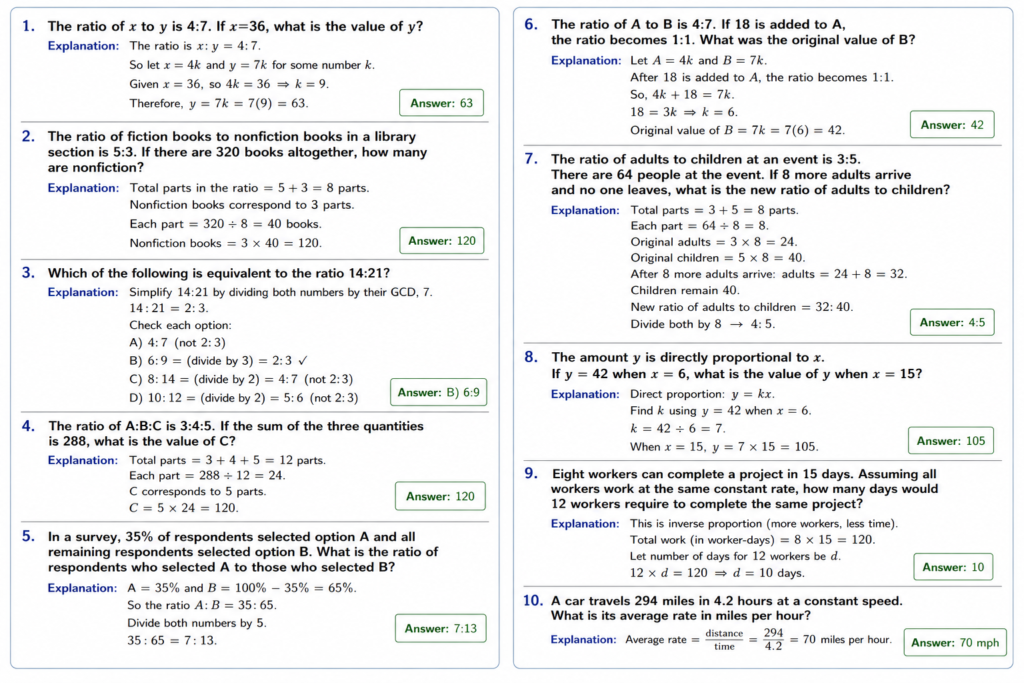
1. The ratio of x to y is 4:7. If x=36, what is the value of y?
- 49
- 56
- 63
- 72
2. The ratio of fiction books to nonfiction books in a library section is 5:3. If there are 320 books altogether, how many are nonfiction?
- 100
- 120
- 160
- 200
3. Which of the following is equivalent to the ratio 14:21?
- 4:7
- 6:9
- 8:14
- 10:12
4. The ratio of A:B:C is 3:4:5. If the sum of the three quantities is 288, what is the value of C?
- 96
- 108
- 120
- 144
5. In a survey, 35% of respondents selected option A and all remaining respondents selected option B. What is the ratio of respondents who selected A to those who selected B?
- 7:13
- 7:20
- 13:7
- 35:100
6. The ratio of A to B is 4:7. If 18 is added to A, the ratio becomes 1:1. What was the original value of B?
- 36
- 40
- 42
- 48
7. The ratio of adults to children at an event is 3:5. There are 64 people at the event. If 8 more adults arrive and no one leaves, what is the new ratio of adults to children?
- 3:4
- 4:5
- 5:6
- 5:8
8. The amount y is directly proportional to x. If y=42 when x=6, what is the value of y when x=15?
- 84
- 98
- 105
- 112
9. Eight workers can complete a project in 15 days. Assuming all workers work at the same constant rate, how many days would 12 workers require to complete the same project?
- 8
- 10
- 12
- 13
10. A car travels 294 miles in 4.2 hours at a constant speed. What is its average rate in miles per hour?
- 65
- 68
- 70
- 72
Click to reveal answers
- C
- B
- B
- C
- A
- C
- B
- C
- B
- C
Explanations to the above answers