
Mixtures is another topic that builds directly on ratios, percentages, averages, and proportions. We can identify mixtures when two or more different types of compounds are mixed together. Same compunds of, when mixed together, can’t be identified as mixtures.
For example:
As we have also discussed about ratios and proporttions being an integral building foundation for several other topics in arithmetic section, let’s see how it can be used to determine the ratio off compounds in the mixtures:
For example we have a mixture of milk and water:
As mentioned in raitos, to find the ratio of this mixture we might a number that divides both. Which could be 2. As a result:
To understand that even better let’s solve a question:
A mixture contains 40 liters of milk and 124 liters of water. What is the ratio of milk to water?
So the mixture contains:
- Milk = 40 liters
- Water = 124 liters
So to find the ratio we can divide both by a common divisor.
the answer is,
Which can further be divided by a common divisor, 2.
As a result the ratio of milk to water is
Another example:
A mixture contains 50 liters of milk and 45 liters of water. If 20 liters of water are added to the mixture, what is the new ratio of milk to water?
Initially, the mixture contains 50 liters of milk and 45 liters of water.
Since 20 liters of water are added, the new quantity of water is:
The quantity of milk remains unchanged at 50 liters. Therefore, the new ratio of milk to water is:
To simplify the ratio, divide both terms by their greatest common factor, 5:
Therefore, the new ratio of milk to water is:
1. Finding an unknown quantity from a given ratio
For example:
A mixture contains milk and water in the ratio 5:7. If the mixture contains 20 liters of milk, how many liters of water does it contain?
The ratio of milk to water is 5:7.
We are given that the quantity of milk is 20 liters. Since 5 parts represent 20 liters, the value of 1 part is:
Water represents 7 parts. Therefore, the quantity of water is:
Therefore, the mixture contains:
2. Finding the total quantity of a mixture
In such questions, it is essential to pay close attention to the phrasing. Students often confuse finding the total quantity of the mixture with finding the quantity of an individual component.
For example:
A mixture contains milk and water in the ratio 7:5. If the quantity of water is 15 liters, what is the total quantity of the mixture?
The ratio of milk to water is 7:5.
This means that for every 7 parts of milk, there are 5 parts of water.
We are given that the quantity of water is 15 liters. Since 5 parts represent 15 liters, the value of 1 part is:
The total mixture consists of 7 parts of milk and 5 parts of water, giving a total of:
Therefore, the total quantity of the mixture is:
Therefore, the total quantity of the mixture is:
3. Finding the quantities of individual components
This time total quantity is given, and the student has to determine the quantity of each component using the ratio.
For example:
The ratio of milk to water in a mixture is 5:3. If the total quantity of the mixture is 40 liters, find the quantities of milk and water in the mixture.
The ratio of milk to water is 5:3.
This means that the mixture consists of 5 parts milk and 3 parts water.
First, find the total number of parts:
The total quantity of the mixture is 40 liters. Therefore, the value of 1 part is:
Since milk represents 5 parts, the quantity of milk is:
Since water represents 3 parts, the quantity of water is:
Therefore, the mixture contains:
4. Finding quantities from the difference between components
For example:
The ratio of milk to water in a mixture is 10:7. If the difference between the quantities of milk and water is 15 liters, find the quantities of milk and water in the mixture.
The ratio of milk to water is 10:7.
This means that the mixture contains 10 parts milk and 7 parts water.
Since we are given the difference between the quantities, first find the difference between the ratio parts:
These 3 parts represent 15 liters. Therefore, the value of 1 part is:
Milk represents 10 parts, so the quantity of milk is:
Water represents 7 parts, so the quantity of water is:
Therefore, the mixture contains:
5. Finding initial quantities after a change in ratio
In such questions, a student has to work backwards from the change in ratio rather than simply apply a ratio.
For example:
The ratio of milk to water in a mixture is 2:3. If 10 liters of water are added to the mixture, the ratio of milk to water becomes 2:5. Find the initial quantities of milk and water and their quantities after the addition of water.
The initial ratio of milk to water is 2:3.
After adding 10 liters of water, the ratio becomes 2:5.
The quantity of milk does not change because only water is added. Therefore, we can use the milk quantity as the common reference.
Initially, the ratio is:
After adding water, the ratio is:
Since the milk remains unchanged and represents 2 parts in both ratios, the 2 parts of milk can be kept the same.
Therefore, the initial water quantity corresponds to 3 parts, while the final water quantity corresponds to 5 parts.
The increase in water is therefore:
These 2 parts represent the 10 liters of water that were added. Therefore, 1 part is:
Initially, milk represents 2 parts:
Initially, water represents 3 parts:
After adding 10 liters of water, the quantity of milk remains unchanged:
The final quantity of water is:
Therefore, initially the mixture contained:
After adding 10 liters of water, it contained:
Same concept can be examined using different terminology.
For example:
The ratio of milk to water in a mixture is 8:3. If 21 liters of water are added to the mixture, the ratio of milk to water becomes 4:5. Find the initial quantities of milk and water and the new quantities of milk and water after the addition.
The initial ratio of milk to water is 8:3.
After adding 21 liters of water, the ratio of milk to water becomes 4:5.
Since only water is added, the quantity of milk remains unchanged.
To compare the two ratios, make the milk portions equal.
Initially:
After adding water:
Multiply the second ratio by 2 so that the milk portion is also 8 parts:
Now the ratios can be compared directly:
The increase in the water portion is:
These 7 parts represent the 21 liters of water that were added. Therefore, 1 part is:
Initially, milk represents 8 parts:
Initially, water represents 3 parts:
After adding 21 liters of water, the quantity of milk remains unchanged:
The new quantity of water is:
Therefore, the initial quantities were:
After adding 21 liters of water, the new quantities are:
Check:
6. Effect on component ratio when removing a portion of a mixture
Remember: removing any quantity from a mixture proportionally decreases the amounts of individual components, but the ratio between them stays constant. It can be understood by the following:
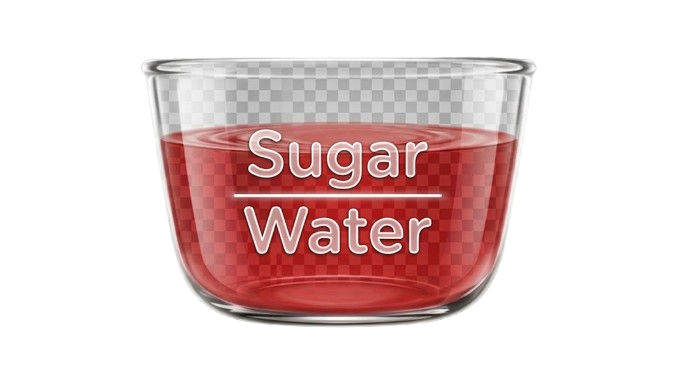
Assume having a bowl of juice with a mixture of sugar and water.
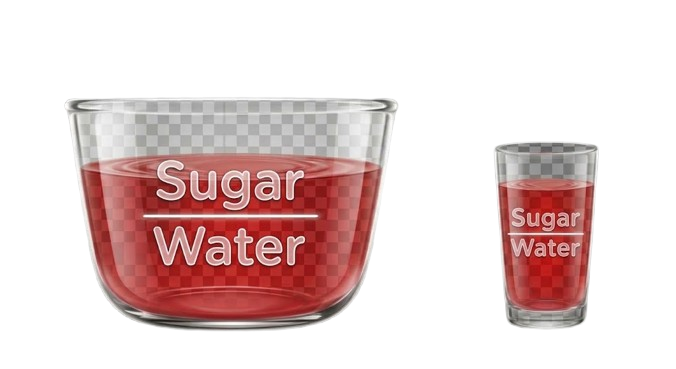
Taking out one glass of water still keeps the ratio of sugar and water same in both the containers.
Whether you take the first glass or the last, the sweetness of the juice remains the same. In the same way, the ratio of the components stays constant even after removing a portion of the mixture.
While taking this rule to another level, we can determine the final quantities after removal and addition to the mixture.
For example:
A mixture contains milk and water in the ratio 2:3. If 50 liters of the mixture are removed, the ratio of milk to water remains unchanged. Then, 12 liters of water are added to the remaining mixture, changing the ratio of milk to water to 2:5. Find the final quantities of milk and water, as well as the final quantity of the mixture.
The initial ratio of milk to water is 2:3.
When 50 liters of the mixture are removed, the ratio remains 2:3. This means the removed mixture also contains milk and water in the ratio 2:3.
The total number of parts in the original ratio is:
Therefore, the 50 liters removed from the mixture contain:
Let the quantities of milk and water remaining after removing 50 liters be represented by 2x and 3x respectively.
After 12 liters of water are added, the quantity of milk remains 2x, while the quantity of water becomes 3x + 12.
The new ratio is 2:5:
Cross-multiplying:
Therefore:
Therefore, after removing 50 liters, the remaining quantities are:
After adding 12 liters of water:
Therefore, the final quantity of the mixture is:
Therefore, the final quantities are:
Check:
So the final ratio is correct.
Part 2 of the same question asks:
Find the quantity of the mixture remaining after 50 liters are removed.
The initial ratio of milk to water is 2:3.
Let the quantities of milk and water remaining after removing 50 liters be 2x and 3x respectively.
After 12 liters of water are added, the quantity of milk remains 2x, while the quantity of water becomes 3x + 12.
The new ratio of milk to water is 2:5. Therefore:
Cross-multiplying:
Therefore:
Therefore, the quantities remaining after 50 liters are removed are:
Therefore, the quantity of the mixture remaining after 50 liters are removed is:
As a result the mixture initially would be:
7. Conditions where ratio doesn’t change
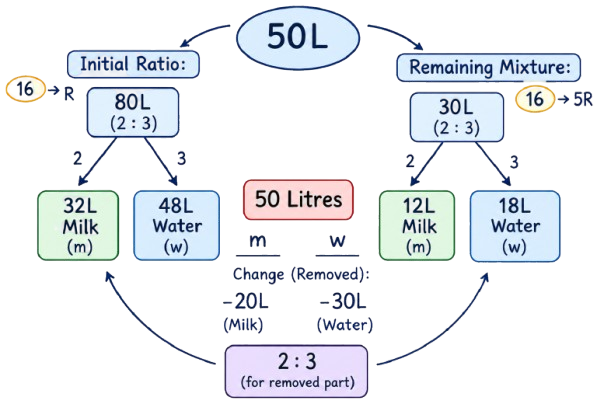
As we can see, the ratio of milk to water remains unchanged—whether in the initial mixture, after removing 50 liters, or after adding more of the same mixture. The core concept is that simply withdrawing or adding portions of a uniform mixture does not alter the component ratio. However, once an individual component is added to the mixture, the ratio changes.
Example 1:
90 liters mixture contains juice and water in the ratio of 5:4 respectively. if 36 liters mixture taken out and same quantity of water added in the remaining mixture, then find ratio of initial quantity of water to quantity of water in resulting mixture.
The total mixture is 90 liters, and the ratio of juice to water is 5:4.
First, find the total number of parts:
Therefore, each part represents:
Now, 36 liters of the mixture are removed. Since the mixture is removed in the same ratio of 5:4, the quantity of water removed is:
Therefore, the quantity of water remaining is:
Next, 36 liters of water are added to the remaining mixture:
Therefore, the initial quantity of water is 40 liters, while the quantity of water in the resulting mixture is 60 liters.
The required ratio is:
Dividing both terms by 20:
Therefore, the ratio of the initial quantity of water to the quantity of water in the resulting mixture is:
Example 2:
120 liters mixture of milk to water are in the ratio of 7:3 respectivelty. Find how much water should be mixed in the mixture so that quantity of milk becomes 50% of resulting mixture?
The total quantity of the mixture is 120 liters, and the ratio of milk to water is 7:3.
First, find the total number of parts:
Therefore, 1 part represents:
The initial quantity of milk is:
The initial quantity of water is:
Let x liters of water be added to the mixture. The quantity of milk remains unchanged at 84 liters, while the total quantity of the mixture becomes:
We want milk to constitute 50% of the resulting mixture. Therefore:
Cross-multiplying:
Therefore:
Therefore, 48 liters of water should be added to the mixture.
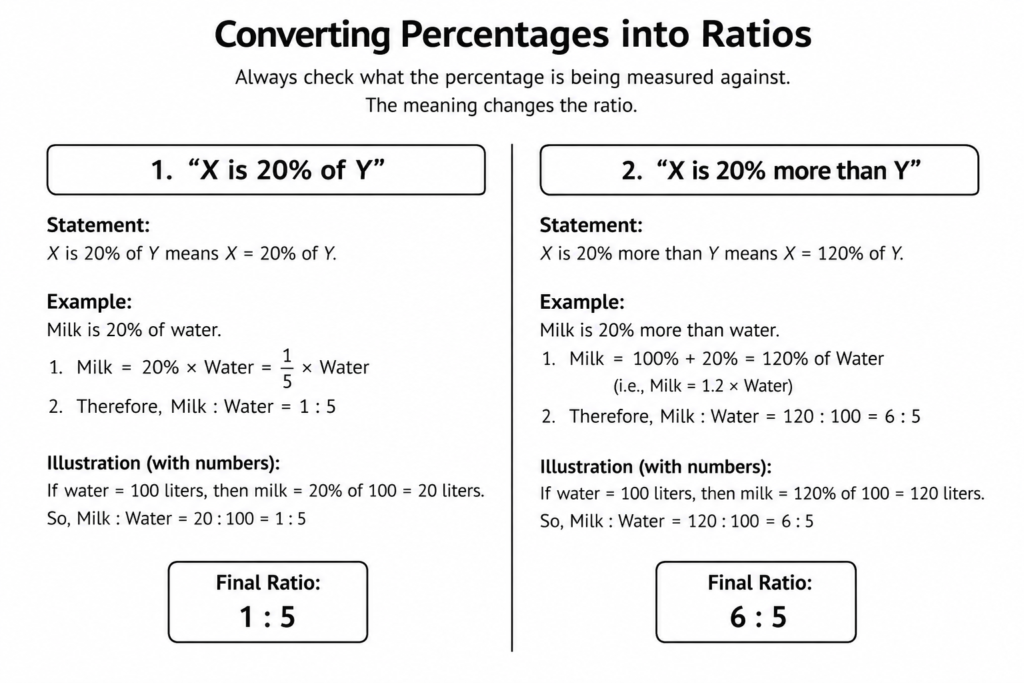
8. Converting percentages into ratios with the right base
This is a very useful concept for mixtures section because students often encounter statements such as:
- Milk is 20% of water.
- Water is 40% more than milk.
- Milk is 25% of the total mixture.
- Water is 60% of the mixture.
The key is to understand what the percentage is being measured against.
means that the quantity of milk is 20% of the quantity of water.
Mathematically:
Since:
we get:
Therefore:
The major distinction:
9. Replacement mixture
This can be identified as a replacement mixture problem because a portion of the mixture is removed and replaced with one of its components.
For example:
A mixture contains milk and water in the ratio 4:3, respectively. If 49 liters of the mixture are removed and replaced with 49 liters of water, the ratio of milk to water becomes 2:5. Find the initial quantity of the mixture.
Let the initial quantity of the mixture be x liters.
The initial ratio of milk to water is 4:3. Therefore, the initial quantities are:
Now, 49 liters of the mixture are removed. Since the mixture is removed in the ratio 4:3, the quantities removed are:
Therefore, after removing 49 liters, the remaining quantities are:
Next, 49 liters of water are added. Therefore, the new quantity of water is:
The quantity of milk remains unchanged. The resulting ratio of milk to water is 2:5. Therefore:
Cross-multiplying:
Expanding both sides:
Rearranging:
Therefore:
Therefore, the initial quantity of the mixture was:
Practice questions
1. A mixture contains milk and water in the ratio 5:3. If 16 liters of water are added to the mixture, the ratio of milk to water becomes 5:7. What was the initial quantity of the mixture?
A) 24 liters
B) 32 liters
C) 40 liters
D) 48 liters
2. A mixture contains milk and water in the ratio 7:5. If 24 liters of the mixture are removed, how much milk is removed?
A) 10 liters
B) 12 liters
C) 14 liters
D) 16 liters
3. A mixture contains milk and water in the ratio 4:5. If 18 liters of water are added, the ratio becomes 4:7. What is the initial quantity of milk?
A) 27 liters
B) 30 liters
C) 36 liters
D) 42 liters
4. A mixture contains milk and water in the ratio 3:2. If 25 liters of the mixture are removed and replaced with 25 liters of water, the new ratio of milk to water becomes 9:11. What was the initial quantity of the mixture?
A) 50 liters
B) 75 liters
C) 100 liters
D) 125 liters
5. Milk is 25% of the quantity of water in a mixture. What is the ratio of milk to water?
A) 1:3
B) 1:4
C) 2:5
D) 3:4
6. A 90-liter mixture contains milk and water in the ratio 5:4. If 18 liters of the mixture are removed and replaced with 18 liters of water, what is the new ratio of milk to water?
A) 5:6
B) 5:7
C) 4:5
D) 3:5
7. A mixture contains milk and water in the ratio 5:3. The difference between the quantities of milk and water is 18 liters. What is the total quantity of the mixture?
A) 54 liters
B) 60 liters
C) 72 liters
D) 90 liters
8. A mixture contains milk and water in the ratio 7:3. If 20 liters of water are added, the quantity of milk becomes 50% of the resulting mixture. What was the initial quantity of the mixture?
A) 40 liters
B) 50 liters
C) 60 liters
D) 70 liters
9. A mixture contains milk and water in the ratio 8:3. If 21 liters of water are added, the ratio becomes 4:5. What is the final quantity of the mixture?
A) 42 liters
B) 48 liters
C) 54 liters
D) 60 liters
10. A 120-liter mixture contains milk and water in the ratio 7:5. If 30 liters of the mixture are removed and replaced with 30 liters of water, what is the ratio of milk to water in the resulting mixture?
A) 7:8
B) 7:9
C) 5:7
D) 3:5