
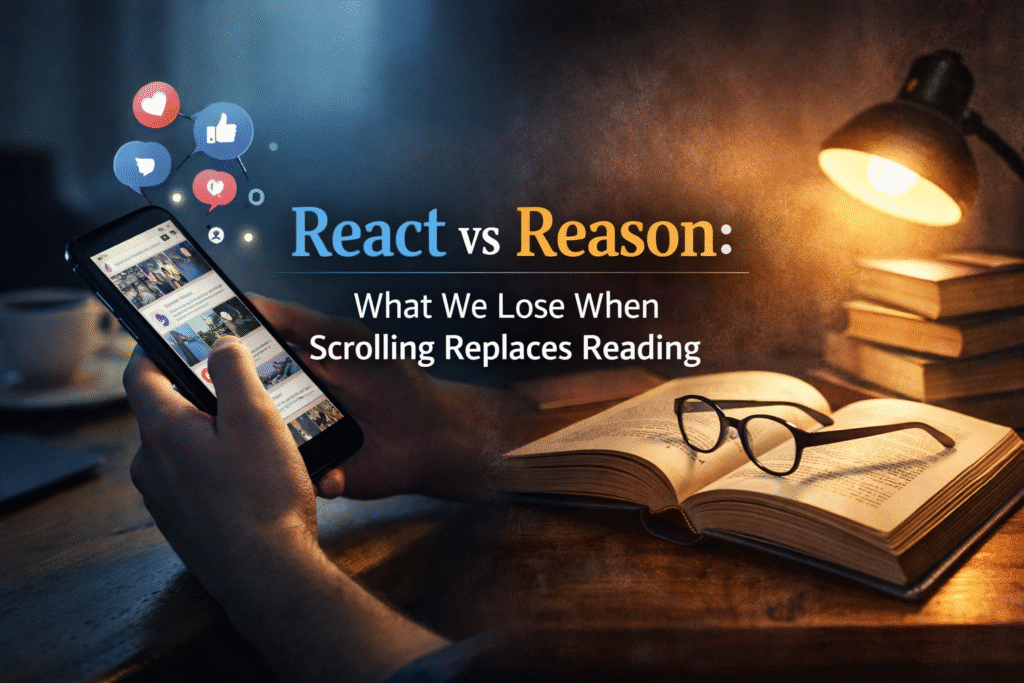
In a World Optimized for Scrolling, Depth Is Becoming Rare
Not too long ago, gaining knowledge required effort. You had to sit with a book, read an article, follow an argument from beginning to end, and sometimes re-read a paragraph just to fully understand it. Today, information reaches us without asking for our attention, it demands it. A few seconds here, a swipe there, and hours disappear without us consciously choosing where they went.
Scrolling has quietly become the default way we consume ideas. Short videos, bite-sized opinions, headlines without context, all of it feels efficient. Yet beneath this convenience lies a subtle cost: we are slowly losing our ability to go deep.
This isn’t about condemning social media or fast content. These platforms have value, and they serve their purpose. The concern is what happens when we replace reading with scrolling, let quick information become our primary teacher, and trade depth for speed.
The Silent Cost of Constant Scrolling
Scrolling feels harmless because it rarely feels heavy. There is no clear beginning or end, no moment that signals “you’ve had enough.” Unlike reading a chapter or finishing an article, scrolling has no natural stopping point. This makes it uniquely capable of consuming time without us realizing it.
More importantly, scrolling trains our minds to expect information without effort. Creators deliver ideas pre-packaged, summarized, and emotionally charged, inviting us to accept or reject them instantly. Information rarely requires us to question its foundations or connect it to a larger framework.
Over time, this changes how we think. When information is always fast, we grow uncomfortable with slowness. Due to everything being simplified, complexity feels exhausting. When we receive easy answers, we feel that reasoning is unnecessary.
What Reading Trains That Scrolling Cannot
Reading demands participation. It requires focus, patience, and engagement. You cannot read deeply while half-present. A meaningful text asks you to follow a line of reasoning, consider different perspectives, and sit with ideas that may not immediately make sense.
This process strengthens something scrolling rarely touches: reasoning ability.
With reading, you:
- Learn to think sequentially, not impulsively
- Understand why something is true, not just what people are saying.
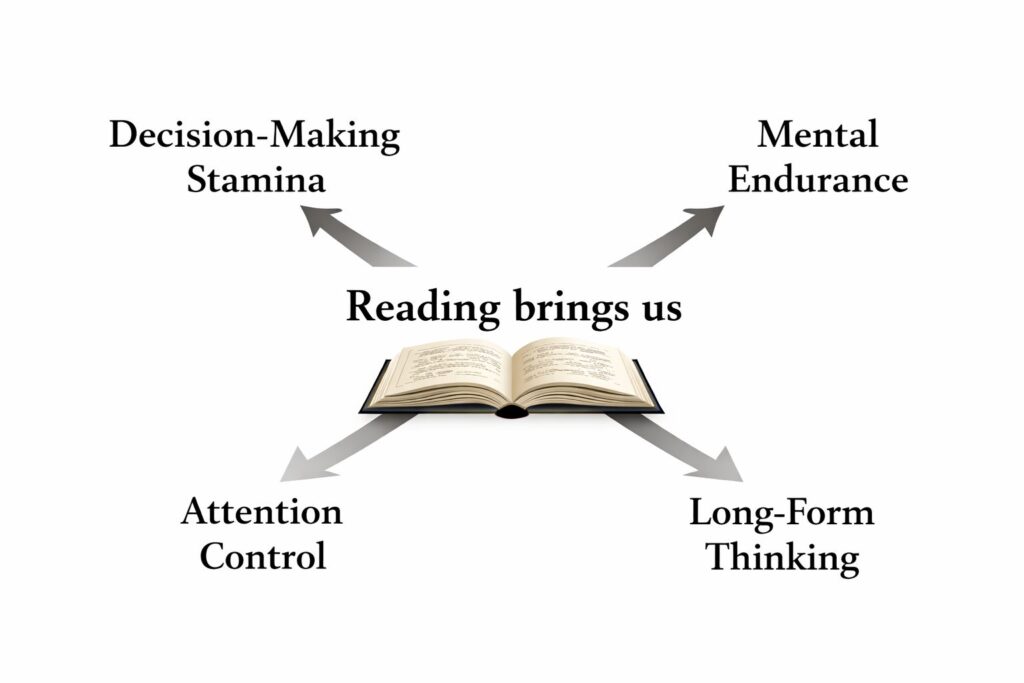
- Build mental endurance, the ability to stay with a problem longer
- Develop clarity, not just awareness
Reading also creates space for reflection. Unlike fast content that moves on before your mind catches up, reading allows you to pause, question, and internalize. This is how ideas turn into understanding.
The Danger of Too Much Quick Information
One of the biggest risks of abandoning reading is not ignorance, it is shallow knowledge. We begin to know a little about many things but understand very little in depth. Opinions feel familiar, yet fragile. Confidence exists, but it is not backed by solid reasoning.
This creates overwhelm. When the mind is flooded with disconnected information, it struggles to prioritize, evaluate, and decide. Everything feels urgent, yet nothing feels grounded.
Decision-making suffers first. Without the habit of deep thinking, choices become reactive. We rely on trends, popular opinions, or emotional impulses rather than structured thought. Creativity also weakens, because original thinking requires time, quiet, and mental space, all of which constant scrolling disrupts.
Why This Matters Even More for Early Professionals
For students, graduates, and early professionals, this shift has serious consequences. The modern workplace does not reward those who merely know information — it rewards those who can interpret, connect, and apply it.
Careers are shaped by:
- the quality of decisions you make
- how clearly you think under pressure
- your ability to analyze problems beyond surface-level solutions
- your capacity to learn continuously
These are not skills built through quick consumption. They are built through sustained reading, reflection, and exposure to well-structured ideas.
Professionals who avoid reading often struggle with:
- articulating thoughts clearly
- thinking independently
- handling complex tasks
- long-term planning and strategic reasoning
Meanwhile, those who read regularly develop a quieter but stronger advantage: mental clarity. They are harder to confuse, harder to manipulate, and better equipped to navigate uncertainty.
Rebuilding the Habit of Depth
The solution is not to eliminate scrolling, but to restore balance. Reading does not need to be excessive or academic. Even 20–30 minutes a day of meaningful reading can slowly rewire how the mind works.
Choose texts that:
- challenge your thinking
- explain concepts in depth
- encourage questioning rather than instant agreement
- align with your personal growth and career goals
Over time, reading becomes more than a habit, it becomes a form of mental training. You regain the ability to think beyond the obvious, reason through complexity, and make decisions with confidence rather than haste.
Preparing for a Thoughtful Future
The future belongs to those who can think clearly in a noisy world. As information continues to accelerate, depth will become rarer, and therefore more valuable.
Reading is no longer just a personal habit. It is a professional investment.
For early professionals especially, returning to reading is a way of preparing for challenges that cannot be solved by quick answers alone. It builds the foundation for resilience, adaptability, and long-term growth.
In a world optimized for scrolling, choosing to read is choosing to think. And thinking deeply may be one of the most important skills you can develop for the future.