
You might think it’s too basic to start with an introduction to this topic, but aptitude tests often trick test-takers by testing even the most fundamental concepts in unexpected ways.
Aptitude tests frequently increases the difficulty level of questions by combining various topics, such as absolute value, inequaltites, exponents, fractions, and often incorporating these topics pinto questions that involve algebra, geometry, or proportions (Each of them are clickeable to lead to the desginated topic).
Test Yourself Before We Begin:
If n is an integer and n(n+1) is multiplied by 3, which of the following must be true?
- The result is divisible by 3 only
- The result is divisible by 6
- The result is divisible by 9
- The result is divisible by 12
Because n and n+1 are consecutive integers, one must be even. Thus n(n+1) is divisible by 2. Multiplying it by 3 makes the result divisible by:
Lets try another one:
If n is a positive integer and \(n^2\) is divisible by both 6 and 10, which of the following must be true?
- n is divisible by 10
- n is divisible by 15
- n is divisible by 30
- n is divisible by 60
Since \(n^2\) is divisible by both 6 and 10, it must contain all the prime factors required by both numbers.
and
Therefore, \(n^2\)must contain the prime factors:
If a prime divides \(n^2\), that prime must also divide n. Therefore:
n is divisible by 3,
and
n is divisible by 5.
So n must be divisible by:
The correct answer is B.
Now that you’ve figured out where you stand, it’s time to dive into the essential rules and key concepts you’ll need to ace your aptitude test.
1. Major types of numbers:
To solve any question regarding number systems, students should initially understand the classification of numbers.
1. Natural numbers:
The positive counting numbers we naturally use when counting objects.
1,2,3,4,5,…
For example: Which of the following is a natural number?
The answer is 7. Because they represent countable, real-world quantities, they cannot be negative.
2. Whole numbers:
Whole numbers are the natural numbers together with zero.
0,1,2,3,4,5,…
Note: There is a difference in convention of identifying “0” as a natural number. Therefore, you have to identify your convention, whether you start the natural numbers with “0” or “1”.
For example: Which number is a whole number but, under our convention, not a natural number?
The answer is 0.
3. Integers
Integers include all positive whole numbers, zero, and their negative counterparts.
…,−3,−2,−1,0,1,2,3,…
They do not include fractions or decimals that have a fractional part.
For example: Suppose the temperature is:
5∘
and it drops by 8∘:
5−8=−3
The new temperature is:
−3∘
So −3 is an integer.
Example: Which of the following are integers?
The integers are:
while 3.5 is not an integer.
4. Rational Numbers
A rational number is any number that can be written as:
where a and b are integers and:
The word rational can also be associated with ratio and the number can be expressed as a ratio of two integers. For example:
However, integers can be rational too.
This is where aptitude test can become tricky. However, you need a basic analysis to identify that. For example
Where 5 is an integer and \(\frac{5}{1}\) looks like a fraction but can be written as 5 too.
For example: Is 0.125 rational?
Yes, because:
Therefore, 0.125 is rational.
Terminating decimals and repeating decimals are rational numbers.
For example:
is rational even though the decimal continues forever.
5. Irrational numbers
A number that is real and cannot be written as:
where a and b are integers and \(b\neq0\).
Its decimal representation continues forever without terminating or repeating in a fixed pattern. (See rational and irrational operations below)
The digits continue without forming a repeating pattern, and there is no pair of integers a and b. Which is why \(\sqrt2\) is an irrational number.
However, not every square root is irrational.
For example:
and
Therefore, \(\sqrt25\) is a rational number.
For example: Which is irrational?
We know:
It can better be memorized with a visual depiction as follows:
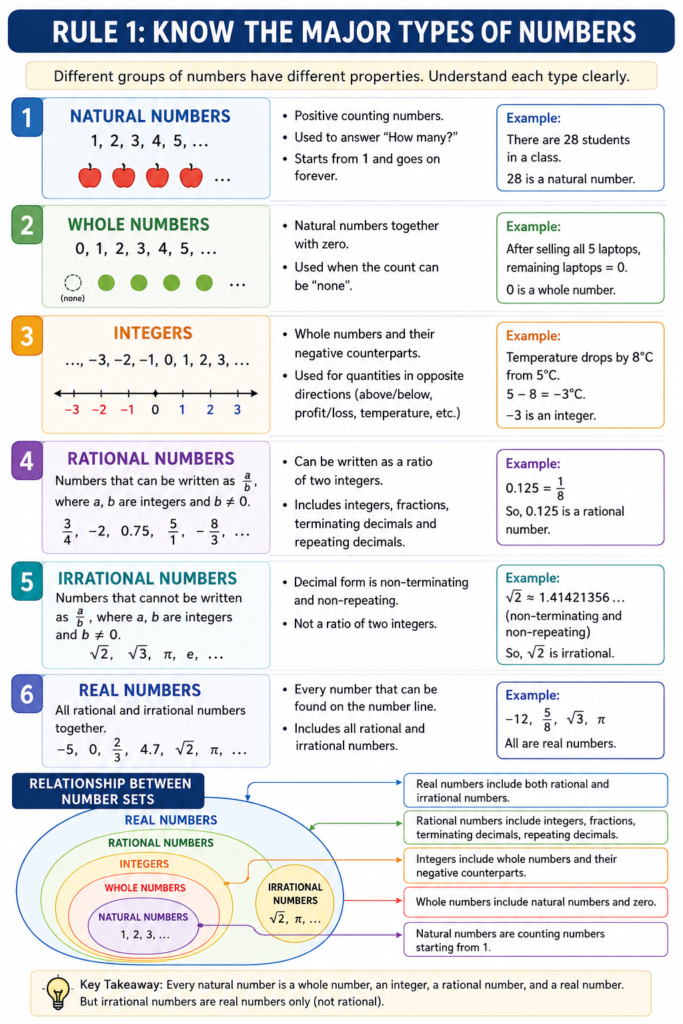
Let’s do an example:
If x is a natural number, which of the following must also be true?
- x is irrational
- x is negative
- x is rational
- x contains a decimal
As every natural number can be written over 1:
Therefore: every natural number is necessarily rational. Hence the answer is “x is rational“.
6. Even and odd numbers
An even integer can be written as:
An odd integer can be written as:
where k is an integer.
For multiplication:
Even × Any integer = Even
odd × odd = odd
These rules are frequently tested indirectly.
For example: If a and b are odd integers, which must be even?
- ab
- a+b
- ab+2
- a+b+1
The key is to remember the basic odd-number operation rules.
Because:
Correct Answer: a+b
7. Factors and multiples (GCF and LCM)
A factor of a number is an integer that divides that number exactly, leaving no remainder.
For example, the positive factors of 24 are:
because each divides 24 with remainder 0.
For example:
the remainder is zero.
Factors are limited. A positive integer has only a finite number of positive factors. For example, 12 has exactly six:
So when the factors of a number are listed, remember that 1 is a factor of every positive integer. And every positive integer is a factor of itself.
To identify the factors of a number efficiently, organize them into factor pairs. Each pair consists of two integers whose product equals the original number, helping you find all factors systematically without missing any.
Let’s say for 72:
So the factors are:
Let’s do an example:
How many positive factors does 144 have?
Instead of listing all the factors, use prime factorization:
Any factor of 144 must have the form:
where:
and
There are 5 choices for and 3 choices for :
So 144 has 15 positive factors.
Another important thing to keep in mind is that perfect squares have an odd number of factors. Since 36 is a perfect square:
Its paired factors are:
As factor 6 pairs with itself, as a result, perfect squares have an odd number of positive factors.
A multiple of a number is obtained by multiplying that number by an integer. Factors divide into a number, while multiples extend from a number. As a result, a number has a finite number of factors, but an infinite number of multiples.
You might also notice the relationship that If is a factor of , then is a multiple of .
For example:
Therefore:
- 8 is a factor of 56.
- 56 is a multiple of 8.
The aptitude might also test you for a common factor that divides two or more numbers exactly.
For example:
Factors of 24:
Factors of 36:
Their common factors are:
So if you are asked for the Greatest Common Factor or the Highest Common Factor of 24 and 36, the answer is 12.
Similar is the case with common multiples.
For example:
Multiples of 8:
Multiples of 12:
Common multiples include:
As a result, if you are asked to sort the Least Common Multiple of 8 and 12, the answer is 24.
Verifying the GCF and LCM for factors with an example:
Two positive integers are 8 and 12. Their greatest common factor (GCF) is 4. What is the least common multiple (LCM) of 8 and 12?
- 16
- 20
- 24
- 32
This question can be solved using the relationship:
Which means to establish verification we can sort the product of ab:
Find GCF:
therefore:
Find LCM:
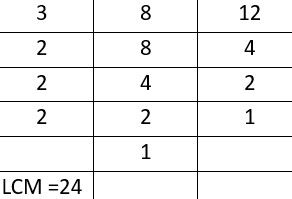
Therefore:
Hence proved:
As a result the LCM = 24. The answer is C.
Or,
can be directly done by equating in the expression:
2. Remainder and division algorithm
A number is divisible by another number when the division leaves a remainder of 0.
For example:
Since there is no remainder, So 42 is divisible by 6.
A few basic divisibility rules for quick aptitude shortcuts are as follows:
| Divisor | Divisibility Rule | Example |
|---|---|---|
| 2 | Last digit is even: 0, 2, 4, 6, or 8. | 738 → last digit is 8 → divisible by 2 |
| 3 | Sum of all digits is divisible by 3. | 741 → → 12 is divisible by 3 |
| 4 | The number formed by the last two digits is divisible by 4. | 1,316 → 16 is divisible by 4 |
| 5 | Last digit is either 0 or 5. | 2,735 → ends in 5 |
| 6 | Number must be divisible by both 2 and 3. | 534 → even, and |
| 8 | The number formed by the last three digits is divisible by 8. | 5,216 → 216 ÷ 8 = 27 |
| 9 | Sum of all digits is divisible by 9. | 7,362 → |
| 10 | Last digit must be 0. | 4,570 → ends in 0 |
| 11 | Difference between the sums of alternating digits is 0 or a multiple of 11. | 2,728 → |
| 12 | Number must be divisible by both 3 and 4. | 1,236 → digit sum = 12 and last two digits = 36 |
However, a few of these might need an extra explanation because they’re particularly useful in aptitude questions.
For instance, divisibility by 3 and 9:
For 3, add the digits.
Take:
Since:
We can say,
4,572 is divisiible by 3
Similarly, divisibility by 4:
You only need the last two digits.
Consider:
Ignore everything except:
SInce,
The entire number is divisible by 4.
Divisibility by 8:
Look at the last three digits.
Consider:
Take:
SInce,
We know:
47,216 is divisible by 8.
Divisibilty by 11:
This is the unusual one.
Consider:
Take alternating digits:
and,
FInd the difference:
SInce 11 is divisible by 11, we can say that,
2,728 is divisible by 11.
Another example where it fails:
Is 47,325 divisible by 11?
Let’s verify:
Difference between the alternating groups:
3 is not 0 or a multiple of 11, so:
47,325 is not divisible by 11.
A remainder is the amount left over when one integer cannot be divided exactly by another integer.
For example:
When an integer is divided by 7, the remainder is 3. Which expression represents ?
- n=7q+3
- n=3q+7
- n=7q−3
- n=3q+4
This can be solved using the “Division Algorithm Formula”:
Where,
- a = dividend — the number being divided
- = divisor — the number we divide by
- = quotient — how many complete times the divisor fits
- = remainder
The remainder must always be non-negative and smaller than the divisor when using the standard division algorithm.
Therefore using the above expression, we get:
where is an integer.
Possible values of include:
Another example:
An integer leaves a remainder of 5 when divided by 8. What remainder does leave when divided by 8?
Since leaves a remainder of 5 when divided by 8, using the division algorithm:
where is an integer.
We need to determine the remainder of :
Since
we can write:
Factor 8:
For a faster method:
You can work directly with the original remainder:
Now divide 12 by 8 and you will get the remainder 4.
Another simple approach to solve this is:
When a positive integer is divided by 7, the remainder is 4. What is the remainder when is divided by 7?
We know that leaves a remainder of 4 when divided by 7.
Instead of worrying about the actual value of , start with the remainder:
The question adds 12 to , so add 12 to the remainder:
Now divide 16 by 7:
There are two complete groups of 7 with 2 left over. Therefore:
3. Properties of consecutive integers
- Consecutive integers are numbers that follow each other in order.
- Consecutive integers can be positive, negative, or include zero.
- Consecutive integers follow each other with the difference of exactly “1” in between.
Consecutive integers can be represented as:
For example, if three consecutive integers have a sum of 72:
So the integers are:
Consecutive integers become more challenging when even and odd ones are asked to be sorted.
Consecutive even integers differ by 2:
For instance:
or simply:
only if n is specified to be even.
For example:
The sum of three consecutive even integers is 78. What are the three integers?
First represent three consecutive even integers as:
their sum is 78:
Open parenthesis and merge:
Solve for n:
Therefore, the three integers are:
Similarly, Consecutive odd integers also differ by 2, but the disctinction is important to be identified in the algebraic expression:
This is actually the safer and more mathematically precise representation because it automatically guarantees that every number is odd. As, 2n is always even for any integer . Adding 1 makes it odd:
However, the same expression can be used for both, the consecutive even integers and consecutive odd integers:
Provided we specify that itself is an odd integers.
For example:
The sum of three consecutive odd integers is 69. What are the three integers?
As consecutive odd integers differ by 2, so represent them as:
Their sum is 69:
Open parenthesis and merge:
Solve for n:
Therefore, the three integers are:
The properties of products of consecutive integers are also important to remember. The following fundamental rules provide useful shortcuts for solving related problems efficiently and accurately:
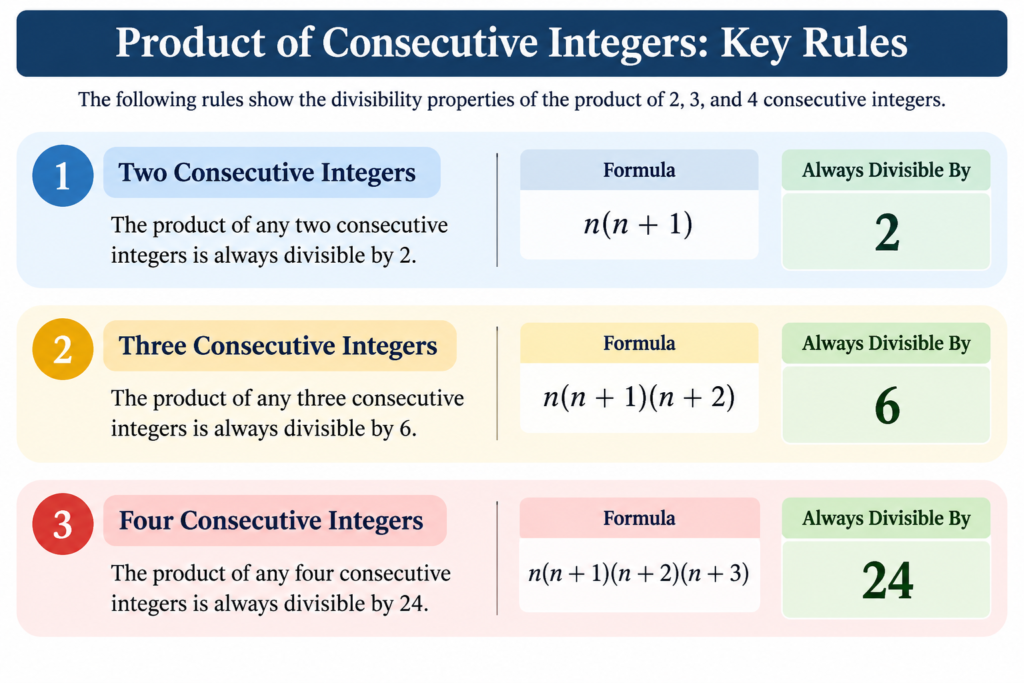
4. Perfect squares
- A perfect square is an integer obtained by multiplying an integer by itself.
- A perfect square has even exponents in its prime factorization.
For instance:
N is a perfect square only and if a,b, and c are even exponents.
Lets do an example:
What is the least positive integer such that is a perfect square?
- 5
- 10
- 15
- 30
Multiplying each option by 540 will take time and you might end up losing questions in the end. Therefore, try prime factorization initially. You do not need to guess the “right” way to split 540. You can start with any convenient factorization.
Now split each number to its own factors:
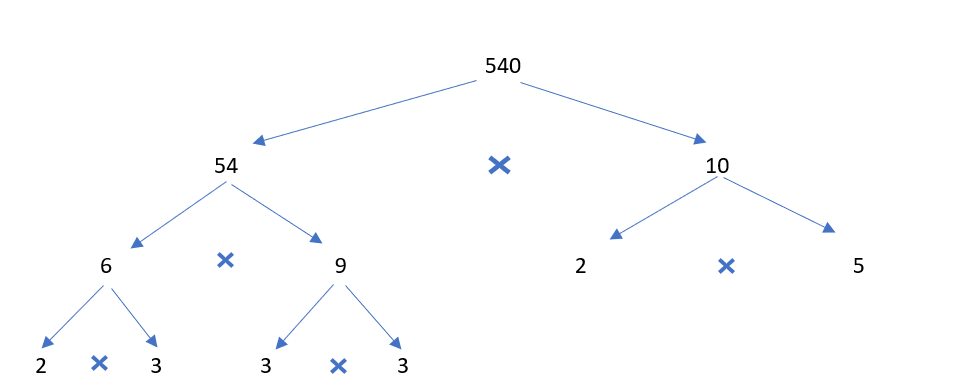
Therefore the factors are:
To add exponents we can say:
Now, for a perfect square, every prime factor must occur an even number of times.
- There are already two 2s = a perfect square
- We have three 3s. After we pair two 3s for a perfect square one 3 is left without a partner. So we need one more 3.
- There is only one 5, so it also needs a partner. Therefore, we need one more 5.
As a result:
Option C is the right answer.
To verify that option C makes the result a perfect square:
Therefore, “make the exponents even” technique is much faster than testing the choices.
Another thing to remember that can save your time is that a perfect square can only end in 0, 1, 4, 5, 6, or 9. Following are some useful perfect squares to recognize immediately:
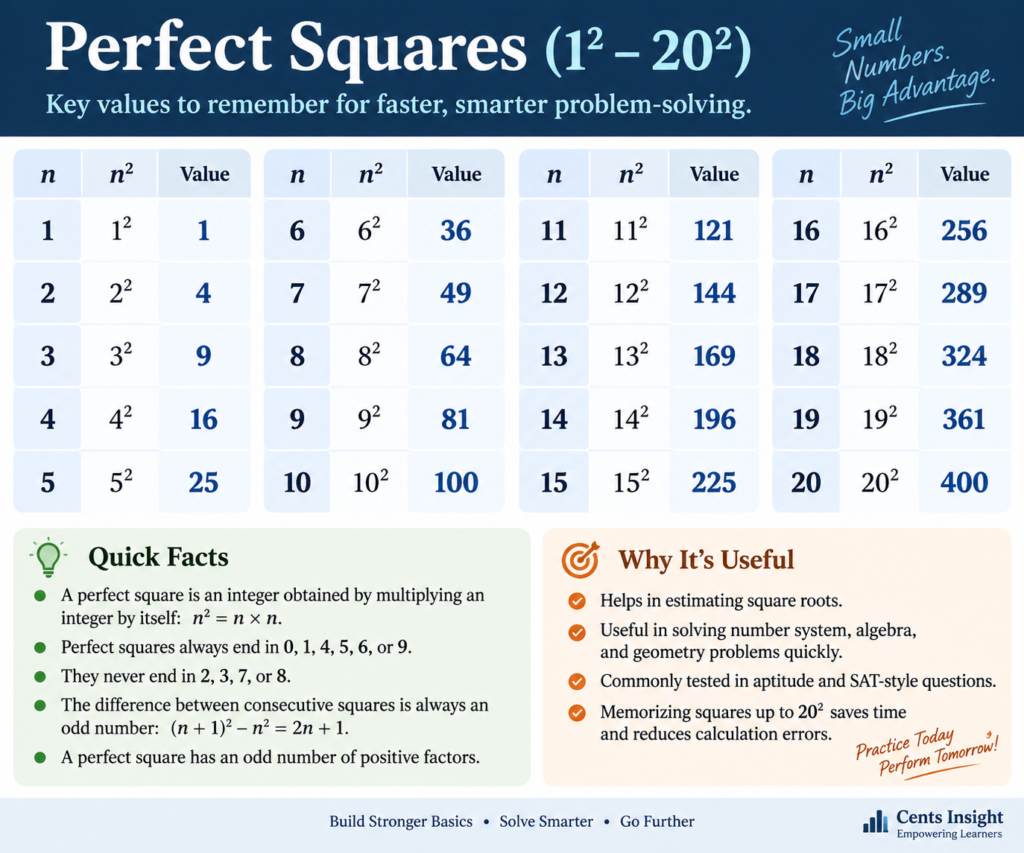
However, a number ending in 4 is only a possible perfect square; the last digit alone does not guarantee that it is one. For example, 34 ends in 4 but is not a perfect square. Therefore, the last-digit rule is useful for ruling out numbers that cannot be perfect squares, but it cannot, on its own, confirm that a number is a perfect square.
Another important aspect: Perfect squares lie between consecutive squares:
But, any integer between 144 and 169 cannot be a perfect square.
For instance:
As a result,
For example:
If:
is an integer and,
how many possible values can have?
Note: We know that an integer is a whole number that can be positive, negative, or zero, and has no decimal or fractional parts.
Find nearby squares:
Between 200 and 300 we have:
Therefore, the answer is 3.
5. Rational and irrational operations.
In the Number Systems material, rational and irrational number operations are especially important because questions often test whether a result must be rational, must be irrational, or could be either. The word “must” is where many of the traps appear.
It is important to highlight the difference first.
A number is rational if it can be written as:
where both are integers and q is not equal to 0.
A decimal number is rational if it either terminates or repeats in a predictable pattern. A terminating decimal ends after a finite number of digits, such as 0.250 or 0.70. A repeating decimal continues indefinitely but follows a recurring sequence of digits, such as 0.333… or 0.181818…. Both types of decimals can be expressed as fractions and are therefore rational numbers.
A decimal number is irrational if it neither terminates nor repeats in a predictable pattern. Its digits continue indefinitely without forming a recurring sequence. For example, numbers such as \(\sqrt{2}\) =1.4142135…and π=3.1415926… continue without ending or repeating a fixed pattern. Since such numbers cannot be expressed as a ratio of two integers, they are classified as irrational numbers.
But it is important to highlight that a sqaure root is not irrational by default:
But,
If a radical seems complicated, simplifying it into an easier irrational can get us closer to answer:
We know that \(\sqrt72\) is not a perfect square. But we can break it down into simplified irrational terms:
Break \(\sqrt72\) into factors (try to break with one possible perfect square):
Therefore:
As a result, wherever you see such numbers:
Ask youself, “Is there a perfect square hiding inside the radical?”
For instance:
Another important concept is: Are there radicals that can be combined?
The answer is “yes”. Lets do an example:
Remember that to apply the above context the radical has to be common.
We can also look into: Can the radicals multiply into a perfect square?
This is a very useful shortcut for an aptitude test as:
can also be presented as:
Lets say.
bring that under common root,
as we know this is a perfect square and we turned the irrational numbers into a rational number:
So we can conclude that:
We can also classify the results: Whether its the final answer?
By seeing the following, one might click on the option saying “Its irrational”:
However, an attempt to further simplification can change the outcome:
Therefore, we can say an irrational expression can result into a rational number.
6. Exponent properties
Understanding the properties of exponents for the aptitude test preparation might include a set of patterns, which once figured out, even dificult looking exponential questions will become easier as soon as you realise which law is being applied here.
We might start with the law of “same base multiplication, add the exponents”:
It is important to figure out that the bases are same and they are being multiplied.
For example:
First combine the numerator,
Then,
As we said product of same bases adds up the powers, similarly, “same base division, deduct the exponents”.
Another example,
If,
Find K.
Apply the same base quotient rule and subtract the exponents:
Power on the exponent, “multiply the exponents”.
This is the case when an exponential expression is raised to another power:
Remember here we cannot add the exponents as its a power upon power. So do figure out that:
- Multiplying same bases → add exponents.
- Power raised to a power → multiply exponents.
Similar to this but with a minor difference is the case: power to the product.
Here we have:
Exactly same should be done with the power on a quotient:
We have another case of a “negative exponent that’s sorted with an inverse”:
If you have:
that it can also be written as:
So if we have:
We can write it as:
Vice versa is the case with a negative exponent in the denominator:
An important point to remember is that a fraction in the exponent always means a root. So:
and more generally we can re-write the fractional power in different ways such as:
For example:
or,
or a little challenging one:
First solve the inner bracket:
and
So to make the fractional power easier, remember that:
- Denominator = root.
- Numerator = power.
A table worth remembering to save your time:
| Situation | Rule |
| Multiply same base | |
| Divide same base | |
| Power of a power | |
| Power of product | |
| Power of quotient | |
| Zero exponent | |
| Negative exponent | |
| Fractional exponent | |
| General fractional exponent | |
| Negative base + even exponent | Positive |
| Negative base + odd exponent | Negative |
| Same base, equal powers |
Exponents do not distribute over addition
You may distribute an exponent over multiplication:
But you cant simply do:
because \((a+b)^2\) simply means:
However, a general pattern works as if:
then it should be represented as:
not:
Lets do an example:
As we have identical terms we can take the common of 3 with the power of 7:
we have:
as a result we can say bases are same in multiplication so we can add the powers:
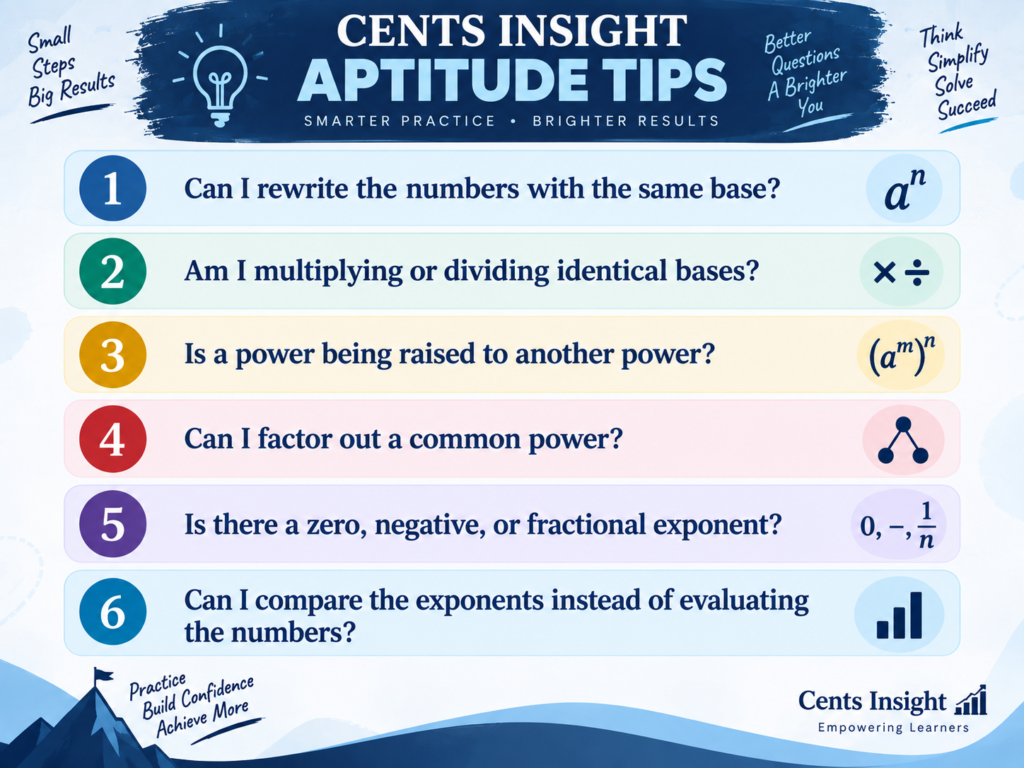
Before directly starting to attempt the exponents based questions it will be helpful to ask the following questions first to yourself:
Practice questions:
1. Which description best classifies the value of √50 − 5√2?
Show Answer
Answer: An even integer
Because √50 = 5√2, the expression becomes 0, and 0 is an even integer.
2. When a positive integer n is divided by 7, the remainder is 5. What is the remainder when 3n + 4 is divided by 7?
Show Answer
Answer: 5
If n = 7q + 5, then 3n + 4 = 21q + 19 = 7(3q + 2) + 5. Therefore, the remainder is 5.
3. Two positive integers have a GCF of 12 and an LCM of 420. If one integer is 60, what is the other integer?
Show Answer
Answer: 84
Use the relationship GCF × LCM = product of the two integers. Therefore, 12 × 420 = 60 × x, which gives x = 84.
4. For every integer n, which of the following is the greatest number that must divide n(n + 1)(n + 2)(n + 3)?
Show Answer
Answer: 24
The product of any four consecutive integers is always divisible by 4! = 24.
5. What is the least positive integer k such that 540k is a perfect square?
Show Answer
Answer: 15
540 = 2² × 3³ × 5. Multiplying by 3 × 5 gives 2² × 3⁴ × 5². All the exponents are now even, so the result is a perfect square.
6. Which statement correctly describes (√12 + √27) ÷ √3?
Show Answer
Answer: It equals the rational integer 5
√12 = 2√3 and √27 = 3√3. Therefore, the numerator becomes 5√3. Dividing by √3 gives 5.
7. If 16^(x + 1) = 8^(x + 2), what is the value of x?
Show Answer
Answer: 2
Rewrite both numbers using base 2. Since 16 = 2⁴ and 8 = 2³, we get 4(x + 1) = 3(x + 2). Solving gives x = 2.
8. If n is an odd integer, which expression must be odd?
Show Answer
Answer: n(n + 1) + 1
n and n + 1 are consecutive integers, so one of them must be even. Therefore, n(n + 1) is even. Adding 1 makes the result odd.
9. A positive integer N gives quotient 17 and remainder 9 when divided by 13. What is N?
Show Answer
Answer: 230
Using the division algorithm: N = divisor × quotient + remainder. Therefore, N = 13 × 17 + 9 = 230.
10. What is the least positive integer k such that 432k is a perfect cube?
Show Answer
Answer: 4
432 = 2⁴ × 3³. Multiplying by 2² = 4 gives 2⁶ × 3³. Both exponents are now multiples of 3, so the result is a perfect cube.