
It’s not too late to become a content creator.
You don’t need to quit your job, post every day, or start from scratch each time you sit down to create. With the right system, content can become a side stream that fits around your schedule—not another obligation competing for your time. Discover a simple content creation strategy busy people can use to generate ideas consistently and build passive income—without burnout or constant brainstorming.
A Simple Content Creation Strategy Busy People Can Actually Stick To
Scroll through any platform today and you’ll see thousands of creators posting daily. From the outside, it looks exhausting—and for many people, it is. That’s why most aspiring creators quit early. Not because they lack talent, but because they try to create content the hard way. The truth is, content creation doesn’t need to consume your entire day. Moreover, there’s a simple and sustainable strategy that busy people can use to build content consistently—and over time, even turn it into a passive income stream.
And no, it doesn’t require fancy equipment, endless brainstorming, or waiting for “creative energy” to strike.
The Shift Most Creators Never Make
The biggest mistake new creators make is believing they must constantly generate original ideas from scratch. This belief creates pressure, slows progress, and eventually leads to burnout. Successful creators think differently. They don’t ask, “What should I create today?”
They ask, “What is already working, and how can I explain it better?”
Once you adopt this mindset, content creation stops feeling heavy and starts feeling systematic.
Start With a Clear Niche to Set The Direction
Before you create anything, you need clarity. A niche is not just a topic—it’s a promise to a specific group of people.
When your niche is clear, you know:
- What type of content to consume
- The problems to focus on
- Language your audience understands
Without a niche, content feels random. With a niche, content feels purposeful.
The 10-Video Rule That Changes Everything
Once your niche is set, your daily task becomes surprisingly simple.
Spend time watching 10 videos per day related strictly to your category. These can be YouTube videos, podcasts, interviews, or even short-form content. You’re not watching for entertainment—you’re watching for patterns.
As you do this, notice:
- What topics keep repeating
- Which titles grab attention
- What questions people ask in the comments
This step alone removes the hardest part of content creation: figuring out what to talk about.
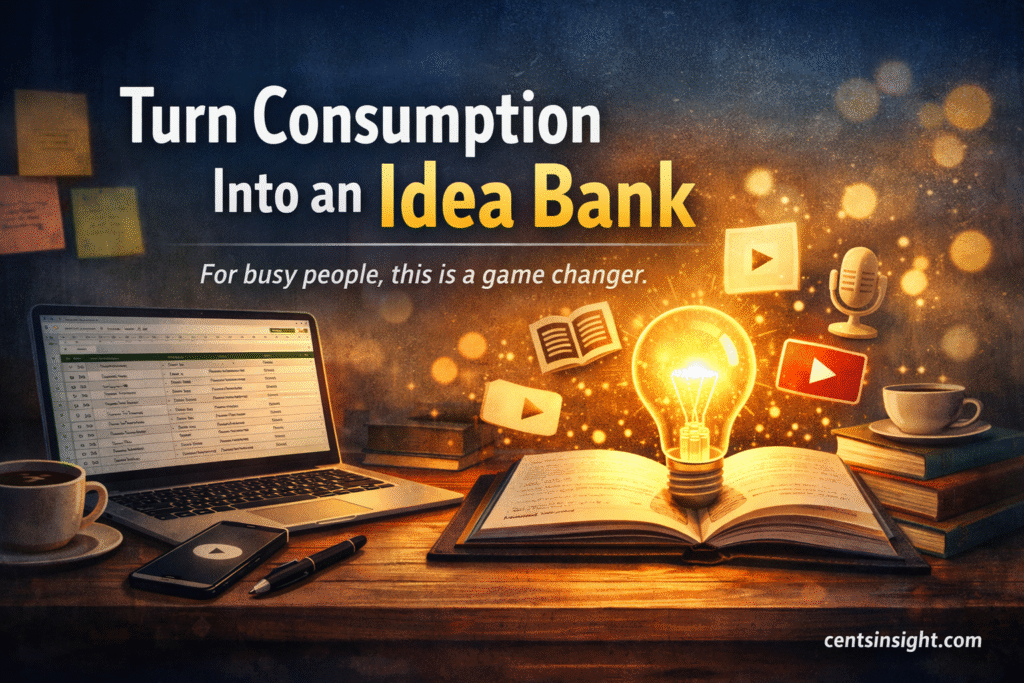
Turn Consumption Into an Idea Bank
Instead of keeping everything in your head, save it.
Create a Google Sheet and start logging:
- The video title
- The link
- The core idea discussed
- Your own thoughts or perspective
Over time, this sheet becomes your personal content library. On days when you feel low on energy or motivation, you don’t need to think—you just pick an idea from your list and move forward.
For busy people, this is a game changer.
Transcripts: The Fastest Way to Scale Content Without Extra Effort
This is where content creation shifts from effort to efficiency. Most videos already include transcripts, yet few creators use them strategically. Instead of copying, treat transcripts as structured raw material. Rewrite the ideas in your own voice, simplify complex points, and remove anything that doesn’t serve clarity. With this approach, a single video can be transformed into a blog post, a LinkedIn article, an Instagram carousel, or a short-form script—without reinventing the idea.
Once this system is in place, content multiplication becomes deliberate, not exhausting. The same concept can be adapted for beginners, reframed as common mistakes, expanded into a step-by-step guide, or anchored in a personal insight. You can even turn one thoughtful comment into a standalone post. This is how consistent creators operate: fewer ideas, executed with structure, reused with purpose, and scaled over time.
Why This Strategy Works for Busy People
This strategy works because it removes randomness from content creation. Instead of chasing inspiration, you operate within a clear process. Ideas are collected in advance, content is batched efficiently, and consistency no longer depends on daily motivation. Over time, your work compounds into digital assets that continue delivering value long after they’re published. Most importantly, content creation shifts from a daily struggle to a repeatable system—something busy people can actually sustain.
Therefore, you don’t need more ideas; you need a better way to organize and reuse the ideas already around you. When content creation becomes structured, it becomes sustainable. And when it’s sustainable, it creates room for growth, authority, and eventually passive income. Create less from pressure. Create more from process. That’s how busy people win in the content game.