
- The Myth That a Degree Is Enough
- Lack of Practical Exposure
- Poor Communication and Emotional Intelligence
- Unrealistic Expectations and Impatience
- Resistance to Continuous Learning
- Turning Early Career Failures into Strengths: What Graduates Can Do?
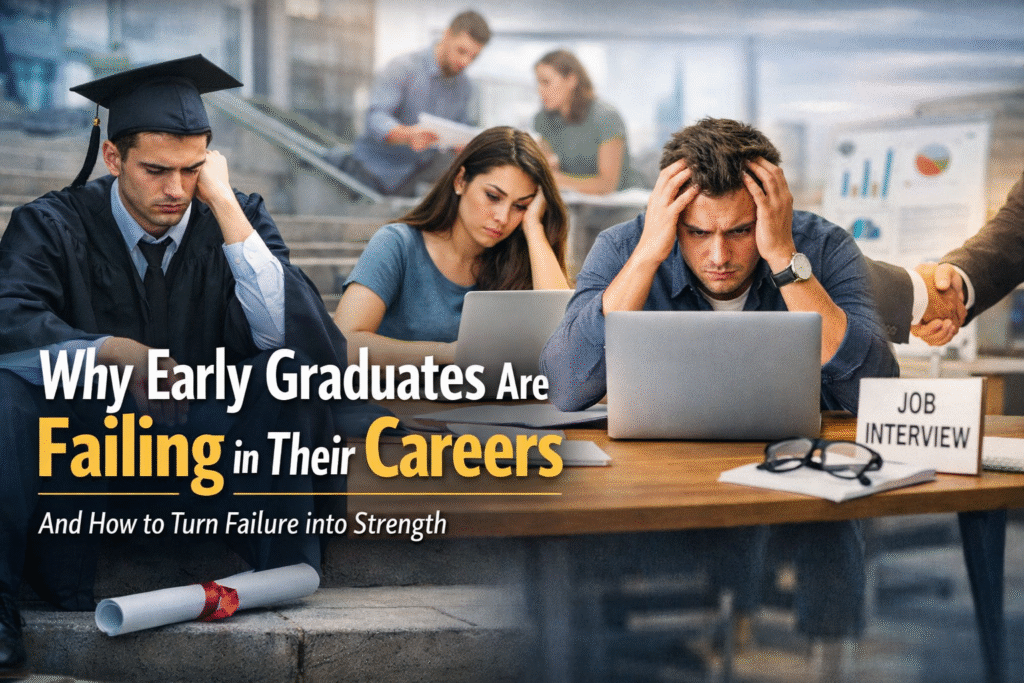
For decades, society sold a simple formula to young people: get a degree, secure a job, and success will follow. Yet today, thousands of graduates’ step into the professional world only to feel lost, underprepared, and stuck. Early career failure has become increasingly common—not because graduates lack intelligence or ambition, but because the world they enter is vastly different from the one, universities prepare them for.
Understanding why early graduates struggle is the first step toward transforming those struggles into long-term strengths.
The Myth That a Degree Is Enough
One of the biggest reasons early graduates fail is their overreliance on academic credentials. Universities focus heavily on theory, grades, and examinations, but the job market demands skills, adaptability, and execution. When graduates realize that their degree alone does not guarantee competence or job security, many feel disillusioned and unmotivated. This mismatch between expectation and reality often leads to early career stagnation. Graduates wait for opportunities instead of creating value, forgetting that employers hire for impact—not certificates.
Lack of Practical Exposure
Many graduates enter the workforce without ever experiencing real workplace dynamics. They may excel in exams yet struggle with deadlines, teamwork, pressure, and accountability. Internships, freelancing, and project-based learning are often ignored during university years, leaving graduates unprepared for the pace and demands of professional life.
As a result, they feel overwhelmed, make repeated mistakes, or lose confidence—sometimes being labeled as “incompetent” despite strong academic backgrounds.
Poor Communication and Emotional Intelligence
Career growth depends heavily on how well one communicates, collaborates, and handles feedback. Early graduates often fail not because they lack knowledge, but because they struggle to express ideas clearly, receive criticism constructively, or navigate workplace relationships. Low emotional intelligence can lead to misunderstandings, workplace conflicts, and missed opportunities. In professional environments, how you say something often matters as much as what you say.
Unrealistic Expectations and Impatience
Social media has distorted perceptions of success. Graduates see peers achieving rapid milestones and expect similar outcomes without understanding the unseen effort behind them. When promotions, recognition, or financial growth take longer than expected, frustration sets in. Instead of focusing on learning and consistency, many early graduates hop between jobs, quit too early, or lose faith in their abilities—mistaking slow progress for failure.
Resistance to Continuous Learning
The modern job market evolves faster than university curricula. Skills become outdated, tools change, and industries transform rapidly. Graduates who treat education as something that ended with graduation quickly fall behind. Those unwilling to re-skill, learn independently, or adapt to new technologies often become irrelevant—while peers who embrace lifelong learning continue to grow.
Turning Early Career Failures into Strengths: What Graduates Can Do?
Early career struggles are not permanent—they are feedback, not final judgments. Here’s how graduates can cope with failure and convert weaknesses into strengths:
1. Shift from Qualification Mindset to Skill Mindset
Stop asking, “What degree do I have?” and start asking, “What problems can I solve?” Focus on developing practical, market-relevant skills alongside your academic background.
2. Gain Real-World Experience—Even Small Ones
Internships, freelancing, volunteering, personal projects, or part-time work can dramatically improve confidence and competence. Experience matters more than perfection.
3. Invest in Communication and EQ
Learn to write professionally, speak confidently, listen actively, and handle criticism maturely. Emotional intelligence is a career multiplier—it accelerates growth in every field.
4. Be Patient and Play the Long Game
Success rarely happens overnight. Accept that the early years of your career are meant for learning, experimenting, and failing safely. Progress compounds over time.
5. Commit to Lifelong Learning
Stay curious. Learn new tools, follow industry trends, take online courses, and adapt continuously. In a fast-changing world, learning agility is more valuable than static knowledge.
Outcome
Early graduates are not failing because they are incapable—they are failing because they were underprepared for reality. With the right mindset, skills, and adaptability, early career failures can become the strongest foundation for long-term success. Failure, when understood correctly, is not the end of a career—it is often the beginning of a meaningful one.