
By the end of this reading, you will be able to:
- Identify which of the three founder archetypes you are — and why it matters
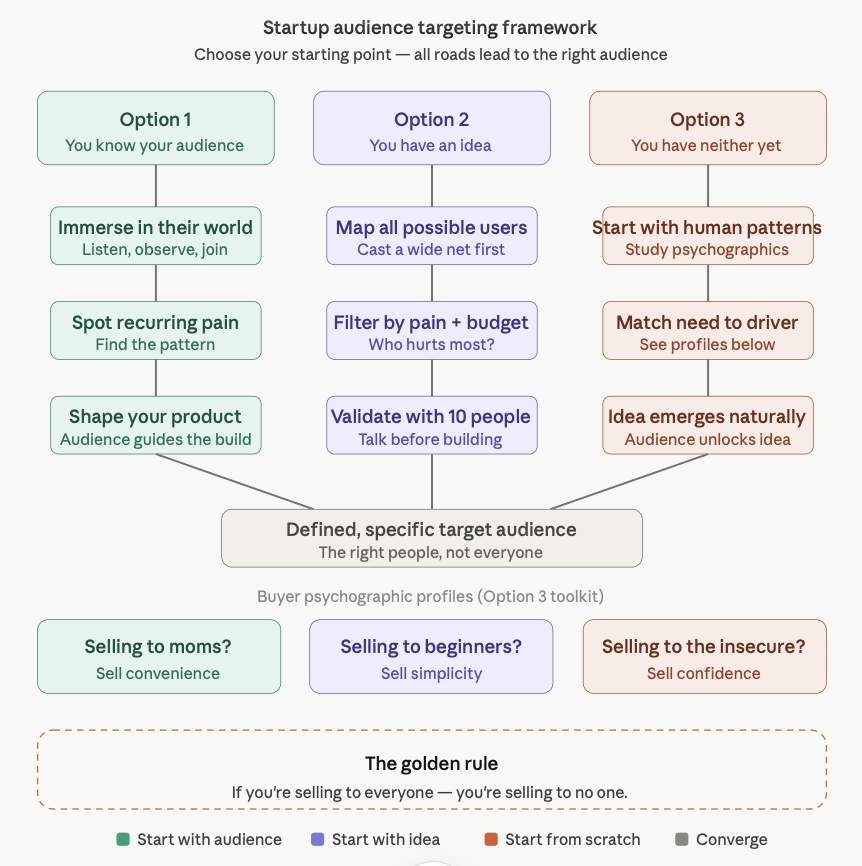
- Apply a structured targeting strategy whether you’re starting with a product, an idea, or neither
- Understand the psychological drivers behind what different audiences actually buy
- Walk away with one golden rule that will permanently change how you think about selling
Why Targeting Is the Make-or-Break Decision for Every Startup
In Part I of this series, we explored how to discover your startup’s core value and generate ideas worth building. Now comes the decision that determines whether those ideas reach the right people or disappear into the void: choosing your target audience.
Most founders think about targeting as a marketing problem. It is not. It is a strategic problem — one that shapes your product, your pricing, your messaging, your hiring, and ultimately your survival. Getting this wrong does not just cost you customers. It costs you months, sometimes years, of building the wrong thing for the wrong people.
The good news? There is a clear, structured way to approach this — and it starts by recognizing which type of founder you are.
Option 1: You Know Your Audience — Now Build for Them
Some founders enter the startup journey with a crystal-clear picture of who they want to serve. A former nurse who wants to build for healthcare workers. A parent who wants to create something specifically for homeschooling families. A gamer who wants to solve a problem every gamer faces.
If this is you, your audience is your anchor — and your strategy should flow from that anchor outward.
Your roadmap looks like this:
Start by immersing yourself in your audience’s world. What are their daily frustrations? What tools do they currently use and why do those tools fall short? Where do they spend time online? What language do they use when describing their problems? Your goal at this stage is not to pitch — it is to listen.
From that listening, patterns will emerge. Specific pain points will surface repeatedly. From those pain points, your product concept takes shape. You are not guessing what to build; your audience is telling you, directly and indirectly, exactly what they need.
The strategic advantage of this approach is alignment. Because you started with the audience, everything you build is already pointed in the right direction. Your product solves a real problem for real people you already understand. Validation is faster, messaging is more natural, and early adopters are easier to find because you already know where they live.
Option 2: You Have an Idea — Now Find Your People
The second type of founder has the opposite starting point. You have an idea — maybe a product concept, a technology, or a solution — but you are not yet sure who it is best suited for.
This is more common than most founders admit, and it is perfectly valid. The key is treating audience discovery as a structured research process, not a guessing game.
Your roadmap looks like this:
Begin by mapping every possible group of people who could plausibly benefit from your idea. Cast a wide net at first. Then, for each group, ask three filtering questions: Does this problem actually hurt them enough that they would pay to solve it? Do they have the budget and willingness to pay? And can you reach them efficiently?
This process will naturally narrow your list. Some audiences will be too small to build a sustainable business around. Others will be too competitive, with established players already solving the problem. Some will not have strong enough pain. What you are looking for is the segment where pain is high, competition is manageable, and your solution offers a genuine advantage.
Once you have identified your most promising audience, go validate immediately. Do not polish the product first. Talk to ten people from that audience this week. If the conversation reveals that you have found the right match — that your idea genuinely resonates and solves something they care about — you have your audience. If it does not, the earlier you discover that, the better.
Option 3: You Have Neither — And That Is Okay
Perhaps the most underserved group in the startup conversation is the aspiring founder who has not yet landed on a specific idea or a specific audience. They know they want to build something. They feel the entrepreneurial pull. But they are staring at a blank canvas and do not know where to begin.
If this is you, the path forward is not to force an idea out of thin air. It is to start with human patterns.
Across every market, in every industry, certain categories of buyers share deeply consistent motivations. These are not demographics — they are psychographics. And understanding them gives you a powerful shortcut to both your audience and your idea simultaneously.
Here are three of the most reliable:
Sell convenience to moms. Time is the single most scarce resource for mothers — working or otherwise. They are managing households, careers, school schedules, emotional labor, and countless invisible tasks simultaneously. Any product that genuinely removes friction from their daily lives, saves them time, or reduces the number of decisions they have to make in a day has a deeply receptive audience. If you can answer the question “how do I give a mom back 30 minutes a day?” — you already have a product worth building.
Sell simplicity to beginners. Every domain has beginners. Fitness beginners. Finance beginners. Cooking beginners. Design beginners. And beginners share one universal trait: they are overwhelmed. They do not need the most powerful solution — they need the clearest one. The startup that strips away complexity and says “here is exactly where to start” wins this audience every time. Simplicity is not a lack of features; it is a deliberate act of respect for where someone is in their journey.
Sell confidence to the insecure. This is perhaps the most psychologically potent of the three. Across beauty, fitness, fashion, finance, and dozens of other categories, there are buyers who are not just purchasing a product — they are purchasing a version of themselves they want to become. They want to feel capable, attractive, smart, or successful. The product is the vehicle. Confidence is the destination. If your offering can credibly deliver a transformation in how someone feels about themselves, you have tapped into one of the most powerful purchase motivations in consumer psychology.
These three patterns are not exhaustive, but they illustrate a crucial point: if you observe people carefully enough, the audience reveals itself. And once the audience is clear, the idea follows naturally.
The One Rule That Changes Everything
No matter which path brought you here — whether you started with an audience, an idea, or neither — there is one principle that must govern every targeting decision you make going forward:
If you are selling to everyone, you are selling to no one.
This is not a catchy slogan. It is a fundamental truth about how attention, trust, and buying decisions actually work. When a product tries to speak to everyone, it ends up resonating with no one deeply enough to compel action. The message becomes generic. The positioning becomes forgettable. The product becomes a commodity.
The startups that win — especially in the early stages — are the ones that make someone feel like the product was built specifically for them. That specificity is only possible when you have made a deliberate, sometimes uncomfortable choice to focus.
Narrow your audience until it feels almost too narrow. Serve that group so extraordinarily well that they become your loudest advocates. Let them expand your reach through word of mouth. Then, and only then, consider broadening your lens.
The counterintuitive truth of startup growth is this: the more precisely you define who you are building for, the faster you will grow.
Bringing It All Together
Targeting is not a task you complete once and move on from. It is an ongoing practice of listening, refining, and sharpening your understanding of the human beings your startup exists to serve. Whether you are entering with a defined audience, a promising idea, or simply the drive to build — the framework above gives you a clear path forward.
In Part III of this series, we will move into how to validate your audience assumptions before writing a single line of code or spending a single dollar on marketing. Because knowing your audience is the first step. Proving it is how you build with confidence.
Stay focused. Stay specific. And remember — the riches are in the niches.