
Series: The Startup Blueprint — Part 1
From Idea to Impact: How to Generate Value at the Start of Your Startup Journey
Every great company in history started the same way — not with a product, not with funding, and certainly not with a pitch deck. It started with a question: “Why does this problem still exist?”
If you are reading this as someone who wants to build a startup but feels overwhelmed about where to begin, you are in exactly the right place. This is the first post in a series designed to walk you through the startup journey from the ground up — practically, honestly, and without the fluff.
Let’s begin at the very foundation: what is the purpose of a business, and how does an idea actually come to life?
The Purpose of a Business Is to Create Value
Strip away the jargon, the investor decks, and the Silicon Valley mythology, and you are left with one simple truth: a business exists to create value. Not just for its founders, not just to generate revenue — but to create genuine, meaningful value for the people it serves and the people who believe in it.
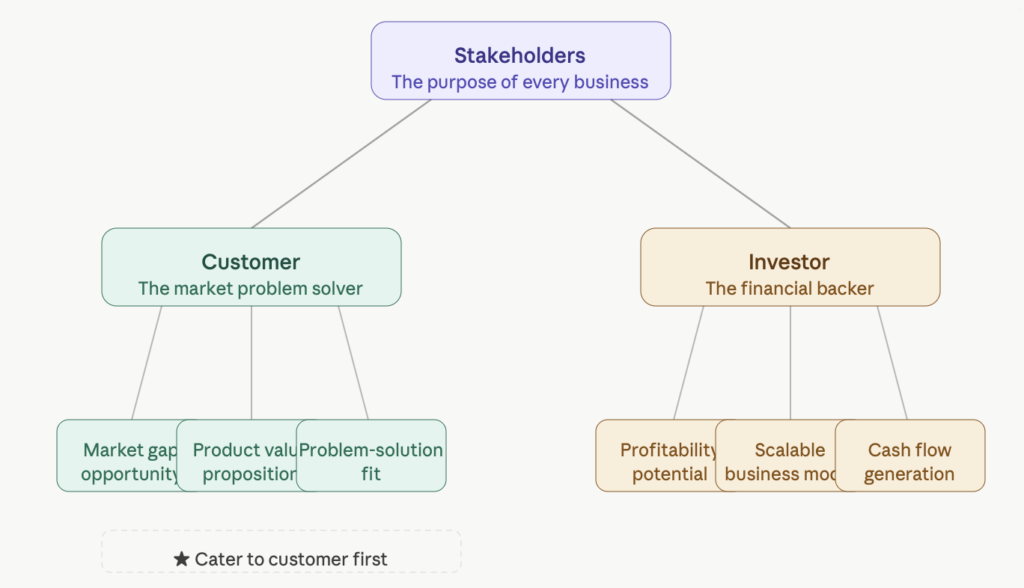
At the earliest stage of a startup, two stakeholders matter above all others: your customer and your investor. Everything you build, every decision you make, and every idea you pursue must eventually answer to these two groups. Understanding who they are and what they need is not just important — it is everything.
Where Ideas Come From: The Market Gap
An idea does not come from thin air. The best startup ideas are born from a very specific observation: there is a gap in the market where a real problem exists, a meaningful number of people are affected by it, and no one is solving it well enough.
This is what entrepreneurs call a market gap — the space between what customers need and what currently exists to serve them.
Finding a market gap requires you to become an obsessive observer. Talk to people. Listen to frustrations. Pay attention to the workarounds people create when proper solutions do not exist — those workarounds are almost always pointing directly at a gap. Look at industries that are outdated, underserved, or inefficient. Ask yourself: Where are people settling for “good enough” when they deserve something far better?
Once you have identified a gap, the next question becomes: Can it be filled with a profitable business activity? An idea is only viable when solving the problem is not just possible, but commercially sustainable. The problem has to be painful enough that people are willing to pay for the solution.
That is the seed of your startup idea — a real problem, a real gap, and a believable path to a real solution.
Two Stakeholders, Two Different Kinds of Value
Now here is where many first-time founders make a critical error — they treat their customer and their investor as the same audience. They are not. They care about completely different things, and your idea must speak to both, in the language each one understands.
Your customer wants one thing: a solution to their problem. They do not care about your company’s financial model or your growth projections. They care about whether your product makes their life easier, better, faster, or more meaningful. The value you offer them is your product itself — the experience, the outcome, the transformation it delivers. This is your customer value proposition: the promise you make about what your solution will do for them.
Your investor, on the other hand, is not buying your product. They are buying the potential of your business. They want to know that your startup can grow, scale, and generate returns. The value you offer them is financial — the profitability of your business model and the startup’s ability to generate sustainable cash flows over time. We will go deep into the financial mechanics of what makes a startup attractive to investors — including the concept of free cash flows — in the upcoming posts of this series.
Which Stakeholder Comes First?
This is one of the most important questions in the early life of any startup, and the answer is clear: start with your customer.
An investor will only believe in your business if customers already do. Traction, engagement, and real-world validation are the most powerful things you can bring to an investor conversation. If people are using your product, talking about it, and paying for it — that is the signal investors are waiting for.
Build value for your customer first. Solve their problem so well that they cannot imagine going back to the old way. When you do that, investor value follows naturally.
How to Begin
Start small, start honest, and start with the problem — not the product. Here is a simple framework to get moving:
Identify the pain. Find a problem you genuinely understand, ideally one you or people around you experience firsthand.
Validate the gap. Research the existing solutions. If none exist, ask why. If poor ones exist, understand what they are missing.
Define your solution. Sketch the simplest version of a solution that would make a meaningful difference. This does not need to be perfect — it needs to be real.
Test before you build. Talk to potential customers before writing a single line of code or spending a single dollar. Their feedback will shape everything.
Build with value in mind. Every feature, every decision should trace back to one question: Does this create value for my customer?
The Road Ahead
Starting a startup is not about having a perfect idea on day one. It is about having the courage to look at a broken or missing piece of the world and say: I think I can fix this. Your idea is the starting point — the market gap you have chosen to close, the customer you have decided to serve, and the value you are committed to creating.
In the next post of this series, we will go deeper into how to validate your idea, understand your target market, and begin shaping your business model.
The journey starts here. And it starts with value.