
By the end of this blog, you will be able to
- distinguish market research from marketing and understand why one must come before the other;
- identify the critical questions every founder must answer before building anything;
- understand why validating the problem — not the solution — is the habit that separates founders who scale from those who burn out;
- build a clear customer persona regardless of where you are starting from;
- size your market opportunity using TAM, SAM, and SOM; assess your idea honestly using a SWOT analysis and competitor research;
- Use Porter’s Five Forces and the Blue Ocean Strategy to decide which market is actually worth entering.
Why Market Research Is Not Optional
Most founders treat market research as a formality — something you do to fill slides in a pitch deck. That is a costly mistake. Market research is not about gathering data for investors. It is about giving yourself permission to keep going. Before you spend a single rupee on development, design, or distribution, market research answers the most important question in entrepreneurship: Is this worth building at all?
The startups that skip this step do not fail because their product was bad. They fail because they built the wrong product for the wrong people at the wrong time — and market research would have told them so. Think of it as a filter. The stronger your filter, the less you waste.
Marketing vs. Market Research: Getting the Sequence Right
Before we go any further, we need to clear up a confusion that derails more founders than almost anything else.
Market research happens before the product exists. It is the structured process of gathering, analysing, and interpreting information about your potential customers, the problem landscape, and the competitive environment. It informs what you build, who you build it for, and whether you should build it at all.
Marketing, on the other hand, happens after the product exists. It is how you communicate, position, and promote something that is already built to people you already understand.
Confusing the two is one of the most common founder errors. Many entrepreneurs jump straight to marketing — building landing pages, running ads, posting on social media — before they have done even basic research. The result is noise without signal. They are promoting a solution to a problem they have not yet confirmed exists, to a customer they have not yet clearly defined. Research comes first. Marketing follows. That sequence is not a suggestion. It is the difference between building something the market pulls toward itself and pushing a product uphill forever.
The questions every founder must answer before launching:
- Who exactly has this problem, and how often do they face it?
- How are they solving it today, and how satisfied are they with that solution?
- What is the size of this market, and is it growing or shrinking?
- Who are the existing players, and what would make someone switch to you?
- What are customers actually willing to pay for a better solution?
- What external forces — regulatory, economic, or technological — could affect this market?
If you cannot answer these with data and direct customer conversations, you are guessing. And guessing is expensive.
Validate the Problem First — Not the Solution
This is the most important principle in this entire blog, and it belongs here — at the beginning of your research process, not as an afterthought.
Most founders validate the solution. They build a prototype, show it to friends, collect enthusiastic feedback, and interpret that enthusiasm as confirmation. It is not. People are polite. People like new things. People will tell you your idea is great to avoid an awkward conversation.
Successful founders validate the problem first.
They ask: Is this problem real? How often does it occur? How much pain does it cause? What has the person already tried in order to solve it? How much would they pay to have it gone completely?
If the problem is real and painful enough, finding customers becomes dramatically easier. Real problems have real sufferers who are already searching for solutions. If you reach them with a credible answer, your customer acquisition cost drops because you are not convincing anyone they have a problem — you are simply showing up with the solution they were already looking for.
If the problem is not real — or too mild for anyone to prioritise — no amount of marketing spend will save you. You will be pouring money into manufacturing demand that was never there. Founders who fall into this trap do not run out of ideas. They run out of money.
Before you validate your solution, sit across from your potential customers and ask them to walk you through the last time they experienced this problem. Listen to the language they use, the frustration in their voice, and the workarounds they have already built. That one conversation will tell you more than any survey ever could.
Determining Your Customer Persona
Once you are convinced the problem is real, the next question is: who has it most acutely?
In our previous blog, we discussed three starting positions every founder can find themselves in: you have the idea but do not know who your customer is; you know your audience deeply and want to build something for them; or you have neither a clear idea nor a defined audience yet.
Your approach to building a customer persona depends on where you are starting from.
If you have an idea but no defined audience: Start broad, then narrow. List every type of person who could theoretically experience this problem. Then ask — who suffers from it the most? Who has the most urgency to solve it? Who has the resources to pay for a solution? That intersection is your early adopter, and your persona starts there.
If you know your audience: You are in the strongest position. Spend time with them. Observe their behaviour. Ask what frustrates them, what tools they currently use, and what workarounds they have built. The persona emerges from observation, not assumption.
If you have neither: Pick a problem domain that genuinely interests you — one you understand from lived experience or professional exposure. Curiosity and familiarity will carry you through the hard stretches. From there, follow the same steps as the first path.
Building the persona — the steps:
- Define demographics — age, location, profession, income range, and education level of your target customer.
- Define psychographics — values, motivations, daily frustrations, aspirations, and decision-making triggers.
- Map their journey — what does a typical day look like? Where does this problem appear in that day, and how much does it disrupt things?
- Identify their current alternatives — what are they doing right now to manage this problem? This tells you who you are truly competing with.
- Validate with real conversations — speak to at least fifteen to twenty people who match your persona. Ask open-ended questions. Listen far more than you talk.
A persona is not a one-time exercise. It evolves as you learn. But you need a starting version to give your research a direction.
How Big Is the Opportunity? — TAM, SAM, and SOM
You now know the problem is real and have a clear picture of who experiences it. The next honest question is: is this opportunity large enough to build a business on?
This is where three terms — TAM, SAM, and SOM — become indispensable, not just for investors, but for your own clarity as a founder.
TAM — Total Addressable Market is the total global revenue opportunity if every potential customer of your solution bought from you. This is the ceiling — a useful number for context and ambition, but not where you actually operate.
SAM — Serviceable Available Market is the portion of TAM you can realistically reach given your business model, geography, language, and product scope. If your product is only available in Pakistan right now, your SAM is not the global market for your category. Be honest here.
SOM — Serviceable Obtainable Market is the slice of your SAM you can realistically capture in the next two to three years, given your current resources, team, and go-to-market approach. This is the number that matters most at the early stage.
These three numbers do two things simultaneously: they reveal whether there is enough opportunity to build a meaningful business, and they force you to think concretely about who your first customers actually are — not in theory, but in practice. A startup chasing a SOM that is too small will struggle to survive. One that inflates its TAM to chase funding without a credible path to SAM will eventually face a reckoning.
Size the market honestly. It will shape every decision that follows.
Stress-Testing the Idea — SWOT Analysis and Competitor Research
You know the problem is real. You know who has it. You know the market is large enough. Now it is time to stress-test the idea itself — honestly and rigorously.
SWOT Analysis is a framework for doing exactly that, and you do not need a business degree to use it. You need honesty.
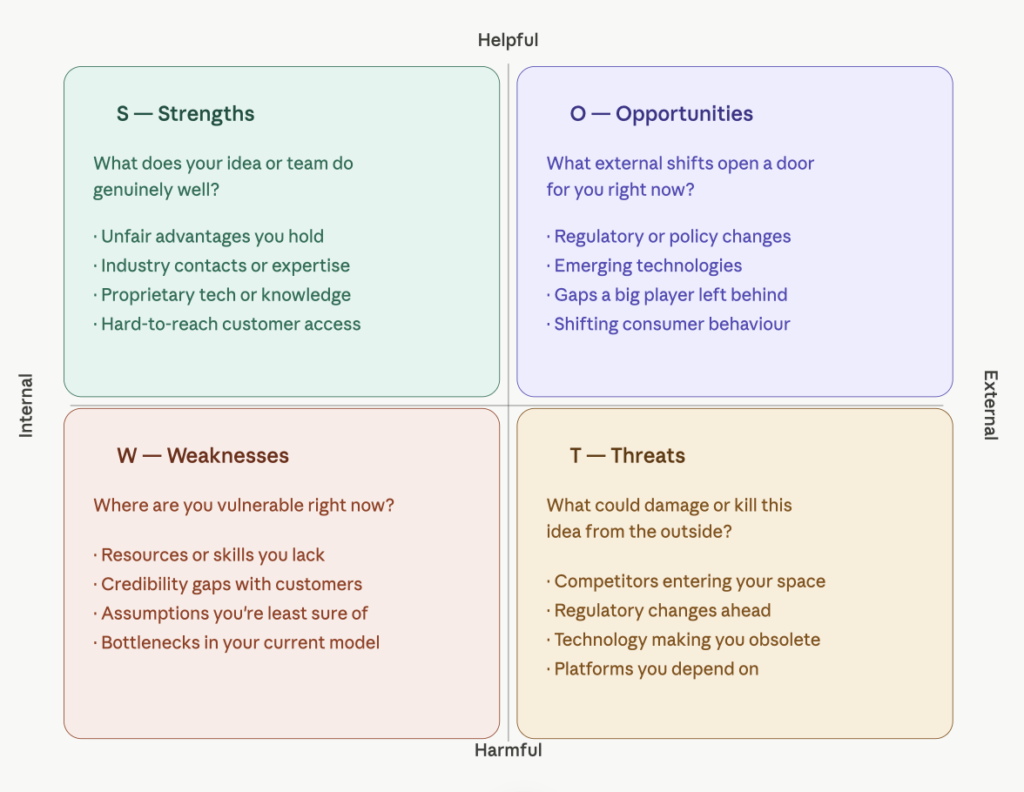
Competitor analysis lives inside your SWOT — specifically within Threats and Opportunities — but it deserves deliberate attention. For every competitor in your space, identify their target customer, their pricing model, their core strengths, and critically, their most common complaints. App Store reviews, Reddit threads, and Trustpilot pages are goldmines for this. Real users complaining about a product you plan to compete with are handing you your positioning on a silver plate.
Your goal with competitor research is not to copy what is working or to dismiss anyone out of hand. It is to understand exactly where the gap is — the underserved customer, the missing feature, the clumsy experience — that you can genuinely fill better than anyone currently does.
Choosing Your Battlefield — Porter’s Five Forces and the Blue Ocean Strategy
You have stress-tested your idea. Now the final question before you commit: Is this the right market to enter, and where exactly within it do you have the best chance?
Two frameworks help you answer this with discipline rather than gut feel.
Porter’s Five Forces assesses the structural attractiveness of the industry you are entering by examining five competitive pressures:
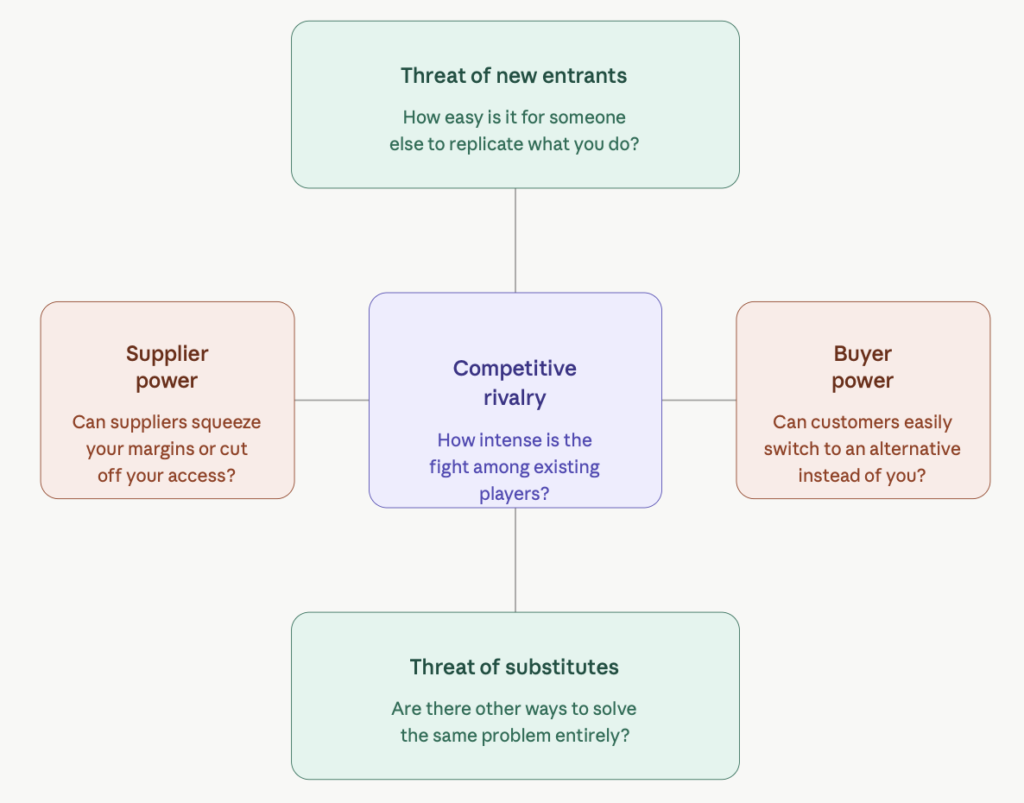
If most of these forces are working against you, it does not necessarily mean you abandon the idea. It means you reconsider your entry point, your positioning, or your target segment until you find one where the forces are more favourable.
The Blue Ocean Strategy offers a complementary perspective. It argues that most businesses compete in “red oceans” — known markets where players fight over the same customers, drive prices down, and erode margins in the process. The alternative is to find or create a “blue ocean” — an uncontested market space where the competitive rules have not yet been written.
For a startup founder, this translates into a deceptively simple set of questions: What if I served a customer nobody is currently designing for? What if I removed features the industry assumes are necessary and added something entirely new? What if I competed on a dimension the incumbents have never considered?
The blue ocean is not always obvious, and it is not always available. But the research you have done by this point — understanding the problem deeply, knowing your customer intimately, mapping your competitors honestly — is precisely what gives you the vision to see it when it exists.
Closing Thought
Market research is not a box you tick before getting to the “real work.” It is the real work. Everything that comes after — your product decisions, your pricing, your marketing, your fundraising — is only as strong as the foundation your research builds.
The founders who do this well do not just launch smarter. They waste less, iterate faster, and build products that the market moves toward rather than away from.
In the next blog, we move from understanding the market to designing a business around it — how to take everything you now know and shape it into a lean, testable business model.
Until then: research relentlessly, assume nothing, and let reality be your co-founder.