
By the end of this blog, you will be able to:
- Understand why a failed idea is not a reflection of your potential as an entrepreneur
- Identify the most common reasons startup ideas fail initial validation
- Diagnose the root cause that led to your specific idea’s failure
- Make a confident, informed decision between improving your idea or pivoting entirely
- Explore five powerful pivot strategies that have helped founders build successful businesses from scratch
Section 1: Failure Is Not the End — It’s the Beginning of Clarity
Here is something no one tells you when you are sitting across the table from your idea, heart full of excitement and a notebook full of plans: failing to validate your startup idea is one of the most valuable things that can happen to you.
One of the biggest misconceptions among first-time entrepreneurs is believing that a failed idea means they are not meant to build a business. They internalize the rejection. They walk away from the drawing board entirely, convinced that the market just “didn’t get it.” But that belief is not just wrong — it is the very thing that separates people who eventually build something great from those who never try again.
Here is the truth: idea testing exists to reveal weaknesses before they become expensive mistakes. Market validation is not a verdict on your potential. It is a diagnostic tool. It is the startup world’s equivalent of a stress test — designed to find the cracks before the building goes up, not after. Every piece of negative feedback, every “no,” every unanswered survey is data pointing you toward a better direction.
The fear of failure is understandable. But failure at the idea stage costs you time and energy — not years of your life, not hundreds of thousands of dollars, and certainly not your identity as a builder.
What separates successful entrepreneurs from the rest is not that they had perfect ideas from the start. It is that they stayed committed to solving a problem — not committed to one specific solution. They understood that the problem they identified was real and worth solving. The solution, however, was just a hypothesis. And when that hypothesis failed, they simply formed a new one.
This is why the most successful founders validate the problem first, long before they fall in love with a solution. They ask: Is this problem real? Does it hurt enough for someone to pay to make it go away? Only once they have confirmed that the answer is yes do they move toward building anything at all.
So if your idea did not pass validation, take a breath. You are not starting over. You are starting smarter.
Section 2: Why Most Startup Ideas Don’t Pass Initial Validation
Understanding why ideas fail is not about assigning blame. It is about developing the clarity to move forward. Most startup ideas that fail initial validation do so for one or more of the following reasons:
There isn’t enough demand. The idea sounds interesting, but not enough people are actively looking for a solution. A problem that affects a small number of people in a passive, low-priority way is rarely a foundation for a scalable business.
The problem isn’t that important to customers. Customers might acknowledge the problem exists, but they are not urgently motivated to solve it. If people are not currently spending time, money, or emotional energy on this issue, they are unlikely to pay for your fix either.
The solution isn’t unique. In a crowded market, a solution that looks and feels like everything already out there will struggle to gain traction. If customers cannot immediately see what makes your offering different or better, they will default to what they already know.
Wrong target audience. Sometimes the idea itself is sound, but it is being pitched to the wrong people. Reaching the wrong audience means your validation data is essentially meaningless — you are measuring the wrong reaction from the wrong crowd. (If you want to go deeper on how to find and define your ideal target audience, check out our separate blog dedicated entirely to that topic.)
Weak value proposition. A value proposition that is vague, generic, or unclear will lose customers before they even give the product a chance. If you cannot articulate in one sentence what you do, who it is for, and why it matters — neither can your customer.
Pricing issues. Your idea might be sound and your audience right, but your pricing model could be the silent deal-breaker. Whether you are charging too much, too little, or simply structuring pricing in a way that creates friction, it can sink an otherwise promising concept. Pricing strategy is a rich topic of its own, and we will be covering it in depth in a dedicated upcoming blog.
Section 3: What to Do After Failed Validation
Accept the Feedback Without Becoming the Failure
The first and most important step is also the hardest: separate yourself from your idea. Your idea failing is not you failing. Emotional attachment to a first idea is one of the most common traps entrepreneurs fall into, and it keeps them stuck in a cycle of defending a concept instead of improving it.
Read the feedback again — not to argue with it in your head, but to listen to it. What were people actually saying? What did they hesitate on? What did they not understand? Feedback from validation is a gift, even when it stings.
Once you have emotionally stepped back, go back to the root causes listed in Section 2 and identify the one — or the combination — that applies specifically to your case. Was the demand genuinely not there? Were you targeting the wrong people? Did your messaging fail to communicate value? Pinpointing the exact failure point is what separates a productive next move from aimless iteration.
The Decision: Improve or Pivot?
Once you have diagnosed the root cause, you face one of the most important decisions in your entrepreneurial journey: do you refine the existing idea, or do you pivot?
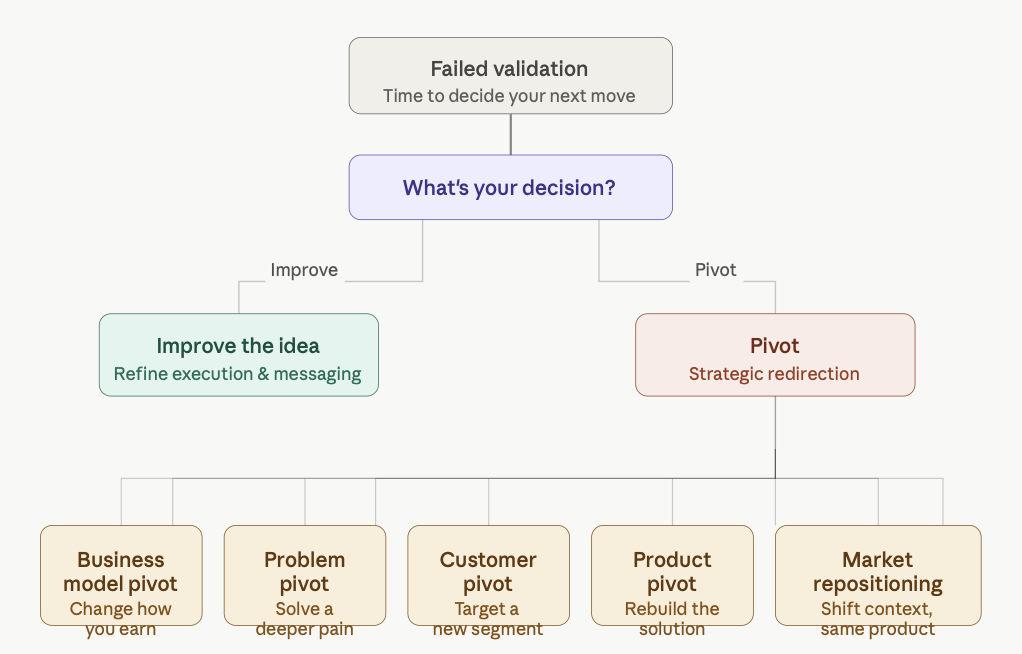
Improving the idea makes sense when the core problem is real and validated, but the execution — your target audience, messaging, pricing, or feature set — missed the mark. If feedback suggests you were close, go back and adjust.
Pivoting makes sense when the root cause points to a deeper structural issue — when the problem itself did not resonate, the market is too small, or there is simply no clear path to differentiation. A pivot is not a retreat. It is a strategic redirection using everything you have already learned.
There are several powerful ways to pivot:
Business Model Pivot — The problem and the product might be right, but the way you are making money from it is broken. Shifting from a one-time purchase to a subscription model, or from B2C to B2B, can completely transform the viability of an idea.
Problem Pivot — Sometimes, while trying to solve one problem, you discover a more pressing, more urgent problem hiding underneath it. A problem pivot means letting go of the original problem and channeling your solution-building energy toward the one that actually hurts more.
Customer Pivot — Your product might be genuinely useful — just not to the people you originally targeted. A customer pivot means identifying a different segment that values what you built far more than your original audience did.
Product Pivot — You keep the customer and the problem, but you rebuild the solution. This happens when the market tells you that your approach to solving the problem is off, even though the problem itself is validated.
Market Repositioning — Your product stays the same, your customers stay the same, but you shift the context in which you present it. A feature meant for small businesses might have stronger traction when repositioned for enterprise clients, or vice versa.
No successful startup story is a straight line. Behind every company you admire is a founder who heard “no,” regrouped, and came back with something better. The question is never whether you will face failure — it is what you decide to do the moment after.
You now have the map. The next move is yours.