
By the end of this blog, you will be able to:
- Understand why leadership shapes a startup’s survival, not just its culture
- Recognize the four core responsibilities every founder carries
- Gauge your own leadership strengths using seven core traits
- Apply four practical decision-making frameworks used by real founders
- Move forward with a clearer, more confident approach to leading your team

Introduction
People often say that great leaders are born. However, research suggests otherwise. While some people may naturally possess certain leadership qualities, the skills that make someone an effective leader can be learned, practiced, and refined.
This mythical claim wasn’t seriously challenged until a twin study conducted jointly by the Department of Psychology at the University of Western Ontario, Canada, and the University of California, US (Johnson et al). Interestingly, the study provided preliminary empirical data showing that leaders are also built through environmental factors. These are exactly the factors we aim to build in you through this blog.
So, unlike the usual leadership blogs flooding the internet, this one won’t just list traits and definitions. Instead, it goes further. It shows you how those traits translate into real decisions, in real startup situations.
After all, knowing that “resilience” is a good trait doesn’t help you much at 11 PM when your co-founder wants to quit. What actually helps is knowing what to say, what to do, and how to think in that exact moment. That’s the gap this blog tries to close.
Moreover, this blog assumes you might not have an MBA. That’s fine. Most successful founders didn’t start with formal training either. What you need instead is a clear, practical roadmap, one that works whether your background is technical, creative, or something else entirely.
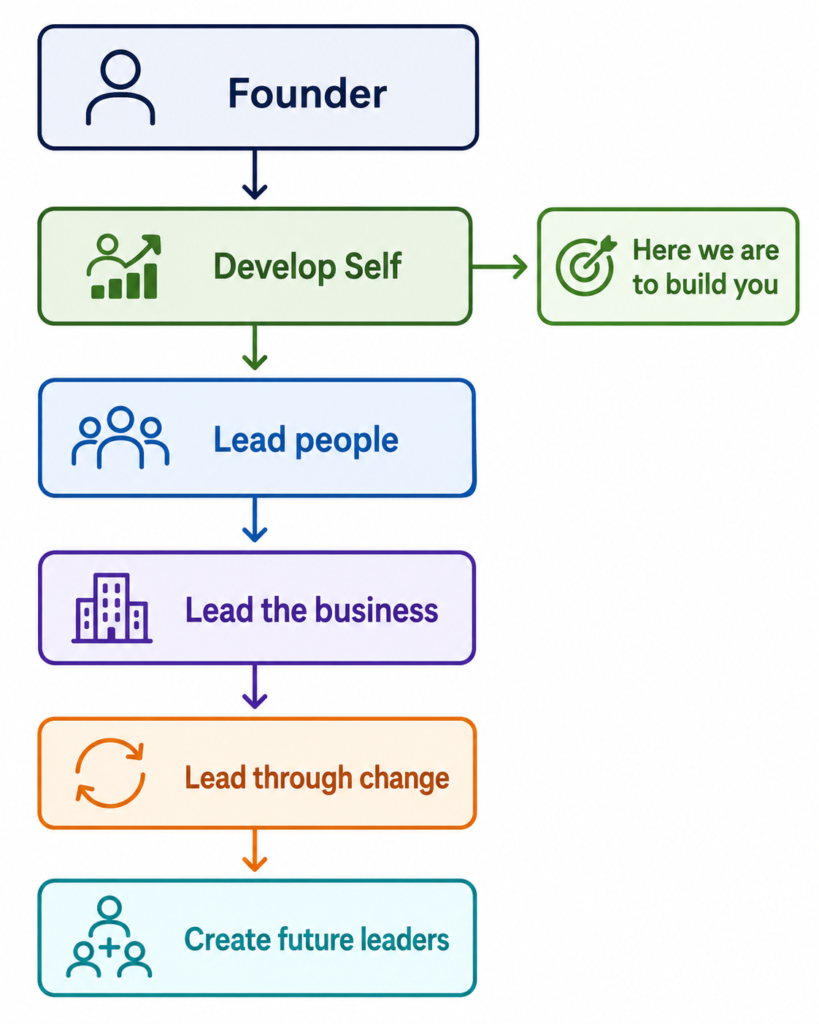
Here’s how we’ll walk through this journey together:
Why Does Leadership Matter More Than Ever in a Startup?
Startups don’t fail because of bad ideas alone. Often, they fail because of leadership gaps.
The Four Responsibilities Every Founder Carries
As a founder, you’re responsible for four major things. First, uncertainty. You rarely have complete information, yet you still need to move forward. Second, limited resources. You have less money, less time, and fewer people than established companies. Third, rapid decisions. Startups move fast, so you don’t get the luxury of long deliberation. Finally, motivating teams. Your team looks to you for energy, especially when things get hard.
Each of these responsibilities alone is demanding. Together, they create constant pressure, and that pressure doesn’t disappear once you raise funding or hit your first milestone. It simply changes shape.
When Validation Tests Team Morale
Speaking of hard moments, validation is often one of them. Sometimes, the process of testing your idea can demotivate your team (validation process). Feedback might be harsh. Progress might feel slow. Morale can dip quickly during this phase.
This is exactly where leadership matters most. Only a good leader can walk their team through this difficult stretch successfully.
Think about it this way: your product can be rebuilt. Your pricing can be adjusted. Your marketing can be redone. However, a demoralized team is much harder to rebuild once trust and energy are gone. That’s why leadership, not strategy alone, often becomes the real deciding factor.
Your Startup Grows as Much as You Do
Remember, failure isn’t the end. It’s actually the starting point. Everyone knows this in theory. Yet, only a true leader can walk that thorny path in practice, especially when the team is watching.
Ultimately, your startup grows only as much as you grow as a founder. This single idea sets the tone for everything else in this blog.
What Makes a Great Startup Leader?
Before diving into frameworks, let’s gauge where you currently stand. Below are seven traits that shape effective startup leadership. Keep in mind, this is just one lens. There’s much more ahead in this blog.
Vision
A great leader can inspire people toward a future that doesn’t exist yet. Without vision, your team simply follows tasks instead of believing in a purpose. Consequently, motivation fades the moment things get difficult.
Integrity
Leaders with integrity keep their promises. As a result, they build trust quickly, and that trust becomes the foundation for everything else your team does for you. Without it, even the smartest strategy eventually falls apart.
Emotional Intelligence
This trait involves four specific components:
- Self-awareness
- Empathy
- Self-regulation
- Relationship management
Together, these skills help you understand yourself and your team on a much deeper level. Consequently, you respond to conflict and pressure with clarity, rather than reacting on impulse.
Resilience
Startups fail constantly, in small and big ways. However, great leaders recover quickly. They treat setbacks as information, not identity, which allows them to move forward instead of getting stuck.
Adaptability
Markets change. Customers change. Technology changes just as fast. Therefore, a great leader knows how to keep adjusting instead of clinging to outdated plans. Otherwise, even a great original idea can quietly become irrelevant.
Accountability
Great leaders own their mistakes publicly. In turn, this builds respect within the team, since no one expects perfection, but everyone values honesty. Blame-shifting, on the other hand, quietly erodes trust over time.
Learning Agility
Finally, great leaders learn faster than their competitors. They absorb new information quickly, apply it immediately, and adjust their approach without ego getting in the way. In a fast-moving startup environment, this trait often separates founders who scale from founders who stall.
Interestingly, learning agility isn’t about knowing everything upfront. Instead, it’s about closing knowledge gaps faster than the market changes around you. Founders who read, ask questions, and seek feedback consistently tend to outpace founders who rely purely on past experience.
How Should Startup Founders Make Decisions?
Now that we’ve covered the traits, let’s move into practicality. This is where those traits actually get applied. After all, a trait means little unless it shows up in the way you actually decide things. Below are four decision-making frameworks that turn leadership qualities into real action.
The OODA Loop
This framework stands for Observe, Orient, Decide, Act. First, you observe the situation around you. Then, you orient yourself by interpreting what that information means. After that, you decide on the best course of action. Finally, you act, and then repeat the loop as new information comes in.
This cycle works particularly well in fast-changing startup environments, where conditions shift constantly. Originally developed for military pilots making split-second decisions, it translates surprisingly well into startup life, where speed and adaptability matter just as much.
First Principles Thinking
This is famously Elon Musk’s go-to framework. Essentially, it involves three steps: break down the problem into its most basic parts, question every assumption you’ve been holding, and then rebuild your solution from scratch.
Rather than copying existing solutions, this approach forces you to solve problems from the ground up. As a result, it often leads to more original, cost-effective solutions than simply following industry convention.
Jeff Bezos’s Reversible vs. Irreversible Decision Framework
According to this framework, if a decision is irreversible, act slowly. Take your time, gather more input, and think it through carefully. On the other hand, if a decision is reversible, act fast. Speed matters more than perfection here, since you can always correct course later.
This simple distinction alone can save founders from wasting time on low-stakes decisions. Consequently, you free up your energy for the decisions that truly deserve careful thought.
Data Plus Judgement
Finally, never rely on data alone. Similarly, never rely on intuition alone. Instead, combine both. Data gives you evidence, while judgement gives you context. Together, they lead to sharper, more balanced decisions than either one provides on its own.
In practice, this means checking your numbers, but also trusting the experience you’ve built along the way. Neither replaces the other; instead, they work best side by side.
Leadership Theories
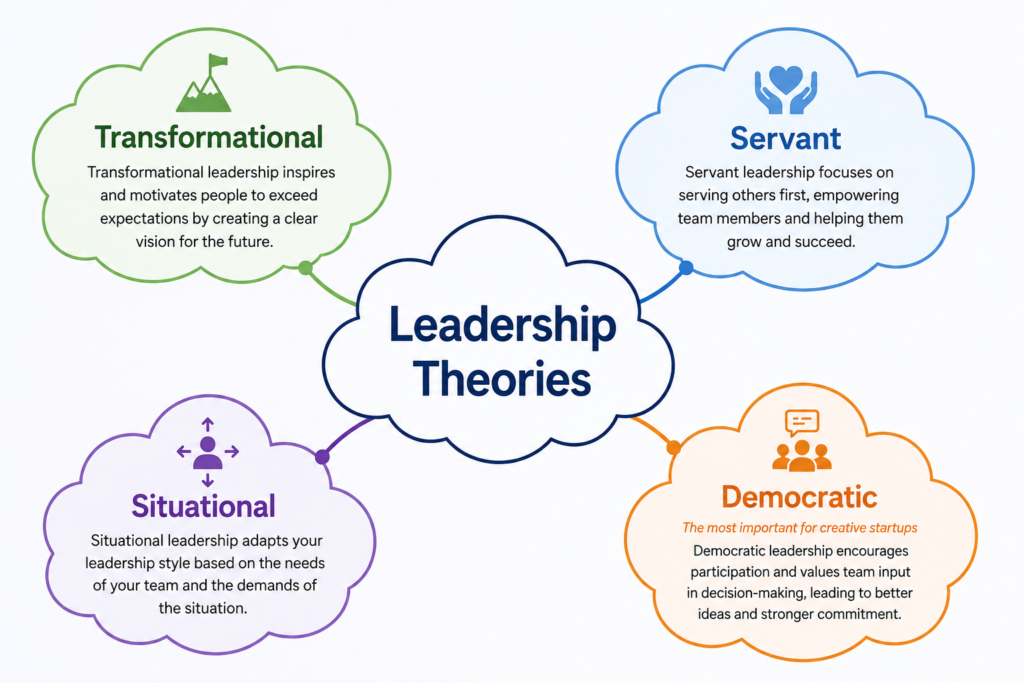
Leadership theories provide practical frameworks that explain how effective leaders inspire people, make decisions, and guide organizations toward success. Rather than relying solely on instinct or personality, these theories help startup founders understand different leadership approaches and when to apply them.
Since startups operate in constantly changing environments, no single leadership style works in every situation. By understanding these theories, founders can adapt their leadership to motivate teams, encourage innovation, navigate uncertainty, and build a healthy organizational culture as their business grows. Below are a few of the most important ones to guide your way towards a great leadership approach:
Final Thoughts
Leadership isn’t a fixed trait you either have or don’t. Instead, it’s a skill you build, one decision at a time.
Start by understanding your responsibilities as a founder. Then, gauge your strengths honestly across the seven traits we covered. Finally, apply the four frameworks whenever you face a tough call.
None of this requires an MBA. It simply requires consistency, self-awareness, and a willingness to keep improving, even when things feel uncertain.
Do this consistently, and you won’t just lead a team. You’ll lead a business that’s ready to scale, no matter how uncertain the road ahead looks.