
Before Breakfast
You wake up. You reach for your phone.
Already, algorithms have been busy.
They selected your notifications, your inbox, and the predicted traffic on your route to work.
Meanwhile, your wearable measured your sleep. It flagged anything unusual. Maybe it even nudged you toward a playlist that fits your mood.
You haven’t eaten breakfast yet. Still, technology has already made dozens of small decisions for you.
This is the revolution we can see. It’s loud. It’s visible. It shows up in headlines every day.
But there’s another revolution happening. It’s quieter. It’s moving inside you, not around you. And most of us haven’t noticed it yet.
The Infotech Revolution, in Plain Terms
Let’s start with the one we know.
Information technology used to mean storage. Computers held data. That’s it.
Then, gradually, computers started processing that data. They began finding patterns. Eventually, they started generating entirely new outputs.
That shift matters enormously. Consequently, it changed what “computing” even means.
AI is the clearest expression of this shift. It’s not the whole story, though. It’s simply the most visible chapter.
Today, AI touches almost everything.
- In medicine, it helps flag tumors.
- Can detect frauds in finance.
- Also predicts delays in transportation.
- In education, it personalizes lessons.
- Predicts target audience in marketing.
- And writes code alongside programmers in software development.
Notice something, though. None of this happened overnight. Rather, it built up gradually, layer by layer, until it became impossible to ignore.
When Machines Started Thinking, Not Just Doing
For decades, automation meant physical labor. Robots welded car parts. Machines packed boxes. Assembly lines replaced human hands.
That’s changing now, however.
Modern AI increasingly performs cognitive tasks. It recognizes patterns, analyzes language, and even generates something resembling creativity.
Here’s the catch, though: outperforming humans at a specific task doesn’t mean general superiority. A calculator beats humans at arithmetic. That doesn’t make it wiser.
So, before we get carried away, let’s be precise. AI is narrow. It’s powerful within specific domains. It isn’t a replacement for the full range of human judgment—at least not yet.
Still, its territory keeps expanding. And that expansion deserves attention.
Meanwhile, a Second Revolution Is Unfolding
While infotech reshapes the world outside us, something else is reshaping our understanding of what’s inside us.
Call it the biotech revolution.
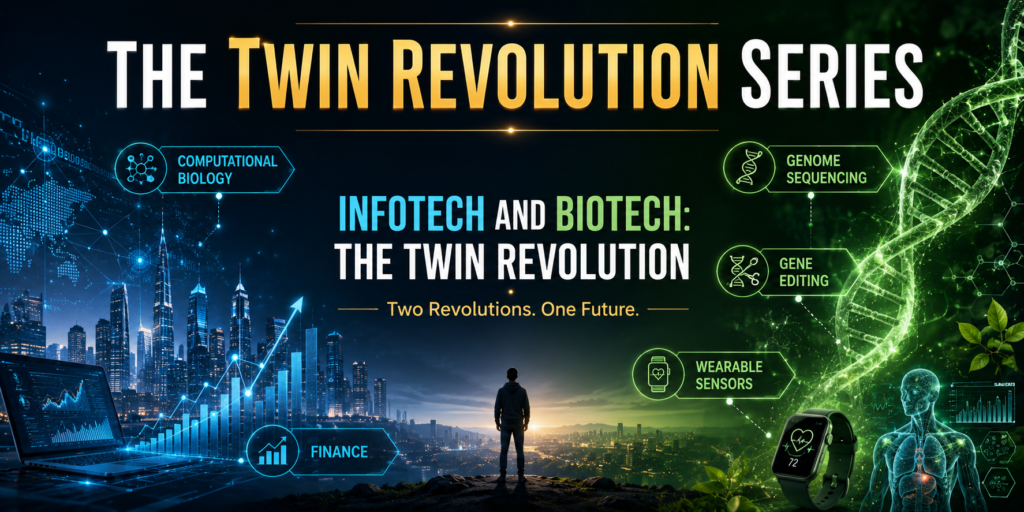
- Consider genome sequencing. Scientists can now read genetic code faster and cheaper than ever before.
- Consider gene editing. Tools like CRISPR let researchers modify biological material with striking precision.
- Consider neuroscience. Researchers can observe neural activity in ways that were unimaginable a generation ago.
- Consider wearable sensors. They now track heart rhythms, oxygen levels, glucose, and sleep patterns continuously.
- Consider precision medicine. Treatments increasingly target the individual, not just the average patient.
- Consider computational biology. Biological research today depends on massive datasets and complex models.
Individually, these developments sound like isolated scientific stories. Together, though, they point toward something bigger: the human body is becoming measurable in ways it never was before. (explore more)
Two Roads, One Destination
At first glance, these two revolutions appear almost entirely unrelated. On the one hand, infotech studies information; on the other, biotech studies life. One feels fundamentally digital, while the other seems inherently biological.
However, when we look beneath these surface-level differences, an important connection begins to emerge: both ultimately depend on the same raw material—patterns. Infotech identifies patterns hidden within vast amounts of data, whereas biotech seeks to uncover patterns embedded within biological systems.
In other words, despite operating in seemingly different worlds, both revolutions are driven by our growing ability to recognize, interpret, and act upon patterns. Consequently, this shared foundation matters enormously, because as these two pattern-driven revolutions continue to advance alongside one another, a natural—and increasingly important—question emerges: what happens when their paths finally begin to cross?
The Central Mystery
Here it is. As these two revolutions move closer together, an important question emerges: what happens when machines capable of processing enormous amounts of information begin gaining detailed knowledge about the humans using them?
In other words, what happens when AI starts learning about us? Not just our clicks and purchases, but our biology, behavioural patterns, and inner signals.
More importantly, this is not merely science fiction. As infotech gets better at processing patterns and biotech gets better at revealing them within us, these two roads may gradually begin heading toward the same destination.
The Territory We Assumed Was Ours Alone
For most of history, humans held onto one comforting assumption: our inner world belongs to us. Machines could calculate. They could execute. But they couldn’t touch what happens inside a human mind or body.
That assumption is starting to look fragile.
Because the next phase of this revolution may not begin when AI understands the external world better. Instead, it may begin the moment AI starts identifying patterns in something far more intimate. Its our sleep, stress, decisions, and biology. All are easily predicted by these algorithms.
And if that’s true, then the questions ahead aren’t really about machines anymore. They’re about ourselves.
Next in the series: What If Human Intuition Is Not as Mysterious as We Thought?