
By the end of this blog, you will be able to:
- Understand what scaling really means, and why it starts after product-market fit
- Avoid the common myth that more money always means faster growth
- Ask the right questions before spending a single dollar
- Prioritize your budget based on immediate needs, not fixed departments
- Follow a simple four-priority spending framework
- Spot the mistakes that kill startups early
- Recognize the KPIs that tell you when you’re ready to scale
Introduction
Scaling technically happens after you’ve already found product-market fit. If you’re at this stage, congratulations. You’ve built something people want.
But raising funding isn’t the finish line. It’s the beginning.
Whether your startup runs on personal savings or investor money, the real challenge starts now. From this point onward, it’s about deciding where every rupee or dollar should go. Unfortunately, this is where many founders lose direction. After celebrating the funding milestone, they often freeze when it’s time to spend the money strategically. On the other hand, some founders move too quickly and spend without a clear plan. As a result, both hesitation and overspending can quietly damage a startup that was otherwise headed in the right direction.
Here’s the biggest misconception founders carry into this stage: more money equals faster growth. It doesn’t work that way. Startups with large war chests fail all the time. Startups with modest budgets scale successfully every day. The difference rarely comes down to how much money they had. It comes down to how they used it.
In reality, better allocation of money leads to sustainable growth. Founders who spend wisely outlast founders who simply spend more. This blog shows you exactly how to do that.
Think of this stage as a second founding moment. You already proved people want your product. Now you need to prove you can turn that demand into a business that lasts. The decisions you make in the next few months will shape your startup’s trajectory for years.
Four Questions to Ask Before You Spend
Before you allocate a single dollar, ask yourself these four questions. They’ll keep you focused on the four “Whats” that actually matter.
- Is the biggest problem stopping growth?
- Creates the highest return?
- Can wait?
- Creates long-term value?
Let’s break down what each question really means.
What is the biggest problem stopping growth? This question forces you to find your real bottleneck. Maybe it’s your product. Maybe it’s your sales process. Find it before you spend anywhere else.
What creates the highest return? Not every dollar creates equal value. This question pushes you to compare options and pick the one that moves your business forward the fastest.
What can wait? Startups have limited resources. This question helps you delay expenses that feel important but aren’t urgent right now.
What creates long-term value? Some spending pays off once. Other spending compounds over time. This question keeps your eyes on the bigger picture, not just this month’s results.
Ask these four questions before every major spending decision. They’ll save you from expensive mistakes.
Think in Terms of Priorities, Not Departments
Most new founders think in departments. They set aside 30% for marketing, 20% for operations, and so on.
This approach sounds organized. But it’s actually risky. Departments don’t tell you where the money should go right now. Priorities do.
Instead of asking “how much goes to marketing,” ask “what does my business need most today.” Maybe that means building something customers actually want. Maybe it means acquiring your next 100 customers. Maybe it means fixing a broken operational process.
Your priorities will shift as your startup grows. Your budget should shift with them. Rigid department-based budgets don’t allow for that flexibility, and rigidity is dangerous at this stage.
Where Should the Money Go First? A Simple Priority Scale
We’ve designed a simple scale to help new founders decide where money should go first. It has four priorities. Follow them in order.
Priority 1: Build the Product
Your product comes first. Always.
This means investing in technology, product development, and design. Your product is the reason customers came to you in the first place. If it doesn’t work well, no amount of marketing will save your business.
Spend here before you spend anywhere else. A strong product creates a foundation for everything that follows.
Priority 2: Build the Team
Once your product is solid, build a lean team around it.
You don’t need twenty employees. You need the right three. Start with one developer, one marketer, and one operations person. This small team can move fast and adapt quickly. Resist the urge to hire more too soon.
A lean team keeps your costs low and your decision-making fast.
Priority 3: Operations
Next, invest in the systems that keep your business running smoothly.
This includes software tools, automation, accounting systems, and customer support. These aren’t exciting expenses, but they’re necessary ones. Without them, small problems turn into big ones fast.
Good operations create the stability you need before you push for growth.
Priority 4: Growth
Only after the first three priorities are solid, shift your focus to growth.
This means adding new team members, expanding your product or service portfolio, or entering new markets. Growth spending works best when your product, team, and operations can actually support it.
Spend on growth too early, and you risk breaking a system that isn’t ready yet.
Mistakes That Kill Startups
Even with the best intentions, many founders fall into the same traps. Here are five mistakes to avoid.
Fancy office. A beautiful office doesn’t grow your business. It drains your cash reserves. Save this spending for when you can genuinely afford it.
Hiring too early. Bringing on employees before you need them adds cost without adding value. Wait until the workload actually demands more hands.
Huge compensations. Overpaying early employees or yourself puts unnecessary pressure on your runway. Keep salaries reasonable until revenue justifies otherwise.
Massive advertising before validation. Spending heavily on ads before you’ve validated your product wastes money fast. Validate first. Scale your advertising second.
Ignoring cash runway. At this stage, some founders lose track of how long their money will last. This is one of the fastest ways to run out of cash unexpectedly. Always know your runway.
Avoiding these five mistakes alone can add months, sometimes years, to your startup’s life.
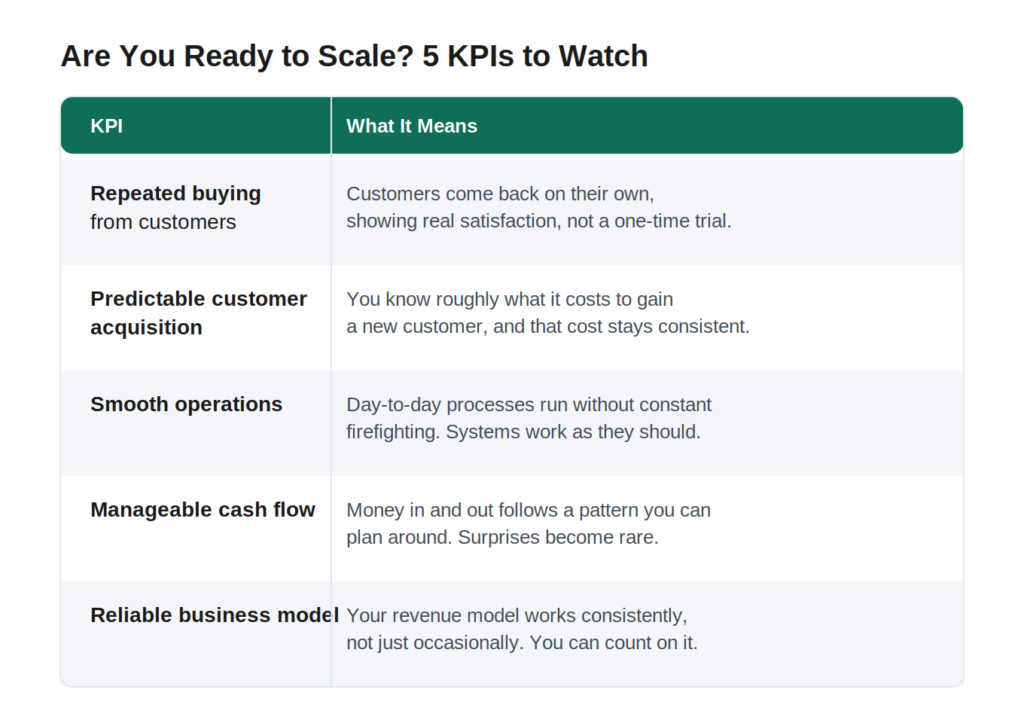
KPIs That Tell You You’re Ready to Scale
Final Thoughts
Scaling isn’t about spending more. It’s about spending smarter.
Ask the right questions. Follow your priorities, not rigid departments. Move through the four-priority scale in order. Avoid the five mistakes that quietly kill startups. And wait for the right KPIs before you push for growth.
Do this, and your startup won’t just grow. It’ll grow the right way, and it’ll last.