
Learn when to keep trying, when to pivot, and when moving on is the smartest path to success.
Introduction
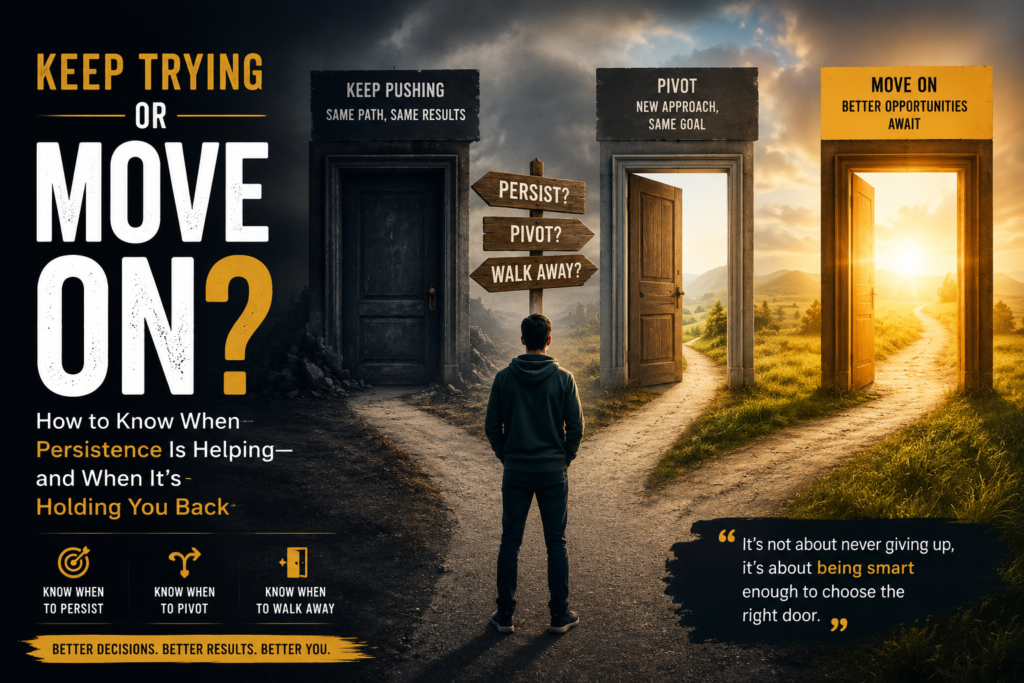
Picture a locked door.
You’ve heard the advice your whole life: keep knocking. Never give up. So you knock harder.
Days turn into months. Months turn into years.
Meanwhile, another door sits just a few steps away. It might already be open.
Persistence gets a lot of praise in business and in life. But here’s the catch: many people confuse persistence with progress. They keep pouring in time, money, and energy, even when the results say otherwise.
So what’s the real skill here? It’s not “how do I keep going.” It’s “how do I know when to keep going, when to pivot, and when to walk away.”
That distinction sounds simple at first. However, in practice, it’s one of the hardest calls anyone makes. For one thing, emotion clouds judgment. On top of that, pride gets in the way. Moreover, nobody wants to feel like a quitter, even when quitting is actually the smart move. Therefore, this decision deserves a real framework, not just a slogan.
Why “Never Give Up” Falls Short
We love stories about people who succeeded after hundreds of failures. Think of Thomas Edison. Colonel Sanders. Walt Disney. Steve Jobs.
But here’s what we rarely hear about: the thousands who tried just as hard, on the same kind of path, and never made it.
This gap has a name. Psychologists call it survivorship bias.
Understanding Survivorship Bias
Survivorship bias happens when we study only the winners and ignore everyone else who followed the same playbook and lost.
Because of this, we draw the wrong lesson. We tell ourselves: “Persistence always pays off.”
The real story is more layered. Persistence pays off only when you pair it with learning, adaptation, and real evidence.
Persistence vs. Stubbornness: Know the Difference
Many people treat these two words as synonyms. They aren’t.
| Persistence | Stubbornness |
|---|---|
| Adjusts strategy | Repeats strategy |
| Learns from feedback | Ignores feedback |
| Focuses on outcomes | Focuses on effort |
| Follows evidence | Follows emotion |
| Flexible path, fixed goal | Fixed path, fixed goal |
A persistent entrepreneur says: “This method isn’t working. Let me try something else.”
A stubborn entrepreneur says: “I’ll keep doing the same thing, because success must be close.”
See the difference? One adapts. The other repeats.
Furthermore, stubbornness often disguises itself as grit. It feels noble in the moment. However, feeling noble and being effective aren’t the same thing. That’s the trap worth watching for.
The Sunk Cost Trap
One big reason people stay too long is the sunk cost fallacy. Specifically, this is our tendency to keep investing in something simply because of what we’ve already put into it. Interestingly, research on escalation of commitment shows that how a decision is framed — as an action versus inaction — can push people to invest even further, even when the evidence says otherwise. When Action-Inaction Framing Leads to Higher Escalation of Commitment
What Counts as a Sunk Cost?
A sunk cost is anything you’ve already spent that you can’t get back. Time. Money. Effort. Emotion.
For example:
- Three years building a startup
- A degree you no longer enjoy
- A business model that never found demand
Here’s the trap. People think: “I’ve invested so much. I can’t stop now.”
But past investment shouldn’t drive future decisions. Instead, ask yourself one question:
“If I were starting today, knowing everything I know now, would I choose this path again?”
If the answer is no, you already have your answer.
The Three-Door Framework
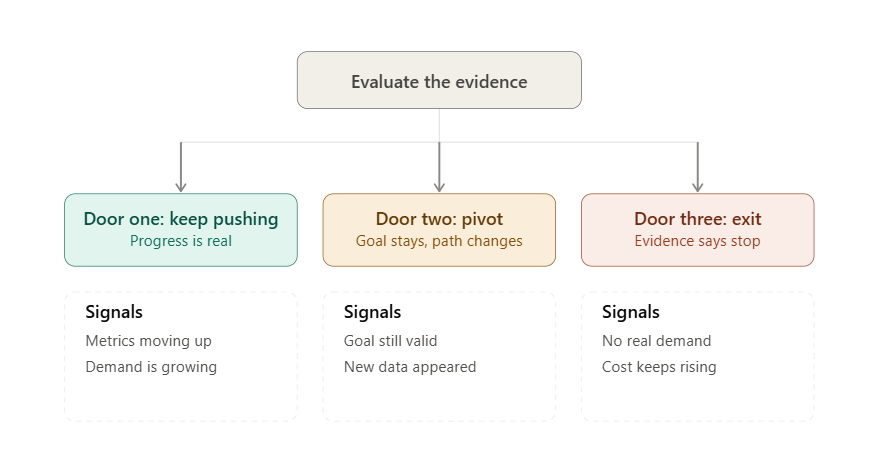
Don’t ask “should I quit?” That question is too narrow. Instead, ask: “which door am I standing in front of?”
Door 1: Keep Pushing
Choose this door when the evidence points forward. Customers respond. Skills improve. Metrics move, even slowly.
Progress may feel slow, but the direction is right. Keep going.
Door 2: Pivot
Choose this door when the goal still matters, but the current path doesn’t work. New information has come in, and it changes the picture.
Many successful companies didn’t survive because they stuck to their original plan. They survived because they changed direction. A pivot simply means: same destination, different route.
Door 3: Exit
Choose this door when the market shows no real demand. When opportunity cost keeps growing. When better options exist elsewhere, and the evidence keeps contradicting your assumptions.
Walking away isn’t failure. In fact, it’s often the smartest move on the table.
Run the Opportunity Cost Test
Economists have a useful concept for this: opportunity cost.
Every hour you spend on one path is an hour you don’t spend on another. So ask yourself: “If I spend another year on this, what am I giving up?”
Maybe it’s a better business, or a stronger career, or it’s a skill you haven’t built yet, or an opportunity you haven’t seen.
The cost of staying often stays hidden. Why? Because you measure it by what could have been, not by what is.
That’s what makes opportunity cost so tricky. It never shows up on a bank statement. Still, it shapes your future just as much as any number does.
Use the Feedback Framework
Here’s a simple test: are you getting evidence, or are you getting excuses?
Evidence looks like this:
- Customer interviews
- Revenue growth
- Engagement data
- Industry demand
- Expert feedback
Excuses look like this:
- “Maybe next month.”
- “People just don’t get it.”
- “Success takes time.”
Without evidence, persistence turns into faith. And business decisions need both faith and facts to work.
Try the 90-Day Rule
Successful entrepreneurs don’t wait forever to check their progress. Instead, they build in structured review periods.
Every 90 days, ask yourself four questions:
- My expectation: What did I think would happen?
- The reality: What actually happened?
- The lesson: What did I learn?
- The next step: What will I change?
If nothing shifts after several of these cycles, pay attention. At that point, continuing isn’t persistence anymore. It’s avoidance.
What Great Entrepreneurs Actually Do
Here’s a common myth: successful founders just persist harder than everyone else. That’s not quite right. They adapt harder than everyone else.
Jeff Bezos didn’t persist with every idea he had. Netflix didn’t cling to DVD rentals forever. Instagram didn’t even start as Instagram.
So what set the winners apart? They weren’t married to a method. They were committed to an outcome. And that distinction changes everything.
A Better Philosophy Than “Never Give Up”
Maybe it’s time to rewrite the advice.
Instead of “never give up,” try this:
Learn constantly. Adapt often. Move toward a goal that matters.
But stay willing to change doors when the evidence tells you to.
Because success rarely goes to the person who knocks on one door forever. Instead, it goes to the person who notices when another door leads to the same destination, faster.
Conclusion
Persistence still matters. It remains one of the most valuable qualities you can build.
But persistence without reflection turns into a trap. And that’s the real danger here.
The goal isn’t to quit at the first sign of trouble. It isn’t to stay forever out of pride, either. The real goal is to build the judgment to tell these two paths apart.
Sometimes success needs one more attempt.