
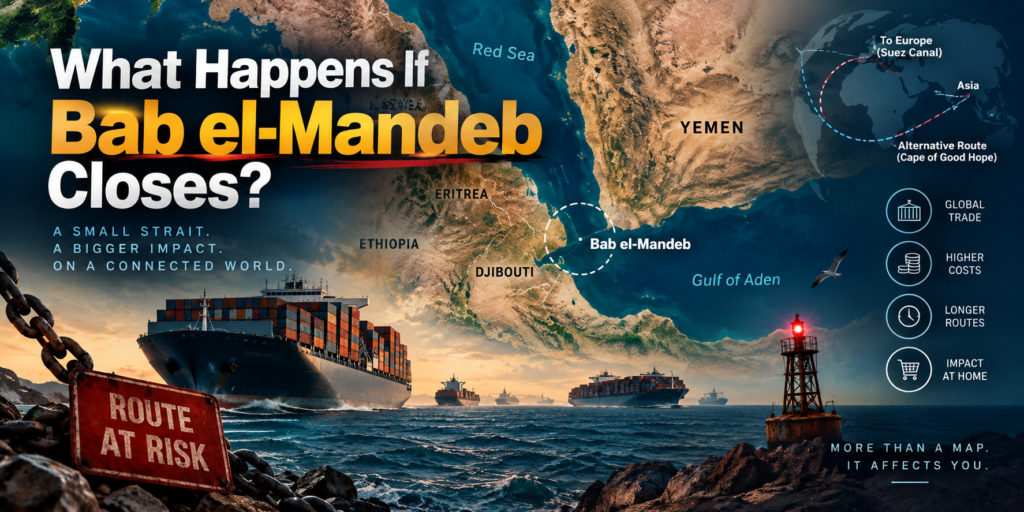
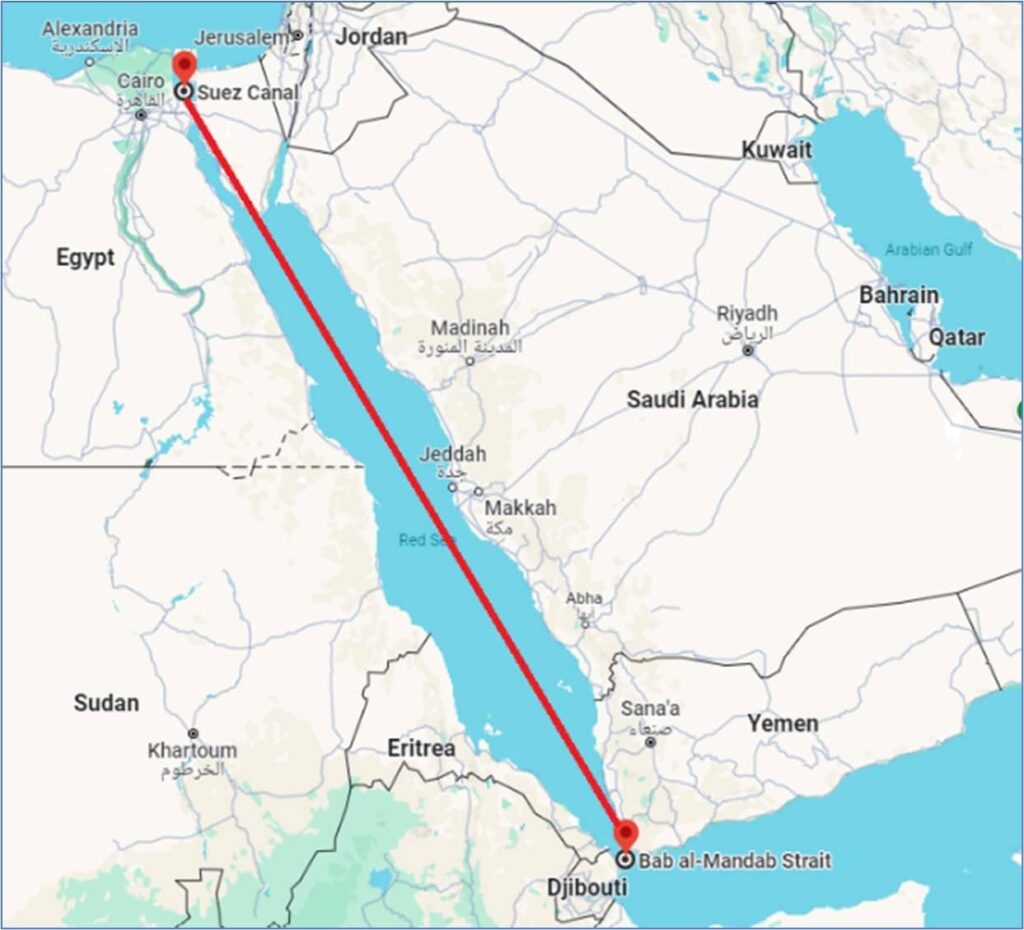
Bab el-Mandeb is a narrow strait between Yemen and the Horn of Africa. It connects the Red Sea with the Gulf of Aden, and it is the southern gateway of the Suez Canal. Daily, tankers, container ships and bulk carriers pass through it, as Asia, Europe and the Gulf require a short-cut between each other.
It may not be a name you’ve heard before, but your grocery bill has. The 30 km choke-point doesn’t sound like much but it has the power to affect around 10% of global trade. About 10 percent of the world’s seaborne oil is now at risk of coming to a standstill. Consequently, approximately 1.5 billion people are on the verge of crisis.
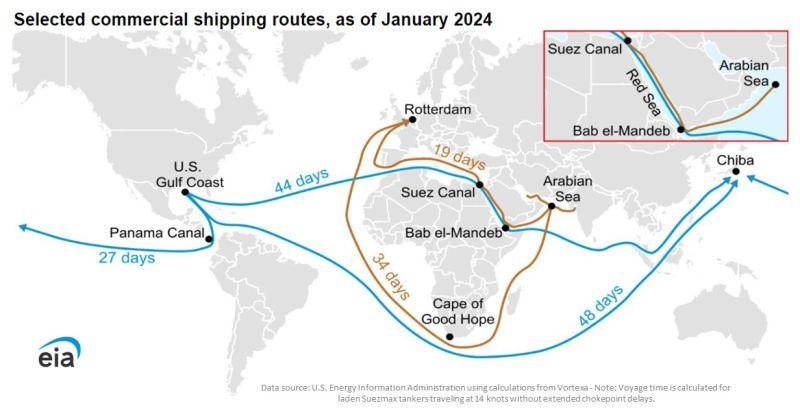
The impacts will affect countries at different times and to different extents. Nevertheless, no one can escape the consequences. Look at the clock first. The journey from Saudi Red Sea ports to Asia used to take some 19 days, and a detour may extend it to some 48 days. This additional time moves through the supply chain all the way to the end of the line, where you can pick them up at your local grocery store.
The prices then follow the delay. Hikes and surges will join the vocabulary. In fact, geography has now become the new economics. But higher price is not the greater risk. Shortage is.
The situation right now
The crisis is now from warning to reality. The Houthis announced in July a blockade of ships at Saudi ports. In September, they seized Mokha and Perim Island and thus directly controlled the Yemeni side of the strait for the first time. The traffic in the strait has since declined by approximately 20%. In other news, Brent crude rose $3.10 to $108 a barrel.
Now there are no longer any guarantees of delivery dates on shipments. Carriers are not able to guarantee the time of delivery, so the importers have to plan blind. The higher the freight and fuel rates, the higher the production costs become. For the first time this month, $6.01 a gallon for U.S. diesel fuel.
Politics add pressure. According to reports, Saudi Crown Prince Mohammed bin Salman has urged President Trump to attack the Houthis, which Trump refused to do.
Next is the dual checkpoint. Since February Iran has maintained they keep Hormuz mostly closed. The cargo trucks travelling from the Gulf to Europe then have to pass through the Bab el-Mandeb strait as well as the Hormuz strait. Saudi Arabia’s remedy, the pipeline to the Red Sea port of Yanbu is going through the same second gate. Saudi Arabia had already closed that pipeline on Sept. 11 and 12, taking between four and five million barrels a day off the market as a result of the attacks.
What could go worse
The first victim is commercial shipping. Insurers increase war-risk premiums and the owners do not run the risk. Carriers then route around the Cape of Good Hope, which increases the length of the voyage by 10-14 days. Extensive routes also consume ship capacity, leading to higher freight rates even if they do not pass through the Red Sea.
The bullwhip phenomenon follows. Increased freight increases production expenses. Then producers hike prices, retailers over-order to hedge themselves against price increases, and little shocks grow into all the crazy swings. At the end, you pay at the check-out.
Last but not least, think about who will be holding the switch. The Houthis already rule over Mokha and Perim, allowing them to close the passage at their will. They assert that navigation continues to be safe. But Yemen’s government claims a Houthi missile hit in the Egyptian-owned Tihamah in August killed six people.
Who gets hit first?
Three sectors will feel the shock before anyone else:
1. Oil
Saudi Arabia sits deeply trapped. With Hormuz shut, it pushed crude to Yanbu, and roughly 70–75% of that crude must pass through Bab el-Mandeb. Its Red Sea exports were already down 41% from the March peak by June. Oil-intensive economies will therefore suffer the biggest setback, since fuel powers their transport, industry, and farms.
2. Food and perishables
Perishables need extra transit time. Longer waits force larger pre-orders, and larger pre-orders lift costs. Consequently, fast-moving consumer goods, the items your daily life depends on, get pricier.
3. Garments, textiles, and leather
These industries employ an estimated 75 to 94 million people worldwide. Delayed shipments and high-priced supplies will drop sales. Revenues will fall, and downsizing will follow.
Alike commodities, there will be specific set of countries that will bear the shock way before the others.
Which countries feel it most?
We can here distinguish the effects between supplier nations and the consumer nations. However, the impact at the end of the day will be quite the same, domestic crisis.
Supplier nations:
- China: electronics, machinery, and consumer goods bound for Europe. The Red Sea normally carries about 30% of Asia–Europe container traffic.
- Saudi Arabia: crude oil, refined fuels, and petrochemicals.
- Pakistan: textiles, garments, leather goods, rice, and sports and surgical goods.
- India: textiles, pharmaceuticals, rice, engineering goods, and refined fuels.
Consuming nations:
- Pakistan: oil and industrial raw materials. A senior petroleum official said Bab el-Mandeb is currently the only route for petroleum imports.
- China: oil. Almost 70% of Yanbu’s crude goes to China, India, and East Asia.
- Europe: oil, plus textiles and leather for its luxury brands.
Who is racing for control?
Two forces are in opposition. The Houthis have the low-cost missiles and drones. Those weapons are enough to take out a commercial ship, and the mere threat is enough to prevent insurance companies from allowing ships to go through. This means the Houthis maintain the pressure at minimal cost.
At their back is a Saudi-led coalition of 14 nations, including the governments of Bangladesh, Comoros, Djibouti, Egypt, Jordan, Kuwait, Pakistan, Qatar, Saudi Arabia, Somalia, Sudan, Turkey and Yemen. Invitations were sent to approximately 50 countries, such as the United States and the members of the European Union. The EU is also conducting its own escort mission, Aspides, which this month elevated its alertness to be aware of the situation.
This is the disharmony. High tech warships and interceptors are more expensive than low tech drones. As patrols keep going, the bill ends up on the budgets of the nation and finally on the shoulders of taxpayers. So allies are pressured to come up with a solution in a hurry.
How ordinary people can make it worse
Consumers hold more power than they think. Three habits can turn a supply problem into a domestic crisis.
Unnecessary demand. Ordering more than you need triggers price surges. Producers must then make more, yet longer routes, limited vessel space, and fuel shortages restrict supply.
Over-consumption. Burning extra fuel and hoarding perishables create shortages. Governments then reach for the invisible hand, and that intervention breeds tension with the private sector. Pakistan has already warned it may revive austerity and fuel-conservation measures if Red Sea supplies tighten.
Overproduction. Excess demand tempts firms to overproduce. However, with little capacity to deliver, goods pile up, sales drop, and domestic revenues fall.
Together, these three habits set off a chain reaction. Any country that falls prey to it faces a domestic crisis.
Possible solutions
Direct military confrontation: The obvious solution to the accumulation. But the alliance waits for a reason. Said oil facilities might be targeted by Houthis if they are in close proximity, and the group already burned Saudi oil sites this month. Those facilities are geared to global demand and military action remains an option.
Continuous economic war: This track ensures a stronger price. Old shipping lines still playing roulette on the Red Sea will end up at the Cape of Good Hope. The same path is significantly more expensive and will be passed on to end consumers due to the bullwhip effect.
Grand bargain: This choice is without any certainty. Which isn’t working for Hormuz, either, as Tehran is claiming it won’t do any more bargaining until Trump meets its demands. Meanwhile delegations travel, time runs out and dialogue events must be organized, and money is lost.
The bottom line
The strait has not fully closed yet, and that distinction matters more than it sounds. A blockade tightens the tap. A closure shuts it off. Right now, the world is living with the tap half-turned, and even that has moved oil past $100 a barrel, pushed diesel above $6 a gallon, and put a 14-nation coalition to sea.
That is the real lesson of Bab el-Mandeb. A 30 km strip of water does not need to close completely to reshape global trade. It only needs to become unreliable. Insurers, shipping lines, and governments do not wait for the worst-case scenario. They price it in the moment the risk appears, and that repricing is what reaches your grocery shelf long before any blockade does.
Sources:
https://www.cnn.com/2026/09/11/business/bab-al-mandeb-strait-houthi-global-economy