
These 5 habits are more common than you think that affects your professionalism
April 4, 2026 7 min read Self-Development
Professionalism is not about the suit you wear or the title on your business card. It is about how you show up — in meetings, in conversations, in moments of pressure. And sometimes, the habits quietly chipping away at your reputation are the ones you are most blind to. Here are five of the most damaging ones, and more importantly, how to fix them.
Habit 01
Talking too much
The problem
There is a version of this we have all witnessed: someone who fills every silence, interrupts to add their perspective, and somehow manages to speak the most while saying the least. Talking too much signals anxiety, not confidence. It signals a need for validation rather than a desire to contribute. In meetings, in negotiations, in one-on-ones — the person who speaks least often carries the most weight. Words, when rationed, become valuable. When abundant, they become noise.
The fix — The art of listening
Listening is not passive — it is a discipline. The next time you feel the urge to respond immediately, pause for two full seconds. Ask one more question before offering your view. Practice what psychologist Carl Rogers called “active listening”: reflecting back what the other person said before you respond. The goal is not to be quiet — it is to make the other person feel heard so deeply that your eventual words carry far more authority.
Habit 02
Oversharing about yourself
The problem
Vulnerability is a strength — but only when it is intentional and contextual. Oversharing your personal problems, financial stress, relationship issues, or past trauma in professional settings does not build connection: it creates discomfort. People around you begin to feel responsible for your emotional state. Worse, they start filtering what they share with you, because if you are open about everything, confidentiality does not feel safe. Oversharing often comes from a genuine desire to connect, which makes it a habit easy to excuse — and hard to notice.
The fix — Boundaries as self-respect
Setting boundaries is not about being cold. It is about knowing the difference between connection and exposure. Ask yourself: “Would I be comfortable if this information shaped how my manager or client sees me?” Use the “one level deep” rule — you can share that you had a tough week without describing the contents of it. Reserve deep personal sharing for relationships that have earned it. Boundaries do not push people away — they tell the world where you begin and end.
Habit 03
Procrastinating work
The problem
Procrastination is rarely about laziness. It is almost always about fear — fear of failure, fear of judgement, fear of starting something that might not be perfect. But in the workplace, the impact is the same regardless of the cause: missed deadlines, rushed output, and a growing reputation as someone who cannot be relied upon. Every time a task sits undone while you convince yourself you will “get to it soon,” you are eroding the trust that took months to build. Procrastination compounds — the longer you wait, the harder it becomes to start.
The fix — Get it done now
David Allen’s “two-minute rule” is deceptively powerful: if a task takes less than two minutes, do it immediately. For larger tasks, adopt a “next action” mindset — never leave a task defined vaguely. Instead of “work on the report,” your next action is “open the document and write the first heading.” Specificity kills procrastination. And if the resistance is deep, use the Pomodoro technique: commit to 25 minutes of focused work, then stop. Starting is always the hardest part — momentum does the rest.
Habit 04
Saying yes to everything
The problem
Being agreeable feels safe. Saying yes feels generous. But chronic yes-saying is one of the fastest routes to burnout, mediocrity, and professional invisibility. When you say yes to everything, your attention — your most finite resource — gets fractured across a dozen half-committed tasks. You stop being the person who does one thing brilliantly, and you become the person who does many things poorly. Paradoxically, saying yes to everyone makes you less reliable to everyone, because none of them gets your best.
The fix — Essentialism
Greg McKeown’s philosophy of Essentialism offers a clean framework: the disciplined pursuit of less. Before accepting any request, ask: “Is this the highest and best use of my time right now?” A useful heuristic is the “hell yes or no” rule — if a request does not make you feel like an enthusiastic yes, it is a no. Practice saying: “I would love to help, but I am at capacity right now.” Protecting your time is not selfish — it is what allows you to show up with full energy for the commitments that truly matter.
Habit 05
Not taking responsibility
The problem
Blame is one of the most professionally corrosive habits there is. When something goes wrong and your first instinct is to point outward — at circumstances, at colleagues, at leadership — you signal that you are not safe to trust with real responsibility. Nobody promotes someone who deflects. Nobody builds a company with partners who make excuses. Avoiding accountability also prevents growth: if everything is someone else’s fault, you have no data to improve from. The habit of blame is often rooted in self-protection, but it destroys the very reputation it is trying to protect.
The fix — Extreme ownership
Former Navy SEAL Jocko Willink’s principle of Extreme Ownership is simple and uncompromising: everything is your responsibility. Not as self-punishment, but as a mindset of agency. When a project fails, ask “what could I have done differently?” not “who let me down?” This does not mean accepting blame for things outside your control — it means refusing to be a victim of them. Leaders who practise extreme ownership become the people organisations cannot afford to lose, because they are the ones who solve problems rather than distribute them.
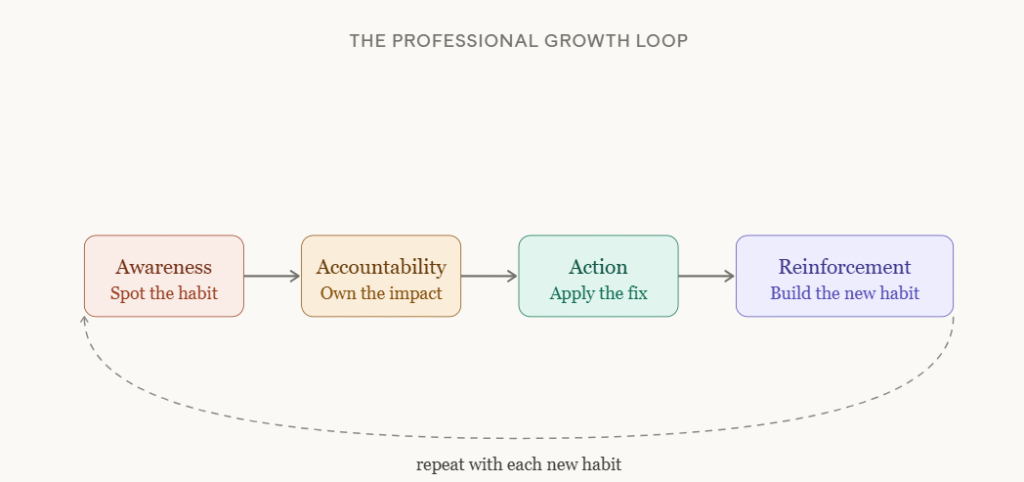
Professionalism is not a destination — it is a practice. Each of these five habits has a fix rooted in real, field-tested frameworks: active listening, essentialism, extreme ownership. The loop above is the mechanism. Spot the habit, own its effect on others, apply the framework, and repeat until the new behaviour becomes automatic. The difference between someone who is merely talented and someone who is truly trusted often comes down to which habits they are willing to confront.