
The world is witnessing a seismic shift — millions are trading corner offices for garage offices, and paycheques for equity. But is entrepreneurship the new dream, or just a glorified gamble?
April 1, 2026· 8 min read· Startups & Business
Something remarkable is happening. Walk into any café in Karachi, Lagos, Berlin, or Mumbai and you will find young professionals hunched over laptops — not filling out job applications, but building companies. According to the Global Entrepreneurship Monitor, startup activity has surged across every major economy in the last five years. The 9-to-5 is no longer the default ambition. The startup has become the new career path.
But behind the viral success stories of unicorns and billion-dollar exits lies a harder truth: over 90% of startups fail within their first five years. The gap between starting a business and sustaining one is enormous — and it is filled with discipline, financial literacy, and relentless execution.

What is a startup — really?
A startup is not simply a small business. Entrepreneur and investor Steve Blank defines it as “a temporary organization designed to search for a repeatable and scalable business model.” That word — scalable — is everything. A startup is built with the intention of growing exponentially, not linearly. A local restaurant is a business. A platform that connects thousands of restaurants to customers across cities is a startup.
Startups operate under extreme uncertainty. They are not executing a known plan — they are discovering one. This is what makes them thrilling, and terrifying, in equal measure.
“The biggest risk is not taking any risk. In a world that is changing quickly, the only strategy that is guaranteed to fail is not taking risks.” — Mark Zuckerberg
The discipline it takes
No amount of passion replaces the daily discipline that entrepreneurship demands. The founders who succeed are not necessarily the most talented — they are the most consistent. Here is what separates those who build lasting companies from those who give up at the first obstacle:
- 1Relentless focus on the customer. Every decision — product, pricing, marketing — must start with one question: does this solve a real problem for real people? Founders who fall in love with their idea instead of their customer almost always fail.
- 2A bias toward action. Perfectionism is the enemy of progress. Successful founders ship early, gather feedback, and iterate fast. The “build-measure-learn” loop, popularized by Eric Ries in The Lean Startup, is the operating philosophy of the world’s best builders.
- 3Radical resilience. Rejection, failure, and setbacks are not occasional events in startup life — they are the daily weather. The discipline to keep moving, recalibrate without losing conviction, is what separates finishers from quitters.
- 4Team-first thinking. No founder builds alone. Assembling a complementary team — and keeping them motivated through uncertainty — is as important as the product itself. Culture eats strategy for breakfast.
- 5Financial discipline. Cash is oxygen. Running out of it is the single most common cause of startup death. Managing burn rate, understanding your runway, and knowing when to raise capital are non-negotiable survival skills.
Sustaining growth — the hardest chapter
Many startups reach early traction and then stall. The skills that help you find product-market fit are very different from the skills needed to scale. Growth brings complexity: more customers mean more support, more hires mean more management, more revenue means more compliance.
Sustaining growth requires founders to evolve. The scrappy, do-everything founder must eventually become a systems-thinker who builds processes, delegates effectively, and leads with clarity. Companies that scale well invest early in operations, data infrastructure, and leadership development — not just product and sales.
Key financial concepts every founder must know
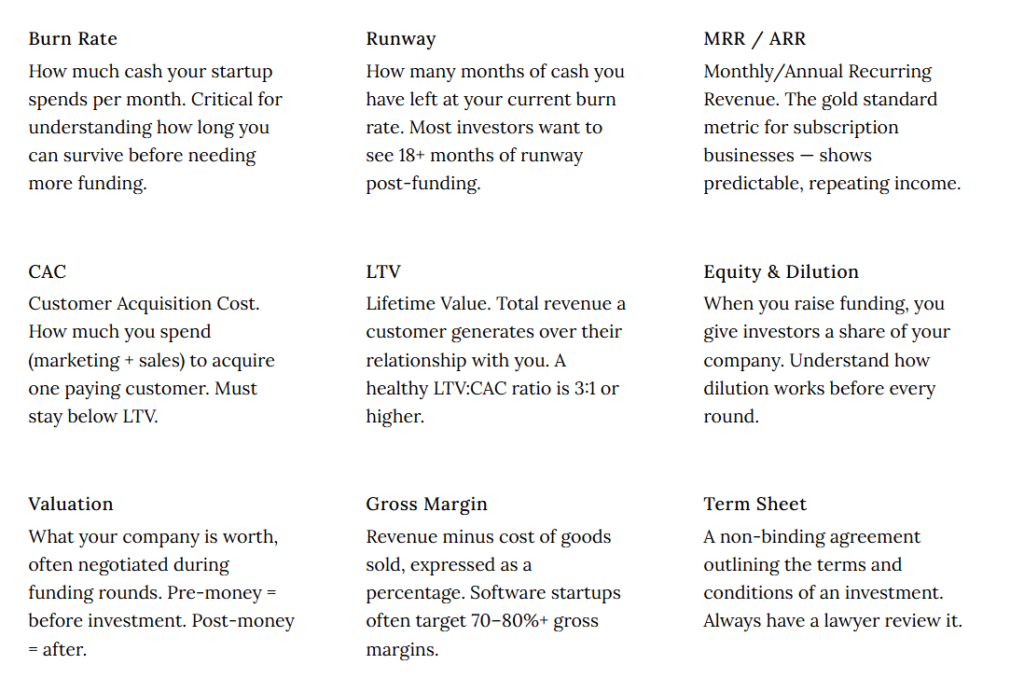
Financial illiteracy is one of the fastest ways to kill an otherwise promising startup. Before you raise a single dollar or sign a single contract, understand these terms:
Is this path for you?
Entrepreneurship is not glamorous — not most days. It is early mornings, difficult conversations, and decisions made with incomplete information. It is saying no to stability in pursuit of something you believe in. It is also one of the most fulfilling, meaningful pursuits a person can undertake.
The shift away from traditional employment is not a trend — it is a structural change in how value is created in the modern economy. Technology has lowered the barrier to starting a company to near zero. What remains is the hardest ingredient of all: the will to start, the discipline to continue, and the wisdom to grow.
