The rules of building a career have changed permanently. The question is no longer whether you can find a job — it’s whether a job alone is enough to build the life you want.
Picture this: You’ve just graduated after years of hard work, tuition fees, and late-night study sessions. You polish your résumé, craft cover letters, and begin applying for jobs — hundreds of them. Weeks pass. Then months. The responses that do come back are polite rejections or silence. This is not a personal failure. This is the new reality of the modern job market, and it’s affecting ambitious, talented people everywhere.
The world you prepared for is not quite the world that exists today. And understanding that gap — clearly, honestly — is the first step toward doing something remarkable about it.
A World Transformed Almost Overnight
Over the past two decades, globalization quietly rewired how economies work. A software developer in Karachi now competes for the same remote role as one in Toronto. A marketing graduate in Cairo bids on the same freelance contract as someone in Berlin. Talent has become borderless, and that means competition has too.
Then came artificial intelligence — not as a distant sci-fi concept, but as a practical workplace tool reshaping job descriptions in real time. Tasks that once required entry-level employees — data entry, basic content writing, customer service responses, financial modelling — are being automated or drastically streamlined. This doesn’t mean jobs are disappearing entirely, but it does mean the type of work that commands value is shifting fast.

The opportunities are still there — they’ve simply moved. And increasingly, they favour people who build, not just apply.
Why Job Hunting Alone Is No Longer Enough
Let’s be honest: there is nothing wrong with employment. A good job offers stability, mentorship, and a paycheck while you develop skills. But treating employment as your only strategy — your entire financial identity — is a fragile plan in an economy this volatile.
When you depend entirely on one employer for your income, your career trajectory, and your sense of professional worth, you hand over enormous amounts of control to someone else. A restructuring decision, a budget cut, or an AI deployment can erase years of effort overnight. That is not pessimism. That is simply the risk profile of the modern employment relationship.
The people quietly thriving in this new economy are those who have built something of their own alongside their careers, or instead of one entirely. They are freelancers, consultants, SaaS founders, content creators, e-commerce operators, and community builders. They have diversified their income, their skills, and most importantly, their options.
What Startup Thinking Actually Means
Here’s a misconception worth dismantling: startups are not just billion-dollar tech companies born in Silicon Valley garages. A startup is simply a business built to solve a real problem and grow. That problem could be anything — and it’s often the most ordinary things that generate the most sustainable businesses.
A university student in Lahore who notices that small restaurants struggle with online orders could build a hyper-local delivery coordination service. A recent graduate with a background in nutrition could launch a meal-planning subscription for working professionals. A young professional frustrated by the chaos of managing freelance invoices could build a simple tool that solves exactly that frustration.
Startup thinking means asking: What problem do I see clearly that others are ignoring? And what would it look like if I solved it?
Practical Opportunities Available Right Now
You don’t need a huge budget or years of experience to start exploring entrepreneurship. The barriers to entry have genuinely never been lower. Here are real, accessible paths:
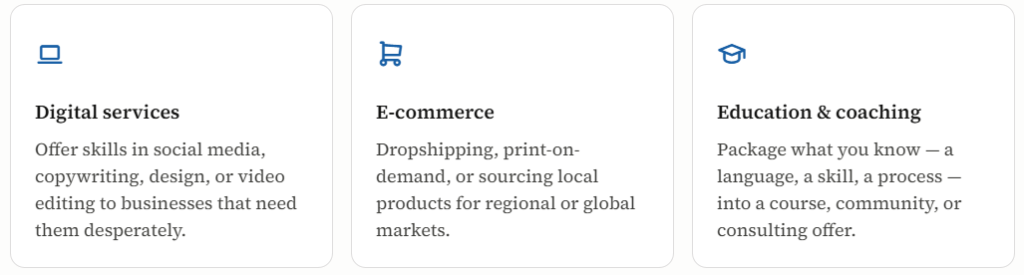
None of these require you to quit your studies or your job tomorrow. Many of the most successful founders started their ventures on evenings and weekends, testing ideas with minimal investment before committing fully. What they had was not more time or money — it was the willingness to start.
The Skills That Will Always Be Worth Something
AI can generate a report. It cannot yet truly understand the context of a community, build genuine trust with a customer, or make the kind of nuanced judgment call that comes from lived experience. The skills that compound in value over time are precisely the human ones: problem-solving, leadership, adaptability, communication, and creativity.
Entrepreneurship, even at a small scale, forces you to develop all of these simultaneously. You will learn to manage people, handle uncertainty, market an idea, survive setbacks, and make decisions without a safety net. These are not skills you pick up in a classroom or a corporate training session. They are forged through doing.
And here’s the thing: even if your first venture doesn’t work out as planned, the person you become in the process is fundamentally more employable, more resilient, and more capable than the version of you who simply waited.
This Is Where Cents Insight Comes In
We built Cents Insight for exactly the person reading this — someone who senses that the old playbook isn’t enough, who is looking for clarity, practical guidance, and real ideas they can act on.
At Cents Insight, we cover practical startup ideas suited to emerging markets and young founders, business planning frameworks that don’t require an MBA, financial guidance for first-time entrepreneurs, management insights from people who have built businesses from scratch, and honest, grounded coverage of the opportunities this changing economy is creating.
We are not here to sell you a dream. We are here to help you build one, carefully and deliberately, one decision at a time.