The most dangerous thing you carry isn’t wrong information — it’s the unshakeable confidence that your outdated picture of the world is still accurate.
Stop. Before you scroll past this looking for the next quick tip or motivational headline, this is the one you actually need to read first. Not because it tells you what to do. But because it questions what you already think you know. And that, more than anything else, is where real learning begins.
We live in an age of instant information and yet, we may be the most confidently misinformed generation in human history. Not because we lack access to knowledge. But because we carry old knowledge in new times, and mistake familiarity for fact.
The map in your head is out of date
Every one of us navigates the world using a mental map, a picture built from what we learned in school, what our parents told us, what we read ten years ago, and what we absorbed from the news, social media, and our immediate surroundings.
The problem? That map was drawn a long time ago. And the world has changed. Dramatically. But our picture of it often hasn’t.

These are not small corrections. These are world-altering facts that most educated, well-read people get spectacularly wrong. The mindset you bring to any subject matters enormously because a wrong frame doesn’t just give you wrong answers, it makes you ask the wrong questions entirely.
Two-sided thinking has us in its grip.
We divide everything into two — a habit so deeply wired into us that we rarely notice it. Rich or poor. Smart or average. Developed or developing. Safe or dangerous. Progressive or backward. We encounter something unfamiliar and immediately ask: which side does it belong on?
This binary instinct served our ancestors well. In the wild, fast decisions, friend or threat, eat or flee kept us alive. But in the complex, layered, deeply interconnected world of the 21st century, this same instinct quietly misleads us every day.
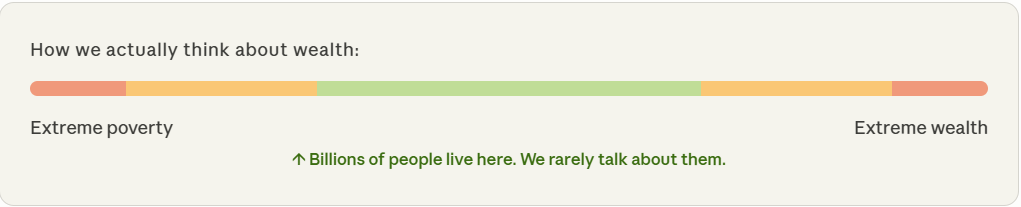
The reality is a spectrum. Between “rich” and “poor” live billions of people/families with a home, a phone, school-going children, and modest but growing stability. Between “good film” and “terrible film” is the majority of human creative output, decent and imperfect and quietly meaningful. Between “safe country” and “war zone” are dozens of nuanced societies with their own contradictions, cultures, and progress.

Why false knowledge feels so true
This is the uncomfortable part. The knowledge that misleads us most is not the stuff we know we don’t know. It’s the stuff we are completely certain about.
False knowledge compounds in three ways. First, through media, which, by design, highlights what is broken, dangerous, or outrageous, because those things attract attention. A decade of falling crime rates doesn’t make the news. One violent incident does. Second, through social echo chambers, online and offline — that confirm what we already believe and filter out evidence to the contrary. And third, through time: we absorb a picture of the world at one point in our lives and carry it forward, rarely pausing to ask whether it still holds.
The student who read a development economics textbook from 2005. The professional whose understanding of a foreign market is based on news clips from a decade ago. The reader whose view of mental health, of poverty, of entire continents, was shaped by one documentary watched years before. All confident. All, in important ways, wrong.
The right mindset is not an opinion — it’s a practice
So what does it actually mean to approach the world with the right mindset? It is not about being sceptical of everything. It is not about constant doubt. It is about something more specific and more useful: intellectual humility combined with a genuine hunger to update.
✓Treat your current worldview as a working draft, not a finished document. It is meant to be revised.
✓Ask when you formed a belief, not just whether you hold it. Old knowledge needs an expiry check.
✓Resist the urge to immediately sort new information into “agrees with me” or “disagrees with me.” Let it breathe first.
✓Make peace with the middle ground. “It’s complicated” is not weakness, it is usually accuracy.
✓Seek out the actual data before forming strong opinions, especially on things that change quickly: poverty rates, global health, education, safety.
✓Disagree with headlines. Look for what the headline is leaving out, which is almost always the most important part.