By the end of this blog, you will be able to:
- Explain what a startup pitch deck is and why investors ask for one
- Understand the difference between a business plan and a pitch deck
- Gather and organize everything you need before you start designing
- Build a complete 11-slide pitch deck in PowerPoint
- Prepare for investor due diligence after a strong pitch
- Understand what investors are secretly evaluating while you present
- Use a simple checklist to track your progress
Introduction
You’ve decided to raise equity funding. Now what? A pitch deck is a series of words and images that illustrate a venture’s story and business model
How do you convince an investor to hand over their money? This is exactly where a pitch deck comes in. This blog assumes you’re moving ahead with equity funding for your startup. That’s a natural choice at this stage. As a startup, you don’t have predictable cash flow yet. Locking your business into fixed loan payments is risky. You don’t know your cash inflow cycle. Equity funding removes that pressure. But equity funding needs a different kind of convincing.
A great idea alone rarely attracts investment. Investors invest in founders who can clearly explain the problem they’re solving, demonstrate market potential, and show a realistic plan for turning the idea into a profitable business. A startup pitch deck is the document that brings all of this together.
This blog walks you through the entire process. We’ll keep the language simple. You don’t need a finance degree or an MBA to follow along. Whether you come from a business background or not, you’ll walk away knowing exactly how to build a pitch deck that gets attention.
Let’s get started.
What Is a Startup Pitch Deck?
The Definition
A pitch deck is a short visual presentation. It explains your business to potential investors. It covers the problem, your solution, your market, your business model, and your team. It usually ends with a funding ask. Think of it as your business’s highlight reel. It’s not the full story. It’s the trailer that makes investors want to see more.
Why Investors Need It
Investors meet dozens of founders every month. They don’t have time to read a 50-page document for each one. A pitch deck respects their time. It gives them the key facts fast. It helps them decide whether your startup fits their investment thesis.
A good pitch deck also shows how you think. Can you simplify a complex business into clear slides? Can you tell a compelling story? Investors are watching for this skill, not just the content.
Pitch Deck vs. Business Plan
Founders often confuse these two documents. They serve different purposes:
A business plan is detailed. It can run 30 to 60 pages. It covers every operational detail, from hiring plans to supply chain logistics.
A pitch deck is different. It usually contains 10 to 15 concise slides. It’s designed to quickly communicate the opportunity. It’s a conversation starter, not an operations manual.
Most investors want the pitch deck first. If they’re interested, they’ll ask for the business plan or other supporting documents later.
Pitch Deck vs. Seed Funding
These terms aren’t interchangeable either:
Seed funding is the money itself. It’s the early-stage capital you raise to build your product, hire your first team members, or enter your first market.
A pitch deck is the tool you use to raise that money. It’s the presentation, not the funding round.
In short: seed funding is the “what,” and the pitch deck is the “how.”
Preparing to Build Your Pitch Deck
Before you open PowerPoint, gather your information. A pitch deck is only as strong as the research behind it.
Market Research
You don’t need to start from scratch here. You already did market research during idea validation. Now you simply organize, refine, and present that research. Pull out the numbers and insights that matter most to investors. Focus on market size, growth trends, and customer demand.
Investors usually look for three market numbers: TAM, SAM, and SOM. TAM is your total addressable market. SAM is the slice of that market you can realistically serve. SOM is the portion you can capture in the near term. Presenting all three shows investors you understand both the big picture and your realistic starting point.
Customer Validation
Investors want proof, not assumptions.Show them evidence that real customers want your product. This could be early sign-ups, pilot customers, surveys, or pre-orders. Anything that proves demand works in your favor. To get more insights on validation and its process you might read more..
Numbers matter more than opinions here. A waitlist of 500 people says more than a survey where people simply agree your idea sounds good. If you have early revenue, retention data, or repeat usage, lead with that. Even a small paying customer base proves people value your solution enough to pay for it, which is the strongest signal you can offer.
Revenue Model
Explain exactly how your business makes money. Is it subscription-based? Is it a one-time purchase? Do you earn through commissions or advertising? Keep this explanation simple and specific.
Also think about your pricing logic. Explain why you chose this price point and how it compares to what customers currently pay for alternatives. If you have multiple revenue streams, rank them by importance. Investors want to see one clear primary engine of revenue, not five untested ideas competing for attention.
Competitor Analysis
No startup exists in a vacuum. Identify your direct and indirect competitors. Show investors you understand the landscape. More importantly, show them why you’re different or better. Don’t claim you have no competitors. Investors read that as a lack of research, not a strength.
Even if no one solves the exact problem you solve, someone is solving it indirectly, perhaps through a manual process, a spreadsheet, or a generic tool. Naming these indirect competitors shows investors you’ve mapped the full landscape, not just the obvious players.
Financial Projections
You need realistic numbers here, not guesses. Investors want to see how your revenue and costs will evolve. This builds confidence in your business model. (You might link this to our previous blog in the series that explained the startup finance).
Base your projections on assumptions you can defend, not on wishful growth curves. Show your reasoning, for example, how many customers you expect per month, and what you charge them. If an investor asks why revenue jumps in month eight, you should have a clear answer ready. Overly optimistic projections without logic behind them can hurt your credibility more than a modest, well-justified forecast.
Funding Requirement
Decide exactly how much money you need. This number should come from your financial projections and business plan, not a random figure. Investors respect founders who know their numbers.
A good rule of thumb is to raise enough to comfortably reach your next major milestone, plus a buffer of a few months. This might mean 12 to 18 months of runway. Asking for too little forces you back into fundraising too soon. Asking for too much without justification can make investors question your judgment.
Use of Funds
Explain where the money will actually go. Will it fund product development? Marketing? Hiring? Break this down clearly. It shows investors you have a plan, not just a wish list.
Try to tie every allocation back to a specific outcome. Instead of saying “30% on marketing,” say “30% on marketing to acquire our first 10,000 users.” This connects spending directly to growth, and it tells investors you’re thinking about return on investment, not just how to divide up the cash.
Building the Pitch Deck in PowerPoint
Why PowerPoint? Simple. It’s the industry standard for pitch decks. Investors expect this format. It’s easy to share, easy to present, and easy to edit as your startup evolves.
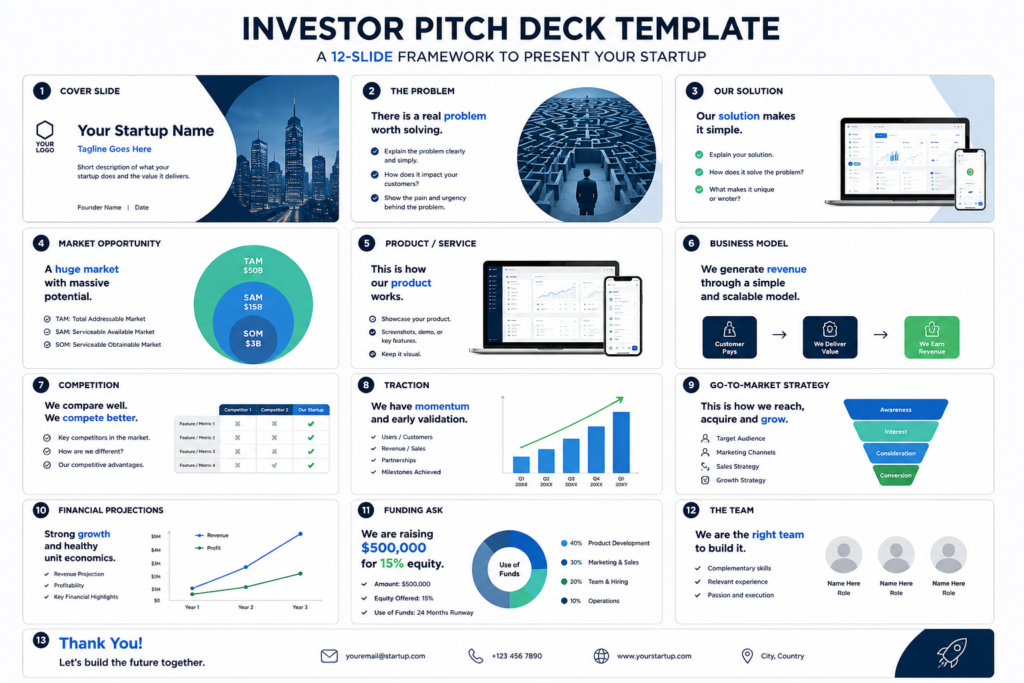
Here’s the basic 11-slide structure that works for most startups:
| Slide | What to Include |
|---|---|
| 1. Company Introduction | Start with your company name, logo, and a one-line description of what you do. Keep it sharp and memorable. |
| 2. Problem Statement | Clearly explain the problem you’re solving. Make it relatable. Use real numbers or real stories if you can. |
| 3. Proposed Solution | Show how your product or service solves that problem. Keep this slide simple and visual. |
| 4. Market Opportunity | Show the size of your target market. Investors want to know the ceiling on your potential growth. |
| 5. Product Demonstration | Show your product in action. Use screenshots, mockups, or a short demo video link. This helps investors visualize what you’ve built. |
| 6. Business Model | Explain how you generate revenue. Refer back to the revenue model you defined in Part 3. |
| 7. Competition | Show where you stand against competitors. A visual works best here. Try a positioning map or a BCG matrix. This helps investors instantly understand your competitive edge without reading long paragraphs. |
| 8. Marketing Strategy | Explain how you plan to acquire customers. Cover your channels, your budget approach, and your growth tactics. |
| 9. Financial Projections | Present your financial forecast, typically for the next three years. This slide demonstrates a clear path toward profitability. Keep it visual, and use graphs instead of dense tables where possible. |
| 10. Funding Ask | This is the most important slide in your entire deck. State exactly how much money you need and how much equity you’re offering in exchange. Then explain your use of funds, for example: 40% on product development, 30% on marketing, 20% on hiring, and 10% on operations. Adjust these numbers to match your actual plan. |
| 11. Founding Team Expertise | Investors don’t just invest in ideas. They invest in people. Explain why your team can execute this plan. Highlight relevant experience, past wins, technical expertise, or industry knowledge. If a team member has built or scaled something before, mention it here. |
Investor Due Diligence
Once an investor shows interest, the real scrutiny begins.
They’ll likely ask for:
- Financial statements
- Legal documents
- Cap table
- Business registration proof
- Customer metrics
- Tax compliance records
Keep these documents organized in advance. A founder who’s prepared for due diligence builds instant credibility.
What Investors Secretly Evaluate While You Pitch
Here’s something most guides won’t tell you. While you present your slides, investors are silently asking themselves four questions.
- Can this founder execute? They’re watching how you handle pressure, questions, and uncertainty in real time.
- Can this business scale? They’re checking if your model works at 10x or 100x the size, not just at your current stage.
- Is the market large enough? A great product in a tiny market rarely excites investors. They need room for real returns.
- Can this team survive failure? Startups rarely go exactly as planned. Investors want founders who can adapt, pivot, and keep going when things get hard.
Your slides matter. But how you carry yourself while presenting matters just as much.
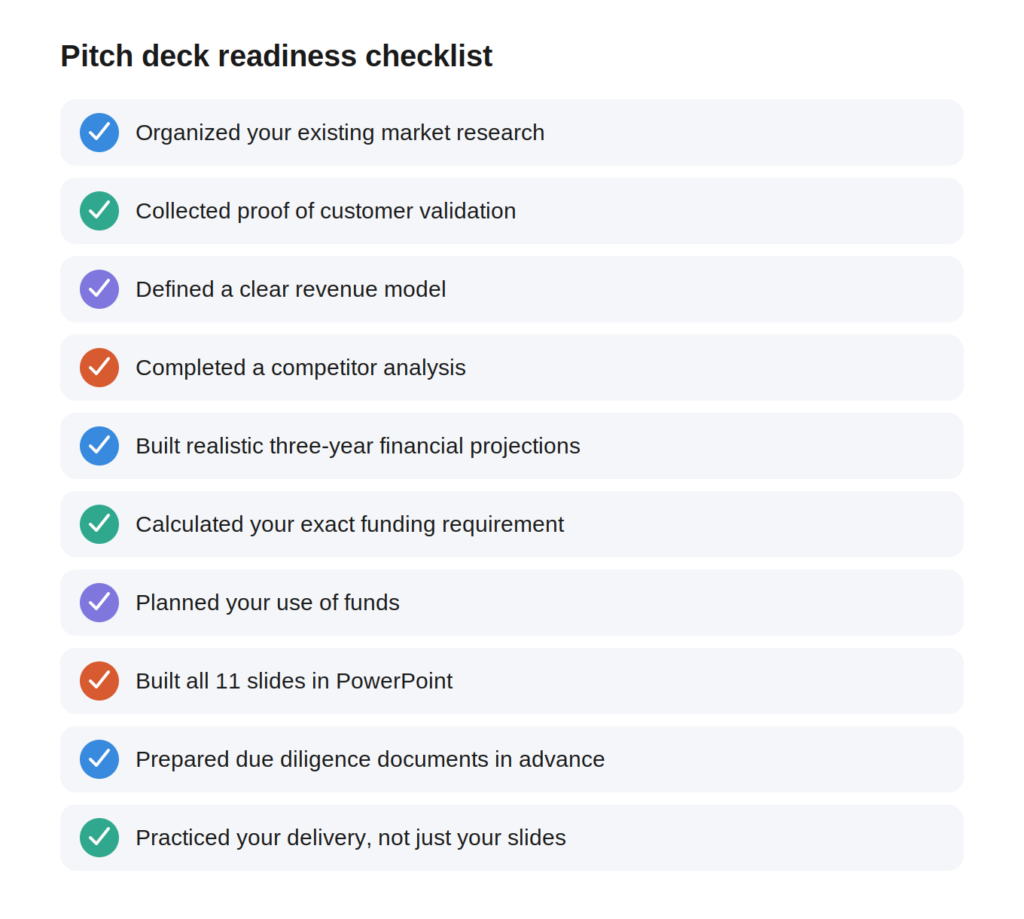
Bonus: Your Pitch Deck Readiness Checklist
We know that’s a lot to take in, so to make your journey a little easier, we’ve put together this simple checklist. Use it before you approach any investor.
A pitch deck is more than a document. It’s your startup’s first impression on the people who can help you grow. Take the time to get it right, and you’ll walk into every investor meeting with confidence.