
By the end of this blog, you will be able to:
- Understand what a brand really is, beyond just a logo
- Define your startup’s purpose, mission, and values
- Identify exactly who you’re building your business for
- Position your brand against competitors with a clear advantage
- Define your brand’s personality, voice, and tone
- Build a visual identity that supports your brand story
- Understand why customer experience is part of your brand
- Learn how consistency builds trust and loyalty over time
- Recognize when a startup actually becomes a brand
- Avoid the branding mistakes that quietly hurt startups
Introduction
What comes to your mind when someone says Apple? For most people, it isn’t the logo. It’s premium quality, innovation. status, and trust. That’s the power of branding. A business sells a product. A brand sells a story.
This distinction matters more than most founders realize. However, you can build an excellent product and still struggle to grow if no one understands what you stand for. Branding gives your startup a personality people can connect with, remember, and trust.
This blog breaks branding down into simple, practical steps. You don’t need a business degree to follow along. You just need to understand how people think, and how your startup fits into their lives. Let’s start with the most basic question of all.
Why Should Anyone Care About Your Startup?
Every startup eventually asks this question. The answer lies in understanding three simple concepts: brand, branding, and brand perception. Understanding how these three ideas connect makes everything else in this blog easier to apply.
Your brand is how people perceive your business. It’s not something you fully control. It lives in your customer’s mind. Two customers can experience the exact same product and walk away with slightly different impressions, and both of those impressions are still part of your brand.
Branding is the deliberate work you do to shape that perception. It includes your messaging, your visuals, and your customer interactions. Every choice you make, from the words on your website to how you respond to a complaint, adds another data point to how people see you.
Brand perception is the result. It’s the feeling people get when they think of your company. This feeling forms gradually, but it can shift quickly if a single experience contradicts everything customers expected from you.
Here’s the key insight: people don’t buy logos. They buy trust, emotions, and solutions. A logo is just a symbol. What people actually connect with is the feeling behind it. That feeling is what makes them choose you again, recommend you to a friend, or forgive an occasional mistake.
If your startup doesn’t invest in shaping that feeling, your competitors will shape it for you. Therefore, perception forms whether you actively manage it or not, so the only real choice is whether you influence it deliberately or leave it to chance.
Why Does Your Startup Exist Beyond Making Money?
Every business needs revenue to survive. But revenue alone doesn’t inspire loyalty. Purpose does.
This is where brand purpose comes in. It’s the deeper reason your startup exists. It answers the question: why does this business matter?
For instance, think about Patagonia. They sell outdoor clothing, but their real purpose is protecting the environment. As a result, that purpose shapes every product decision they make, from materials to repair programs. Ultimately, it gives customers a reason to care beyond the product itself.
Building on that purpose, your mission describes what you do every day to fulfill it. It’s practical and action-oriented. Similarly, Patagonia’s mission centers on building quality products while minimizing environmental harm through their actual business operations.
In contrast, your vision describes where you want your business to go in the future. It’s aspirational rather than immediate. For example, a startup’s vision might be “a world where every small business can afford great software,” even if today they only serve a small niche.
Your brand values guide how you operate along the way. They shape your decisions, your culture, and your communication. If one of your values is transparency, it should show up in your pricing, your marketing, and even how you handle mistakes publicly.
Take time to define these clearly. Founders who skip this step often build businesses that feel directionless, even if their product works well. Customers can sense that missing clarity, and it affects how they perceive your brand.
Who Are You Really Building This Business For?
Many founders try to appeal to everyone. This almost always backfires.
Your target audience is the specific group of people your product serves best. Trying to serve everyone usually means serving no one well.
To understand your audience deeply, build a customer persona. This is a detailed profile of your ideal customer, including their goals, frustrations, and habits.
Once you understand your persona, focus on their customer needs. What problem are they trying to solve? What do they expect from a solution like yours?
Market segmentation helps you break your audience into smaller, more specific groups. This makes your messaging sharper and more relevant.
A startup that speaks clearly to a specific audience always outperforms one that speaks vaguely to everyone. You can find a detailed blog on how to define your target audience here..
Why Should Customers Choose You Instead of Your Competitors?
This might be the most important question in this entire blog. It answers the customer’s biggest concern: why should I pick you?
Brand positioning defines where your startup sits in the market compared to competitors. It’s how customers mentally rank you against other options. Here’s the positioning map, using the coffee industry as a relatable example — Starbucks in the premium quadrant (high price, high quality), Dunkin’ in the accessible-quality quadrant, McDonald’s McCafé in the budget quadrant, and airport/convenience coffee in the “overpriced for what you get” quadrant. This is a good framework for founders to reuse: pick two attributes that matter most to your buyers, plot yourself and your competitors, and see which quadrant is actually empty — that gap is often your opportunity.
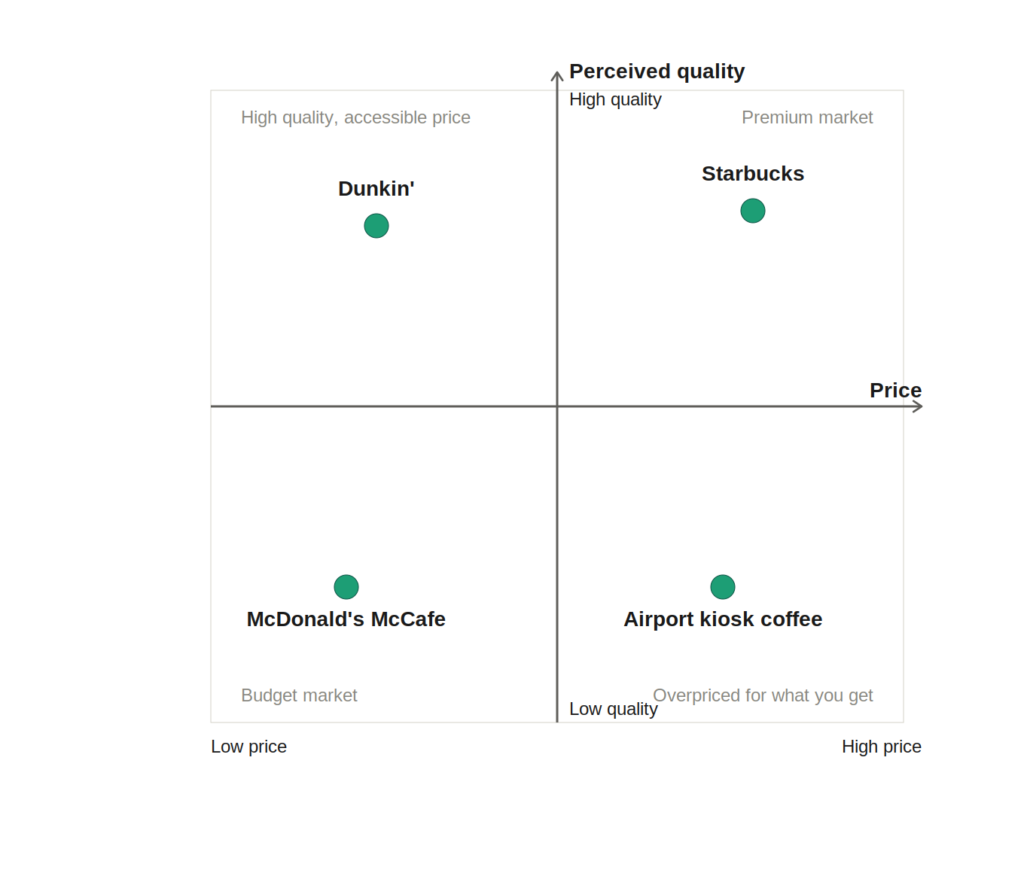
Your competitive advantage is the specific strength that makes you better suited to win. This could be speed, price, quality, or expertise. A food delivery startup might win on speed, promising delivery in under 15 minutes, while a competitor wins on variety by offering access to more restaurants.
Your Unique Value Proposition, or UVP, communicates that advantage in one clear statement. It tells customers exactly why you’re the better choice. Slack’s early UVP was essentially “email is broken, and we’ve fixed team communication.” That single sentence told customers exactly what problem they’d stop having.
Ultimately, differentiation ties all of this together. It’s what makes your startup memorable in a crowded market. For example, two coffee shops might sell the same coffee, yet one differentiates through a cozy, work-friendly atmosphere, while the other focuses purely on speed for people grabbing coffee on the go.
Without clear positioning, customers default to comparing you on price alone. That’s a race no startup wins long-term.
What Kind of Company Do You Want Customers to Feel They’re Buying From?
Every brand has a personality, whether founders design it intentionally or not. Three aspects of which allow your customer to develop a perception of who you are:
- Brand personality describes the human traits your business reflects. Do you want to feel innovative? Trustworthy? Premium? Friendly? Bold? Professional? Jennifer Aaker’s dimensions of brand personality classify personality traits into five dimensions: Sincerity, Excitement, Competence, Sophistication, and Ruggedness. (Read more)
- Brand voice is how that personality comes through in words. It stays consistent across your website, social media, and customer support.
- Tone of communication can shift slightly depending on the situation, but your core voice should remain steady.
This is where founders decide who their brand truly is. Get this right, and your communication naturally feels authentic. Get it wrong, and customers sense the disconnect immediately
How Should Your Brand Look and Feel?
Now, and only now, we arrive at visuals.
Many founders start here by mistake. However, your visual identity should support your brand, not create it. In other words, it only works well once your purpose, audience, and positioning are already clear.
To begin with, your logo is a small but important piece of this identity. It should reflect the personality you’ve already defined. Similarly, your colour palette and typography reinforce that same feeling. For instance, warm colours feel different from cool ones, while bold fonts feel different from soft, minimal ones.
Likewise, your imagery should align with your brand voice too. After all, a premium brand looks different from a friendly, approachable one.
Finally, design consistency ties everything together. Whether someone sees your website, packaging, or social media, it should all feel like the same brand.
Are You Delivering the Experience You Promise?
Branding doesn’t stop once someone makes a purchase. In many ways, this is where it truly begins.
Your brand promise is what customers expect based on everything you’ve communicated so far. If you promise premium quality, customers expect that in every interaction. Your customer experience either reinforces or damages that promise. Every touchpoint counts, from your website to your support team. Service quality plays a huge role here. Fast, helpful, respectful service builds trust quickly.
The result of all this is customer satisfaction. Happy customers become repeat customers, and repeat customers become your strongest brand advocates.
How Do Great Brands Earn Customer Trust?
Trust doesn’t happen overnight. It builds through repetition.
Brand consistency means showing up the same way, every time, across every platform. This includes your visuals, your voice, and your service quality. When customers experience that consistency repeatedly, brand loyalty naturally follows. They start choosing you automatically, without comparing alternatives each time. This loyalty leads directly to customer retention. Retained customers cost less to keep than new customers cost to acquire, which makes this one of the most valuable outcomes of strong branding.
Consistency might feel repetitive from the inside. From the customer’s perspective, it feels reliable.
When Does a Startup Become a Brand?
This is a question every founder eventually asks.
The truth is simple: brand equity isn’t created overnight. Rather, it’s earned over time through consistently delivering on your promises. In essence, brand equity is the added value your business gains just by being a trusted, recognized name, which is why some companies can charge more for a similar product, and customers still choose them. Therefore, you don’t build brand equity through one great campaign. Instead, you build it through months and years of showing up the same way, every single time.
What Branding Mistakes Should Every Startup Avoid?
Even well-intentioned founders make branding mistakes. Here are the most common ones to avoid.
- Treating a logo as the brand. A logo is just one visual piece. Your brand lives in perception, not in a symbol.
- Copying competitors. This might feel safe, but it makes your startup forgettable. Differentiation matters more than imitation.
- Changing branding too often. Frequent changes confuse customers and weaken recognition. Consistency builds trust; constant change erodes it.
- Having no clear positioning. Without positioning, customers can’t tell why you’re different. This leaves you competing on price alone.
- Ignoring customer experience. Great branding falls apart if the actual experience doesn’t match the promise.
- Trying to appeal to everyone. This dilutes your message and weakens your connection with your real audience.
- Making promises the business can’t deliver. This might attract customers initially, but it damages trust the moment reality falls short.
Avoiding these mistakes keeps your branding efforts focused and effective.
Final Thoughts
Branding isn’t a task you finish once. It’s a discipline you practice every day.
Start with purpose. Understand your audience. Position yourself clearly. Define your personality. Build visuals that support all of this. Deliver on your promises consistently.
Do this well, and your startup won’t just be another business. It’ll become a brand people trust, remember, and choose again and again.