
By the end of this blog you will get to know why a weaker currency sounds like economic failure. But from China to Switzerland and Britain, governments have sometimes fought to keep their currencies from becoming too strong?
When Falling Isn’t Always Failing
Imagine this: one dollar used to buy 100 units of a country’s currency. Now it buys 150.
Surely, something went wrong. Right?
For ordinary people, that assumption makes sense. Imports get pricier. Travel costs more. Purchasing power shrinks.
However, there’s another side to this story.
Sometimes, policymakers deliberately weaken their currency. Or, they simply stop it from getting stronger. Why? Because the exchange rate is also a price—specifically, the price attached to everything a country sells abroad.
A currency that’s too strong can hurt exporters badly. Factories struggle. Tourism suffers. Competitiveness fades.
So here’s the strange question at the heart of this article: why would any country want its own money to be worth less?
What Does “Weakening” a Currency Actually Mean?
Let’s use a simple example.
Suppose $1 equals 100 local currency units (LC). A factory sells a product for 10,000 LC, or $100.
Now, the currency weakens. Suddenly, $1 equals 125 LC.
That same 10,000 LC product is now worth just $80. Nothing about the product changed. The factory didn’t improve. Workers didn’t take pay cuts.
Yet to an American buyer, the product just got 20% cheaper.
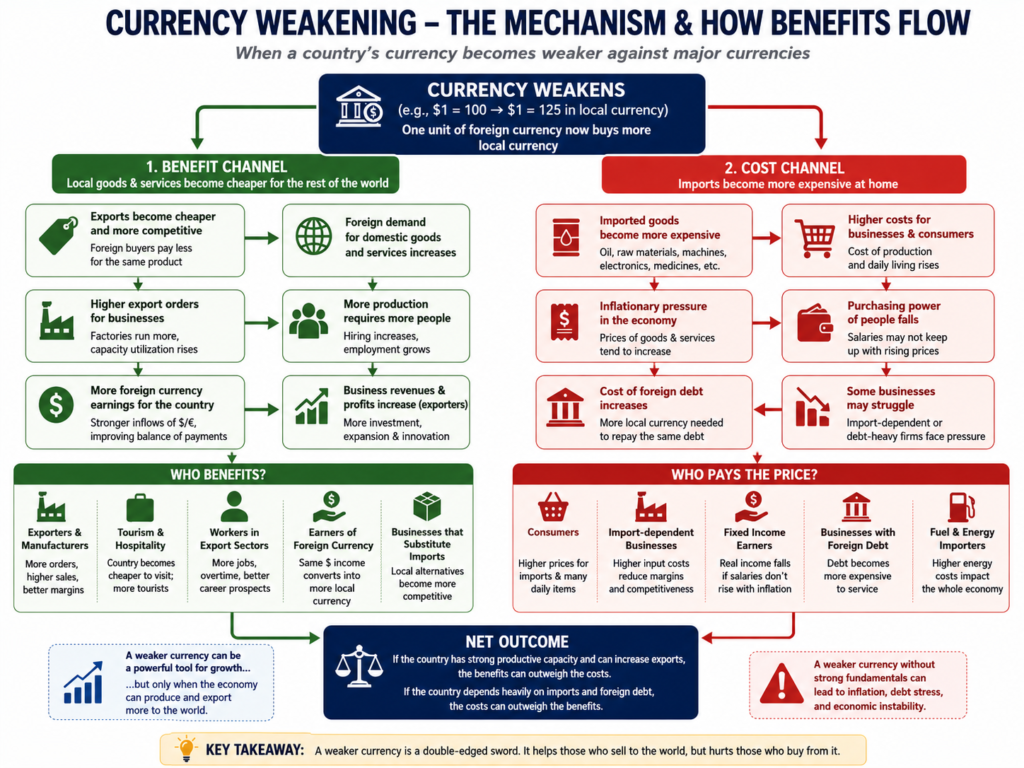
Here’s the upside chain: the currency weakens, so exports become cheaper abroad. Consequently, foreign demand rises. Then, exporters expand. Eventually, employment and investment can grow.
But there’s a downside too. As the currency weakens, imports become pricier. Fuel, machinery and raw materials all cost more. Therefore, businesses face higher costs. Ultimately, consumers face inflation.
So remember this: currency weakening doesn’t create wealth from nothing. Instead, it shifts who wins, who pays, and where economic activity happens.
There’s another benefit worth mentioning, though: the balance of payments.
A country’s balance of payments tracks money flowing in versus money flowing out. Exports, remittances and foreign investment bring money in. Imports and outflows send money out.
When a currency weakens, exports typically become more attractive. Simultaneously, imports become less attractive. As a result, money tends to flow in faster than it flows out. Consequently, a persistent deficit can gradually narrow, or even turn positive over time.
That’s precisely why some governments tolerate—or actively encourage—a weaker currency. It isn’t just about helping individual exporters. It’s about keeping the entire national ledger in better balance.
How Do Governments Actually Weaken a Currency?
Governments can’t just announce a cheaper currency. Several mechanisms exist instead.
First, central banks can intervene directly. They create domestic currency, then use it to buy foreign currency. This increases domestic currency supply, which pushes the exchange rate down.
Second, lower interest rates help too. Cheaper rates make domestic assets less attractive to foreign investors. Consequently, capital moves elsewhere, weakening currency demand.
Third, quantitative easing plays a role. Expanding the money supply can, under the right conditions, contribute to depreciation—even without that being the primary goal.
Finally, under fixed exchange-rate systems, authorities can simply change the official peg. That takes us straight into an important distinction.
Depreciation and Devaluation Aren’t the Same Thing
These terms often get used interchangeably. However, they mean different things.
Depreciation happens when a currency’s value falls due to market forces. Nobody officially decides it. Supply and demand simply shift.
Devaluation, on the other hand, happens when authorities deliberately lower a currency’s official value under a fixed exchange-rate system.
| Determinants | Depreciation | Devaluation |
|---|---|---|
| Determined by | Market forces | Government/central bank |
| Typical system | Floating exchange rate | Fixed/pegged rate |
| Deliberate? | Not necessarily | Yes |
Importantly, not every country benefiting from a weaker currency has formally devalued it. Some simply intervene quietly.
So Why Would Anyone Want a Weaker Currency?
Several reasons exist.
First, exports become more competitive. Remember our $100-to-$80 example? Foreign buyers respond to lower prices.
Second, imports get discouraged. A $20 imported item costing 2,000 LC suddenly costs 2,500 LC. Consumers shift toward domestic alternatives.
Third, domestic employment can benefit. As producers regain competitiveness, they receive more orders. Then, they hire workers and invest further. That said, this outcome isn’t guaranteed.
Fourth, the trade balance can improve. Exports minus imports may widen favorably. Interestingly, though, this doesn’t happen instantly. Existing import contracts take time to adjust—a delay economists call the J-Curve.
Fifth, weakening can fight deflation. An overly strong currency lowers import prices, which can trigger dangerous deflationary pressure.
Sixth, it can support export-led growth strategies. However, a cheap currency alone won’t transform an economy. Without real productive capacity, depreciation just creates inflation.
Real-World Case Studies
China built a manufacturing powerhouse through currency management. Before 2005, it maintained a fixed exchange rate. Afterward, it moved toward a more flexible, though still managed, system. Still, China’s rise wasn’t about currency alone. Labor, infrastructure, supply chains and productivity mattered enormously too. (read more)
Switzerland faced the opposite problem entirely. During Europe’s debt crisis, investors rushed into the Swiss franc as a safe haven. Consequently, it became dangerously strong. In 2011, the Swiss National Bank set a floor of 1.20 francs per euro, promising unlimited intervention. This lasted until 2015.
Britain, meanwhile, offers a textbook devaluation. In 1967, facing balance-of-payments pressure, Britain cut sterling’s value from $2.80 to $2.40—a 14.3% devaluation. The goal? Restore competitiveness. Did it work? Not entirely. Devaluation bought time. It couldn’t fix deeper productivity problems.
Does Weakening Actually Work?
The honest answer: sometimes, but only under the right conditions.
Consider Country A. It has factories, skilled workers, and export infrastructure. When its currency weakens, foreign demand rises. Factories expand. Employment grows. Here, weakness becomes an advantage.
Now consider Country B. It relies on imported fuel, machinery and foreign debt, with little export capacity. When its currency weakens, costs spiral. Inflation rises. Debt becomes harder to repay. Here, weakness becomes a crisis.
Therefore: a weak currency helps when an economy has something to sell. It hurts when an economy mostly has things to buy.
What Happens to Ordinary Workers?
Immediately, imported goods become pricier. Fuel, medicine, electronics and food all cost more.
Consequently, inflation often rises. Real wages can fall too, even if nominal salaries stay the same.
However, workers in export industries—manufacturing, tourism, IT—may eventually benefit. Short-term pain often comes first. Long-term gains depend on whether industries actually expand.
Startups Face Very Different Outcomes
Startups relying on imported equipment suffer immediately. Costs rise; margins shrink.
Meanwhile, startups earning dollars but paying domestic costs can benefit hugely. Their revenue, converted to local currency, suddenly increases.
Startups holding dollar-denominated debt face real danger. Their liabilities grow overnight, without borrowing an extra cent.
For startups dependent on imported equipment, software, or raw materials, currency depreciation can rapidly increase operating costs and compress margins. This makes exchange-rate exposure an important consideration when planning and managing startup finances. (see managing startup finance for more).
Winners, Losers, and the Limits of This Strategy
Exporters, tourism businesses, and import-substitute producers tend to win. Importers, foreign-debt holders, and fixed-income households tend to lose.
That’s precisely why currency policy becomes political, not just economic. A visual representation can give us an insight on how a benefit/cost channel flows, to identify the beneficiaries and those at cost.
Still, no country can keep weakening its currency forever. Inflation accelerates. Foreign debt becomes crushing. Investors lose confidence, triggering capital flight. Trading partners may retaliate, sparking currency wars—something international institutions have specifically tried to prevent since the Great Depression.
Deliberate Weakening vs. a Currency Crisis
These look identical on the surface. Both mean one dollar buys more local currency.
However, they’re completely different underneath.
Controlled weakening involves credible policy, adequate reserves, and manageable inflation. A currency crisis involves fleeing investors, collapsing reserves, and a central bank losing control entirely.
Think of it this way: a pilot deliberately descending an aircraft looks similar to an aircraft losing altitude from engine failure. Altitude drops either way. The reason—and outcome—couldn’t be more different.
The Bigger Lesson
We naturally assume strong currency equals strong country. Weak currency equals weak country.
But economics rarely works that simply.
The real question isn’t whether a strong currency is good. Instead, it’s whether the exchange rate actually fits the economy’s structure and goals.