
By the end of this blog you will be able to…
- Explain what a business model is and identify the four pillars it rests on: problem, solution, revenue, and resources
- Distinguish between why a business model matters to founders versus why it matters to investors
- Design a value proposition rooted in your validation findings and target audience
- Compare common revenue models, including product sales, subscription, freemium, and consulting
- List and estimate the core cost categories every startup needs to plan for
- Identify the key partners your startup will likely depend on to grow
- Build a basic plan for acquiring customers and, just as importantly, retaining them
- Understand why a soft launch is necessary to test your business model before scaling
A validated idea proves that people want your solution. It tells you that a real problem exists and that your proposed fix resonates with the people who feel that problem most. But wanting a solution and being able to sustainably deliver one are two very different things. This is where a business model comes in. A business model proves that your startup can actually deliver that solution while generating enough value, in the form of revenue, resources, and relationships, to survive and grow. Validation answers the question “does anyone care?” A business model answers the much harder question: “can this actually work as a business?”
Step One: Define What a Business Model Really Is
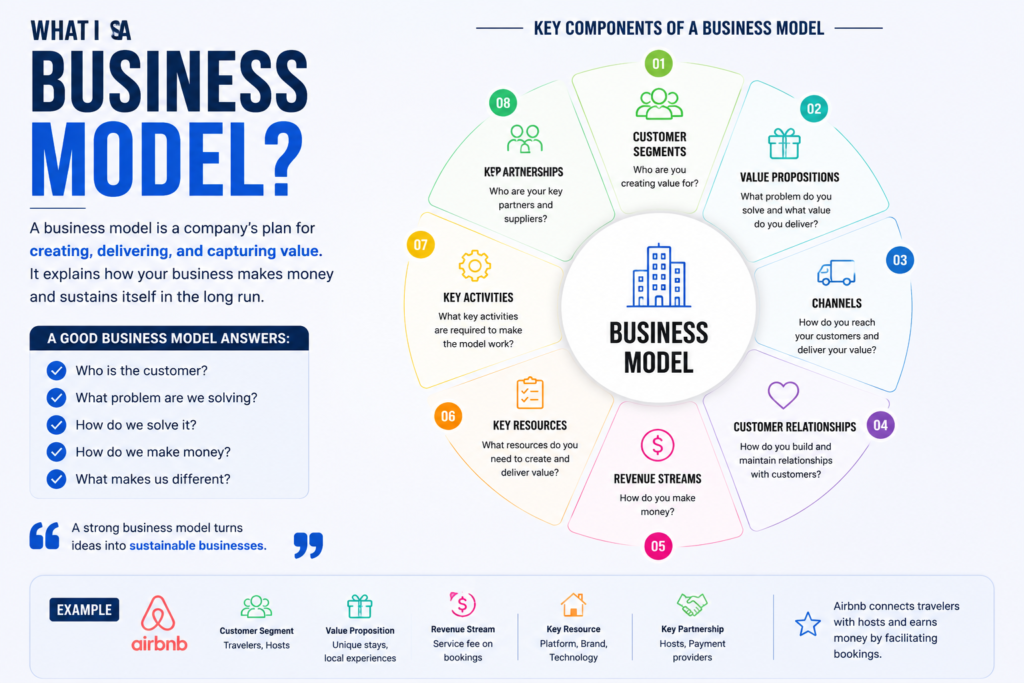
Before you build anything, you need to understand what you are building. At its core, a business model is a framework that answers four fundamental questions:
- What problem are we solving?
- How do we solve it?
- How do we earn money doing it?
- What resources do we need to make it happen?
These four pillars are not independent checkboxes; they are interconnected. Your resources shape how you solve the problem, and how you solve it shapes how you can charge for it. As a founder, your first job at this stage is to design a simple framework around these four points and honestly assess where you currently stand on each one. Are you clear on the problem but vague on monetization? Do you know how you’ll solve it but haven’t thought about the resources required? Mapping this out early prevents you from building on a shaky foundation.
It’s also worth asking: who is a business model really for? The honest answer is that it serves two audiences at once. For founders, it’s a working blueprint that guides daily decisions. For investors, it’s a lens for judging whether the startup has a credible path to profitability. Balancing both, staying practical enough to run the company while staying compelling enough to attract capital, is a nuanced skill we’ll explore further in an upcoming blog.
Step Two: Design Your Value Proposition
With the framework in mind, the next step is to translate your validation findings into a value proposition. Take everything you learned while validating your idea, the pain points people expressed, the language they used, the alternatives they were unhappy with, and combine it with a clear picture of your identified target audience. Then craft a statement that articulates exactly why this audience should choose your solution over anything else available to them.
Your value proposition is the bridge between “we found a problem” and “we built something worth paying for.” Because this is such a foundational element and deserves its own deep dive, we will dedicate a separate blog entirely to how you can design a strong, persuasive value proposition.
Step Three: Decide How You Will Generate Revenue
Once your value proposition is clear, you need to decide how the business will actually make money. There is no single right answer here; the correct revenue model depends on your product, your audience, and your industry. Common options include direct product sales, where customers pay once for a physical or digital good; subscription models, where customers pay recurring fees for ongoing access; freemium models, where a basic version is free and advanced features are paywalled; and consulting or service-based models, where revenue comes from expertise and customized delivery rather than a standardized product.
Many successful startups even blend two or more of these approaches. The key is choosing a model that aligns naturally with how your customers already prefer to pay.
Step Four: Estimate Your Costs
Revenue means little without a clear-eyed view of your costs. This step requires you to list out every meaningful expense category: product development, marketing and advertising, equipment, day-to-day operations, supplies, and any other recurring or one-time costs specific to your business. Being thorough here matters more than being precise; the goal is to understand the shape of your cost structure so you can later determine whether your revenue model can realistically cover it and leave room for profit.
Step Five: Identify Your Key Partners
No startup grows in isolation. Identify the key partners who will help you deliver your product and scale your operations. This may include investors (whose specific role in your business model will be covered in a future blog), along with manufacturers who produce your goods, cloud service providers who host your infrastructure, and marketing agencies who help amplify your reach. Recognizing these dependencies early allows you to plan realistic timelines and budgets around them.
Step Six and Seven: Plan Customer Acquisition and Retention
With the economics in place, turn your attention to people. Customer acquisition planning means mapping out exactly how potential customers will first discover you, whether through SEO, your website, organic social media, paid advertising, or referral channels. But acquisition alone isn’t enough. Customer retention planning determines whether those customers stick around. This includes post-purchase support, building a social community around your brand, rewards and loyalty programs, regular product updates, and email newsletters that keep your audience engaged. Acquisition gets people in the door; retention keeps your business alive.
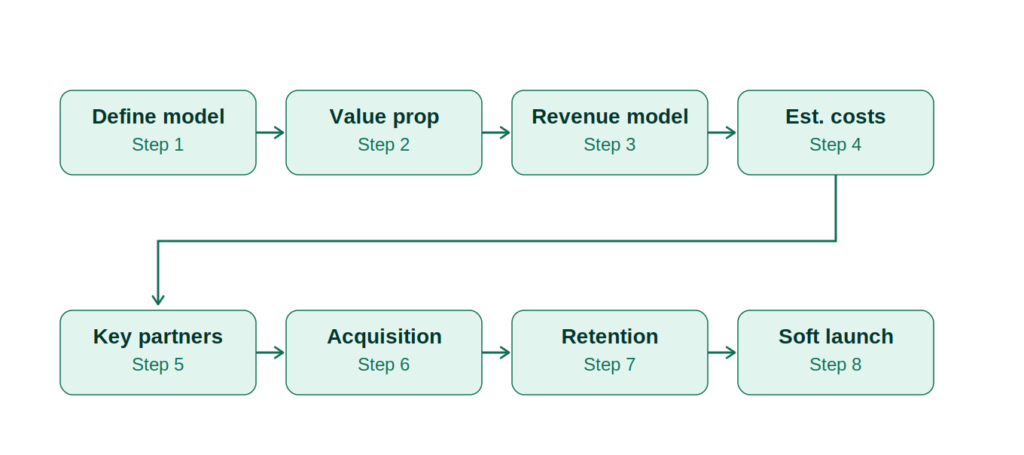
Framework Recap: The Eight Steps to Developing a Startup Business Model
Step Eight: Test the Model with a Soft Launch
By this point, you likely know that customers like your product. But do you know they will actually pay your proposed price? Do you know they will come back after their first purchase? Probably not, and that’s the uncomfortable truth every founder must confront.
Every business model rests on assumptions: that people will pay a certain amount each month, that a specific advertising channel will reliably bring in customers, that subscribers will stay subscribed, that your operating costs won’t outpace your revenue. None of these assumptions are proven yet; they’re educated guesses dressed up as a plan.
This is why a soft launch is essential. Rather than committing your full budget and reputation to an unproven model, offer your product to a small group, perhaps twenty potential customers, and spend a modest amount on advertising to see how people actually respond. Watch what they do, not just what they say. Do they pay the price you set? Do they return? Does your cost per acquisition line up with what you projected? A soft launch turns your business model from a theoretical framework into a tested hypothesis, giving you the real-world evidence you need before scaling with confidence.