
By the end of this blog, you will be able to:
- Know exactly what separates a “validated idea” from a “launch-ready business”
- Tell real validation from false validation
- Revisit your research and vision with fresh eyes
- Turn a broad target audience into an ideal customer profile
- Sharpen your value proposition
- Map out risks before they surprise you
- Understand why your network matters more right now than at any other stage
- Build a simple roadmap that keeps you accountable
- Recognize the common post-validation mistakes that quietly sink founders who were otherwise doing everything right
Congratulations, But Don’t Rush
If you’ve made it this far, take a moment to actually feel good about it. Most ideas never even get tested — yours did, and the early signs are encouraging. But here’s the misconception that trips up even smart, capable founders: validation is not a green light to start building tomorrow.
Validation simply means that your assumptions about customer demand were mostly correct. People have a problem, they’re open to a solution, and what you proposed seems to resonate. That’s it. It doesn’t mean you know exactly who will pay you, how much, through which channel, or what your product needs to actually look like on day one.
Treating validation as a finish line instead of a checkpoint is one of the most common reasons early startups stumble — not because the idea was wrong, but because the founder skipped the preparation that turns a good idea into a real business. So before you touch a single line of code or spend a rupee on inventory, let’s slow down and do this properly.
Section 1: How Do You Know Your Idea Is Actually Validated?
This is worth pausing on, because a lot of founders confuse “people like my idea” with “the market has validated my idea” — and those are two very different things.
People liking your idea is emotional and social. It feels great, but it costs the other person nothing. Market validation, on the other hand, involves some form of commitment — time, money, or genuine behavioral change on the customer’s part.
Real indicators of validation usually look like this:
- Willingness to pay: Has anyone actually given you money, a deposit, or a pre-order — even a small amount?
- Detailed, specific feedback: Are people describing their problem in their own words, unprompted, with frustration or urgency in their voice?
- Repeat interest: Are the same people coming back to ask “is it ready yet?”
- Behavioral signals: Are people changing what they currently do (switching tools, canceling a subscription, referring a friend) because of what you showed them?
- Time investment: Will people sit through a 20-minute call, fill out a detailed survey, or test a rough prototype?
Now compare that to false validation, which feels good but means very little:
- A friend or family member saying “great idea!”
- Likes, hearts, and “this is so cool” comments on social media
- Strangers saying they’d “definitely use this” without ever taking a real action
- High engagement on a poll with no follow-through
False validation is comfortable because it’s free of risk for the person giving it. Real validation almost always costs the other person something. If most of your “validation” so far has been compliments rather than commitments, it’s worth gathering a bit more evidence before moving forward — and that’s perfectly normal, not a failure.
Section 2: Revisit Everything You Learned
Before you plan your next move, go back through everything you collected during validation — survey responses, interview notes, sign-up data, conversations, even the throwaway comments people made in passing. If you followed the process from our earlier piece on idea validation, you likely have more raw data sitting around than you realize.
The goal here isn’t to skim it once more for reassurance. It’s to look for patterns you may have missed the first time: recurring phrases people used to describe their problem, objections that came up more than once, or a feature people kept asking about that wasn’t part of your original pitch. This is also a good moment to separate strong signals from noise. Not every data point deserves equal weight — a paying customer’s feedback should carry more influence than a casual “interesting” from someone scrolling past your post.
Section 3: Revisit Your Startup Vision
When you first had your idea, you probably had a vision in your head — who you’d help, how you’d help them, and why it mattered. After collecting real feedback, it’s worth checking that vision against reality.
Ask yourself honestly: does my original vision still hold up, or has something shifted? Maybe the core problem you wanted to solve is the same, but the audience turns out to be slightly different than you imagined. Maybe people want a simpler version of what you pitched, or maybe they revealed an adjacent problem that’s actually more painful than the one you set out to solve. This isn’t a sign of failure — it’s a sign that you’re listening. Founders who refuse to adjust their vision after getting real feedback are often the ones who end up building something nobody asked for.
Section 4: From Identified Customer Persona to Ideal Customer
During validation, you probably had a fairly broad idea of who your customer is — something like “small business owners” or “working professionals.” Now it’s time to narrow that down significantly.
Build out your ideal customer profile (ICP): the specific buyer most likely to purchase, stick around, and refer others. Get clear on their budget and share of wallet (how much they’ll realistically spend on a solution like yours), what they currently use instead of your product, their pricing and communication preferences, and the exact channels where they spend their time — so you know precisely where to find and market to them. The sharper this profile, the easier every future decision becomes, from product design to marketing to pricing.
Section 5: Clarify Your Value Proposition
Once you know exactly who you’re building for, you need to be crystal clear about what you’re promising them. Your value proposition should answer one simple question in plain language: what will this person get by using your product that they can’t easily get elsewhere?
Avoid vague statements like “we make things easier” or “we save you time.” Instead, be specific: easier than what, and by how much? Saved time doing what exactly, and what will they do with that time instead? A clear value proposition isn’t just useful for your future customers — it becomes the foundation for your messaging, your pricing, and even your product roadmap. If you can’t explain it in one or two simple sentences a non-expert friend would understand, it’s not clear enough yet.
Section 6: Identify Risks and Their Intensity
Every startup carries risk — the goal isn’t to eliminate it, but to know where it lives and how serious it is. Sit down and list out the things that could realistically go wrong, then sort them by intensity.
High-risk factors might include things like dependency on a single supplier, a regulatory hurdle that could shut you down, or a market that’s dominated by a much bigger competitor. Medium-risk factors could include uncertain customer retention or a pricing model you haven’t fully tested. Low-risk factors might be things like minor design choices or non-critical feature decisions. Mapping risks this way helps you prioritize your time and energy toward the few things that could actually break your startup, instead of spreading yourself thin worrying about everything equally.
Section 7: Start Building Your Professional Network
Many first-time founders, especially those without a traditional business background, underestimate how much a strong network accelerates everything. This is the stage to start building it intentionally.
Reach out to mentors who’ve built something similar, even loosely, and ask for thirty minutes of their time rather than a long-term commitment. Join founder communities, online or local, where people are facing the same uncertainties you are. Connect with industry experts who can sanity-check your assumptions before you spend money based on them. Stay close to your early customers — the ones who showed real interest during validation — because they often become your first real users, your loudest advocates, or your best source of honest feedback. And don’t overlook suppliers or partners early on; the relationships you build now, before you urgently need them, tend to be far more favorable than the ones you scramble to form under pressure later.
Section 8: Design Your Startup Roadmap
With your customer, vision, value proposition, and risks clarified, it’s time to put it all into a simple visual plan. A Gantt-style roadmap works well here because it forces you to think in terms of milestones, timelines, and progress — not just a vague to-do list.
A basic version might look like this:
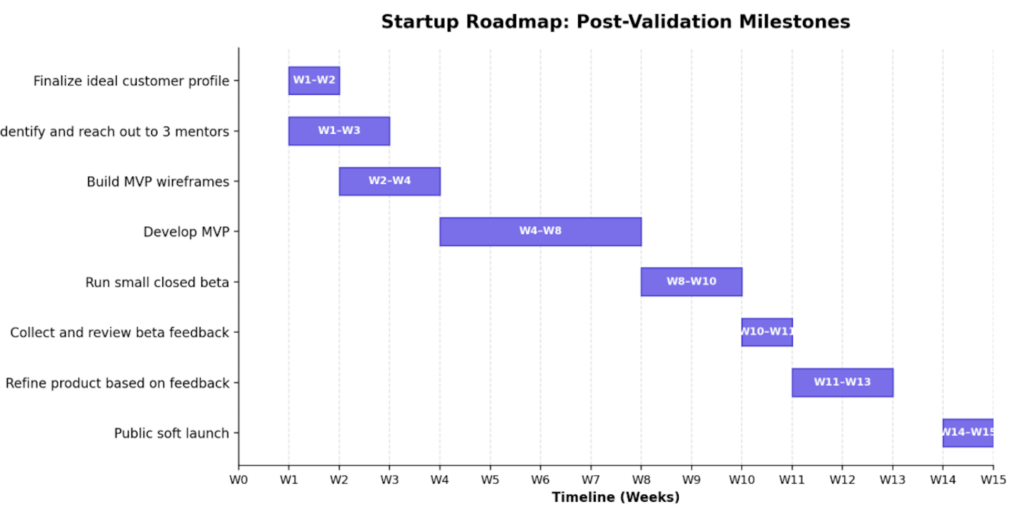
You don’t need expensive software for this — a simple spreadsheet or even a whiteboard works. What matters is that every milestone has a realistic date and a visible progress status, so you always know where you stand and what’s next.
Common Mistakes Founders Make After Validation
Before you go, it’s worth knowing the patterns that tend to derail otherwise promising startups right after validation:
Launching too quickly. Excitement from early positive signals can push founders to skip the preparation above entirely. Validation tells you there’s a problem worth solving — it doesn’t mean you’re ready to solve it at scale yet.
Ignoring customer feedback after the validation phase ends. Some founders treat feedback collection as a one-time event instead of an ongoing habit, then wonder why their product drifts away from what customers actually wanted.
Building unnecessary features. Once founders get attached to their idea, it’s tempting to add “just one more feature” before launch. This delays your timeline and often adds complexity your actual ideal customer never asked for.
Skipping planning. Jumping straight from validation into building, without a roadmap or a clear customer profile, often leads to wasted time, confused messaging, and direction-less decisions.
Hiring too quickly. Bringing people on board before you’ve nailed down your vision, customer, and roadmap often leads to misalignment, wasted payroll, and difficult conversations down the line. Stay lean until your foundation is solid.
Validation proved your idea has potential — but the real work of becoming a founder happens in this in-between stage, where careful preparation turns potential into a real, sustainable business. Take your time here. The startups that last aren’t always the ones that moved fastest; they’re the ones that moved with clarity.